I woke this morning to the call to prayer.
It was still early, and for a few moments I simply listened.
There are five calls each day here, and after hearing the first one yesterday evening, waking to another this morning made me realize that this sound would become part of the rhythm of our days in Istanbul.
There is something particularly fitting about that in a city whose history has crossed religious boundaries almost as readily as its people cross the Bosphorus.
Once Constantinople, this was for centuries one of the great centers of Christianity. Then came the Ottomans and Islam. The buildings themselves carry the evidence. Churches became mosques. Mosques became museums. Some became mosques again.
And yet modern Turkey is a secular republic.
Perhaps contradiction is the wrong word.
Layers may be better.
Before leaving the hotel, I found myself noticing some of the objects around us.
On one wall hung an old-fashioned telephone—wood and brass, rotary dial, receiver dangling from its cord. I don’t know its history, or whether it belonged to this building in an earlier life, but in a place that had already lived for more than a century before becoming our hotel, somehow it didn’t feel merely decorative.
It felt like an echo.
And then there was a statue I had noticed earlier.
It depicted a man almost doubled over beneath an enormous load. Before knowing anything about it, I had already given him my own name: the human camel.
A camel, after all, is a beast of burden, built to carry enormous weight across difficult terrain. Looking at this bent figure, I couldn’t escape the comparison. Except here, the beast of burden was a human being.
Later I learned that he was a hamal—one of Istanbul’s traditional porters. For centuries, men like him carried goods on their backs from the waterfront into the city’s markets, navigating streets too narrow and steep for other forms of transport.
Suddenly the statue meant something different.
Istanbul’s palaces tell us about the sultans who ruled it. Its mosques tell us about faith. Its fortresses tell us about conquest.
But someone still had to carry the load.
Perhaps that bent man tells another history of Istanbul—the history of the ordinary people upon whose backs great cities are built.
Outside, the scale changed again.
We left these smaller echoes of the past behind and took to the Bosphorus, where history was written not in telephones and statues, but in palaces, fortresses and continents.
The Bosphorus is not a river. It connects Asia to Europe. It is a natural saltwater strait, not a river or man-made canal, connecting the Black Sea with the Sea of Marmara and ultimately the Mediterranean. It has a fascinating two-layer current: generally southward at the surface and northward below because of differences in salinity and density.
That geographical fact suddenly seemed extraordinary when experienced from the water.
To one side, Europe.
To the other, Asia.
And we were sailing between them.
Most of Turkey—about 97 percent of it—is actually in Asia, something easily forgotten when thinking of Istanbul as a European city. Today we would cross over and, for a little while at least, stand on another continent.
History lined both shores.
Ottoman palaces appeared along the waterfront. Magnificent old wooden mansions—yalıs—sat close to the water, reminders of a time when position on the Bosphorus was itself a statement of wealth and power. Today, some command extraordinary prices.
Then came the fortresses.
At one of the narrowest points of the Bosphorus stands Rumeli Hisarı, built by Sultan Mehmed II as he prepared to conquer Constantinople. Looking at its massive walls, I wondered how long construction had taken.
Years seemed reasonable.
The answer was four months.
Thousands of men, working day and night.
There are moments when history becomes easier to understand not through dates but through ambition. Standing there more than five centuries later, looking at those walls from the water, four months told me almost everything I needed to know about how badly Mehmed wanted Constantinople.
And then there was modern Istanbul.
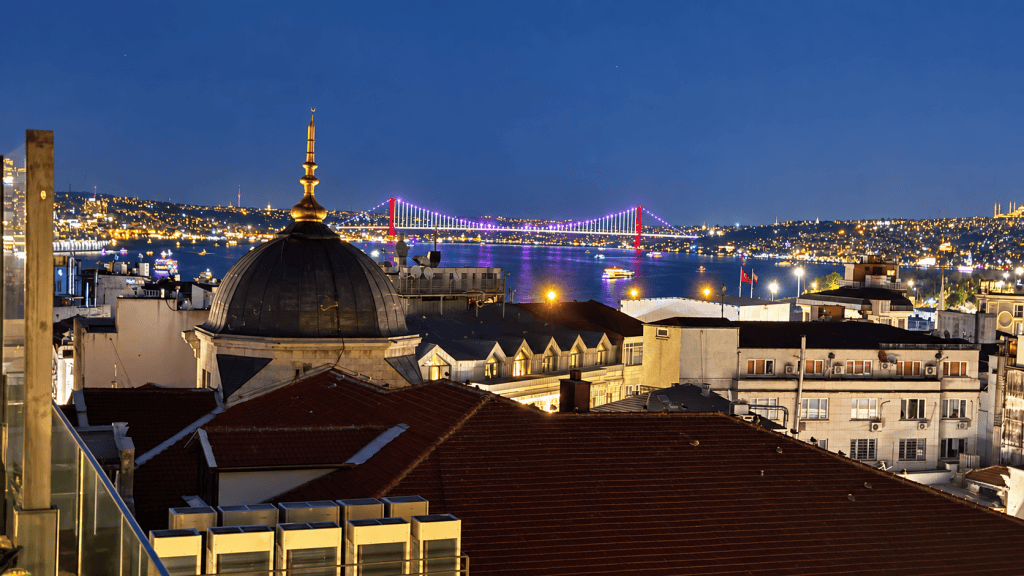
Bridges now span the water that once required ferries to cross. The first Bosphorus bridge opened in 1973 and offered a new way of moving between Europe and Asia.
Apparently Istanbul responded by producing more traffic.
Much more traffic.
A lady on a local radio joked that in Istanbul there is little need for therapy because the traffic itself is therapeutic.
I’m not entirely convinced that therapeutic is the word I would choose.
I come from Lagos.
I know traffic.
But Istanbul is certainly making a respectable effort.
And perhaps that is what I am beginning to understand about this city.
Yesterday, everything seemed bigger.
Today, everything seems layered.
Christian and Muslim.
Ancient and modern.
Sultans and porters.
Palaces and ordinary homes.
Fortresses and suspension bridges.
Europe on one shore.
Asia on the other.
And between them, the Bosphorus—carrying ferries, tankers, fishermen, tourists and centuries of history back and forth across the same water.
Yesterday I wrote that first impressions are invitations.
Today, Istanbul began explaining why.
Simply O

