Journeys across Europe—where history, memory, and quiet reflection intersect. From ancient cities to sacred spaces, these travels trace both geography and meaning.
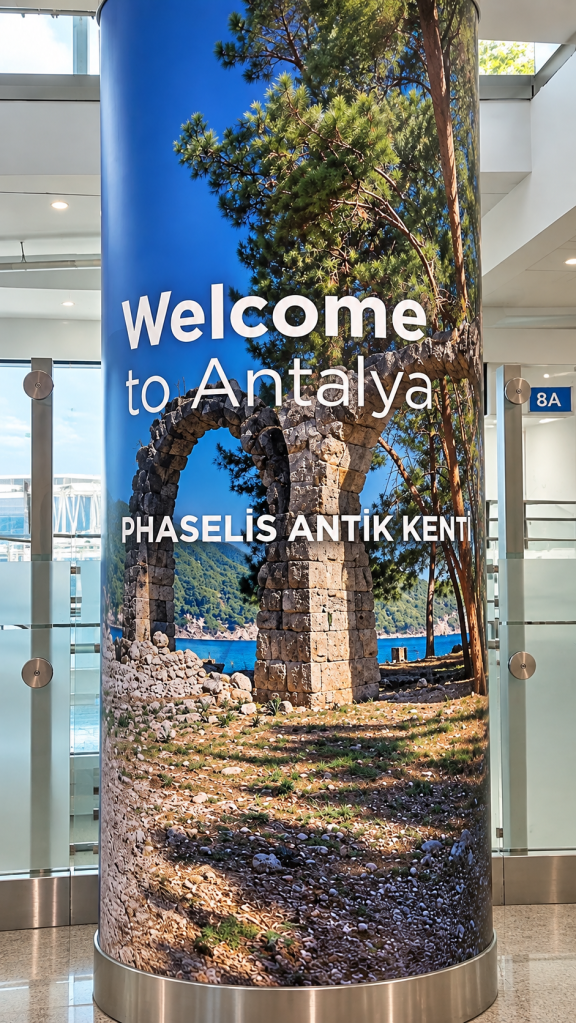
We woke early to catch our flight to Antalya, which meant another encounter with the enormous scale of Istanbul Airport. This time, though, we knew what to expect. The endless corridors, the distances, the sheer size of the place no longer surprised us quite as much. Perhaps that is what travel does. What overwhelms you on arrival can feel almost familiar only a few days later.
The flight to Antalya was short, and the difference was noticeable almost as soon as we stepped outside. It was warmer. Much warmer. The jackets that had occasionally been useful in Istanbul suddenly seemed unnecessary.
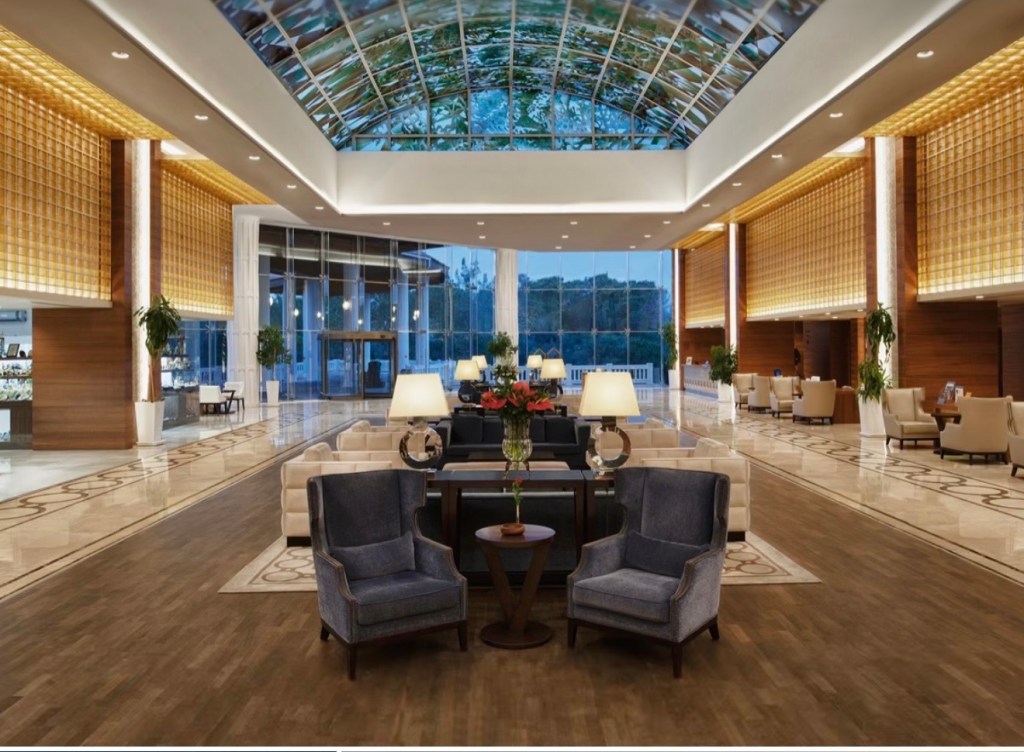
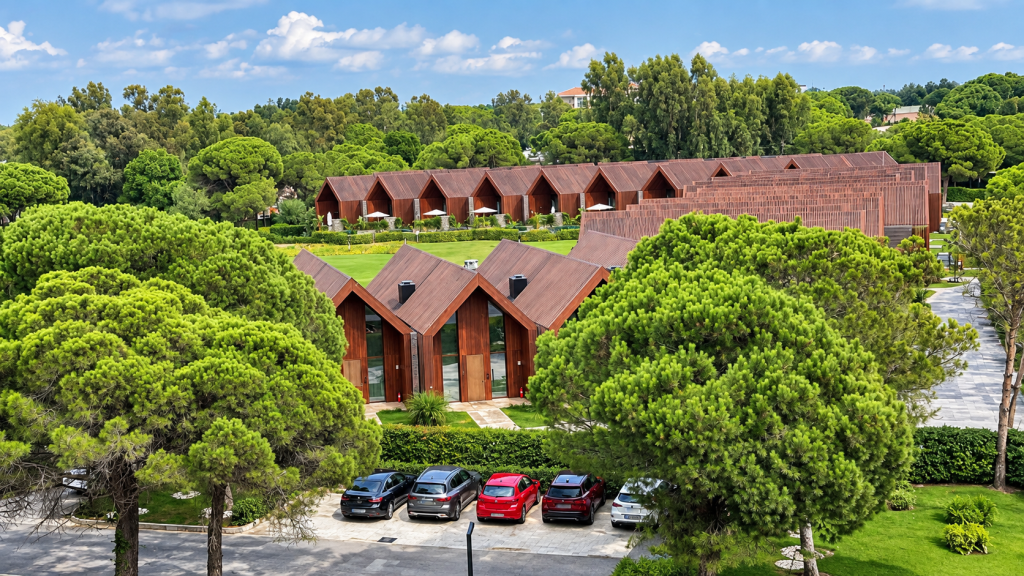
Our drive to the Sirene Belek Hotel took about forty-five minutes. The resort, built in 2001 and renovated in 2012, is enormous in its own way, spreading through beautifully landscaped grounds all the way to the Mediterranean. After several days of navigating Istanbul’s streets, mosques, palaces, bazaars, ferries and crowds, the change of pace was immediate.
We didn’t try to do very much.
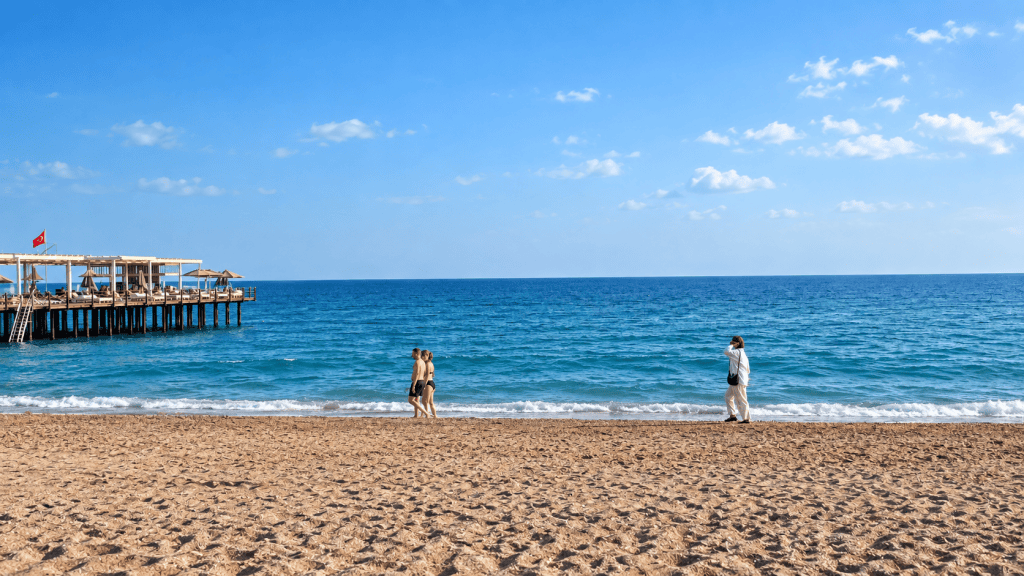
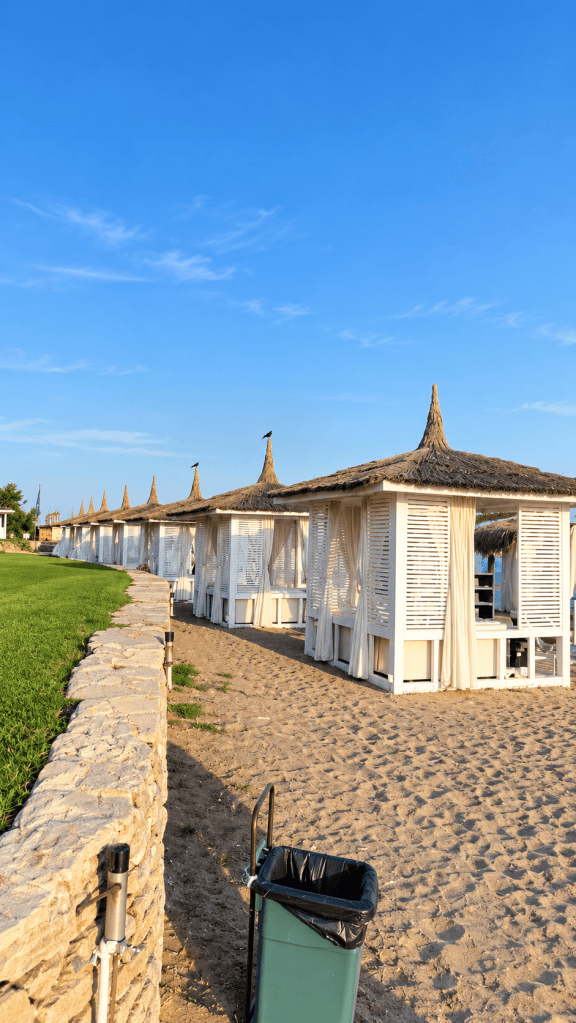
We walked leisurely through the grounds toward the beach, eventually settling down for Turkish tea and cookies while waiting for dinner. The Mediterranean stretched out ahead of us, the resort behind us, and for once there was nowhere we particularly needed to be.
Dinner was an all-you-can-eat affair with more choices than I could reasonably count. Istanbul had already introduced us to the extraordinary relationship Turkey seems to have with food. Antalya appears determined to continue the education.
Later in the evening, we met up with friends at the MAXGOLF Golf Tours gathering to go over the plans for the next few days. There was, however, one small complication: we don’t play golf.
While our friends had come to Antalya partly for the fairways, Yemi and I would have to create an itinerary of our own while the golfers golfed. Somehow that didn’t feel like much of a hardship. We were in a part of Turkey we had never seen before, with the Mediterranean at our doorstep and several days available to explore it.
And then it was time for bed.
Istanbul had been about movement—walking, looking, learning, trying to understand centuries of history compressed into one extraordinary city.
Antalya, at least on this first evening, felt different. Warm air, Turkish tea by the sea, an absurd number of choices at dinner, and friends gathered together before we all went our separate ways in the morning.
They would have their golf courses. We would have Antalya.
That seemed like a perfectly reasonable arrangement.
Five days ago, I wrote that first impressions are not conclusions. They are invitations.
Istanbul had five days to make its case.
It began, appropriately enough, with scale. Everything seemed bigger here. The airport appeared endless. The roads were enormous. Bridges stretched across water as though connecting continents were an entirely ordinary municipal undertaking. Even the traffic seemed determined to impress me.
I come from Lagos. I know traffic.
But Istanbul made a respectable effort.
Then the city began revealing its layers.
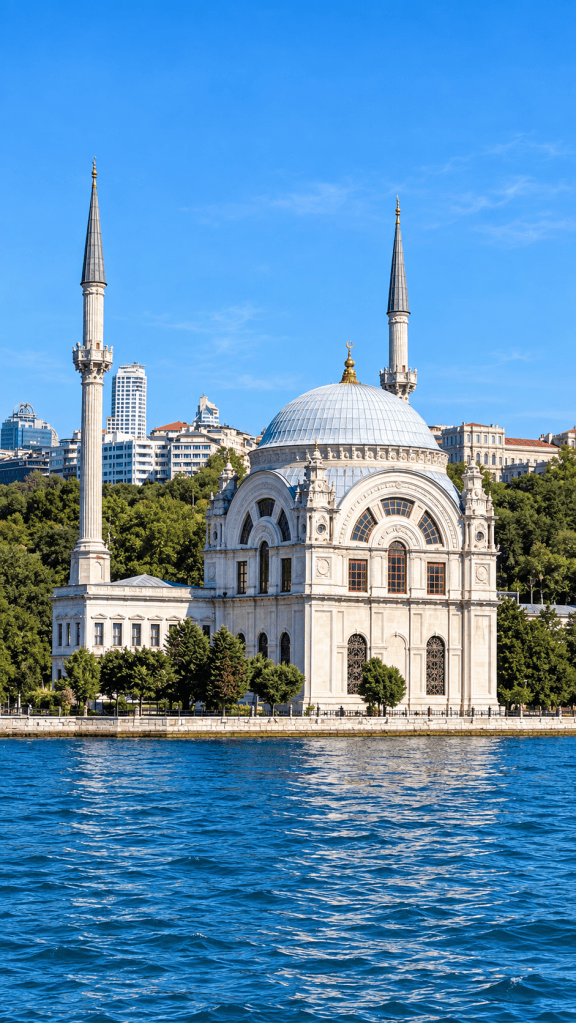
From the Bosphorus, Europe sat on one side and Asia on the other. Ferries crossed between them while tankers moved through a natural waterway that had carried armies, merchants, fishermen and ambitions for centuries. Ottoman palaces lined the shore. Old yalıs faced the water. Fortresses reminded us that beautiful places have not always had peaceful histories.
And everywhere, the call to prayer floated above the noise of the city.
Istanbul seemed comfortable holding contradictions that elsewhere might appear impossible. Christian and Muslim. European and Asian. Ancient and modern. Sacred and commercial.
At Hagia Sophia, those contradictions occupy the same building.
Nearly fifteen centuries of faith, conquest, earthquakes and human ambition are written into its walls and floors. Christian mosaics were covered when the building became a mosque; centuries later some were uncovered again. The building itself shifted and cracked, yet somehow survived.
Standing there, I found myself thinking less about which faith had possessed the building at any particular moment and more about something simpler.
With all the churches, mosques, temples and synagogues humanity has built, one might have expected us to have learned a little more kindness by now.
Perhaps buildings are easier to construct than compassion.
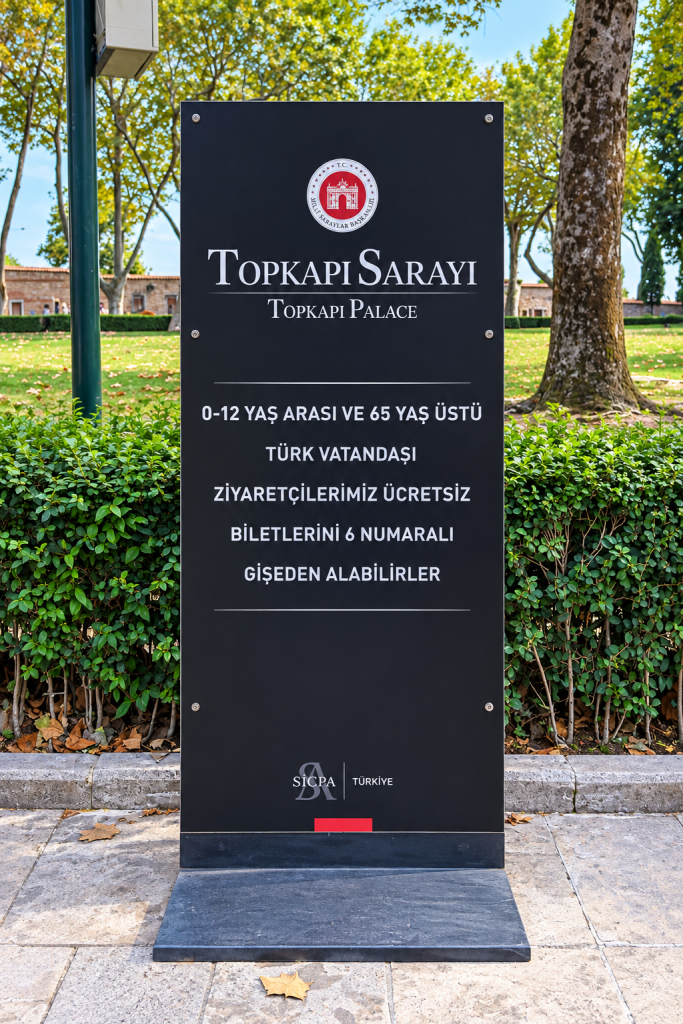
Then came Topkapı.
There were diamonds and jeweled weapons, magnificent rooms and the accumulated treasures of empire. The Spoonmaker’s Diamond glittered behind glass—86 carats surrounded by dozens more diamonds, as though 86 were somehow insufficient.
But the palace became more interesting to me when we moved away from the treasures.
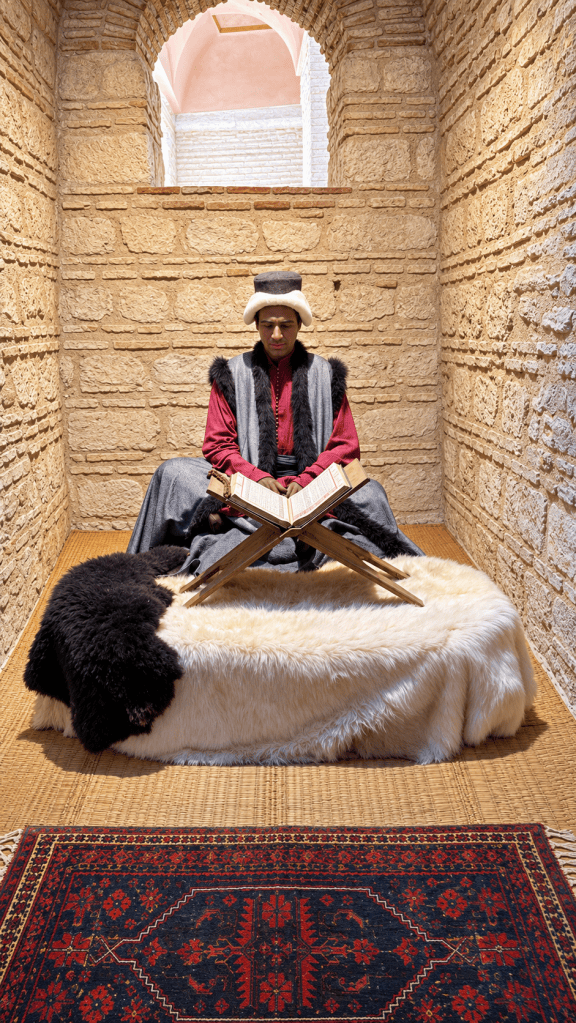
There were the quarters of the halberdiers. Bedding cupboards. Fountains. Baths. Inscriptions recording money left to buy candles for men who became sick. Prayers requested for people long dead.
And suddenly the Ottoman Empire was no longer merely sultans and conquests.
People slept here.
They worked here.
They became ill here.
They worried about money, said their prayers, tried to keep warm and eventually died here.
Earlier in the trip I had encountered the bent figure of the Istanbul porter—the hamal—carrying an enormous burden on his back. I jokingly called him the human camel. But perhaps he and the palace servants were telling the same story.
Great civilizations leave monuments to the powerful.
Look carefully enough, though, and you eventually find the people who carried the load.
Today Istanbul required less interpretation.
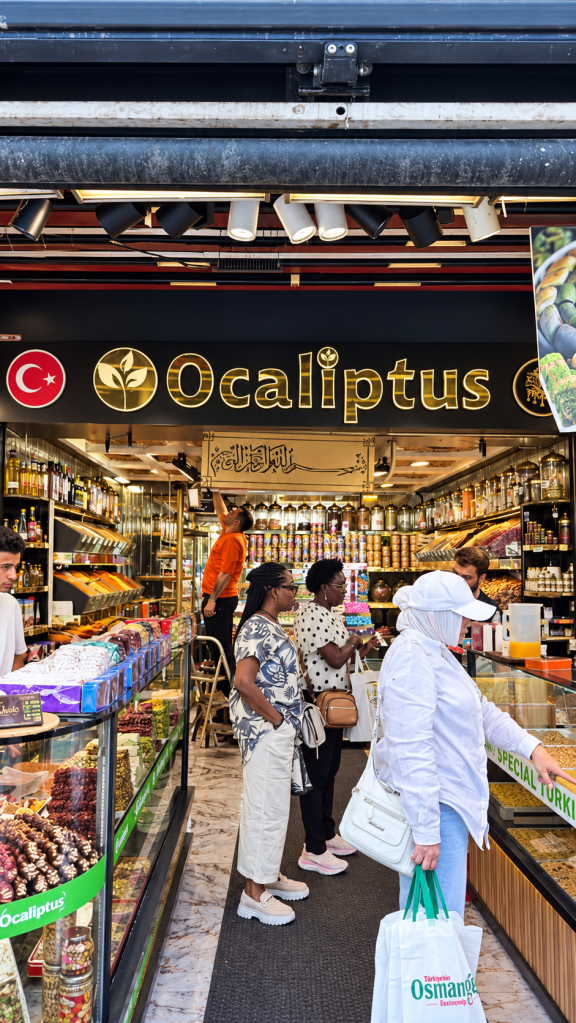
We wandered through streets filled with shops, spices, sweets and people. Turkish delight sat in great colorful piles. Sausages hung over market stalls. The Galata Tower appeared above the city in the distance. There were gulls overhead and crowds everywhere.
And there was food.
Cooking has long been part of my life in Tallahassee, so perhaps it shouldn’t surprise me that markets and spices fascinate me. Here, ingredients I had known in the kitchen seemed to acquire biographies of their own. Even saffron—those tiny red threads—became another lesson in how much human labor can hide inside something beautiful.
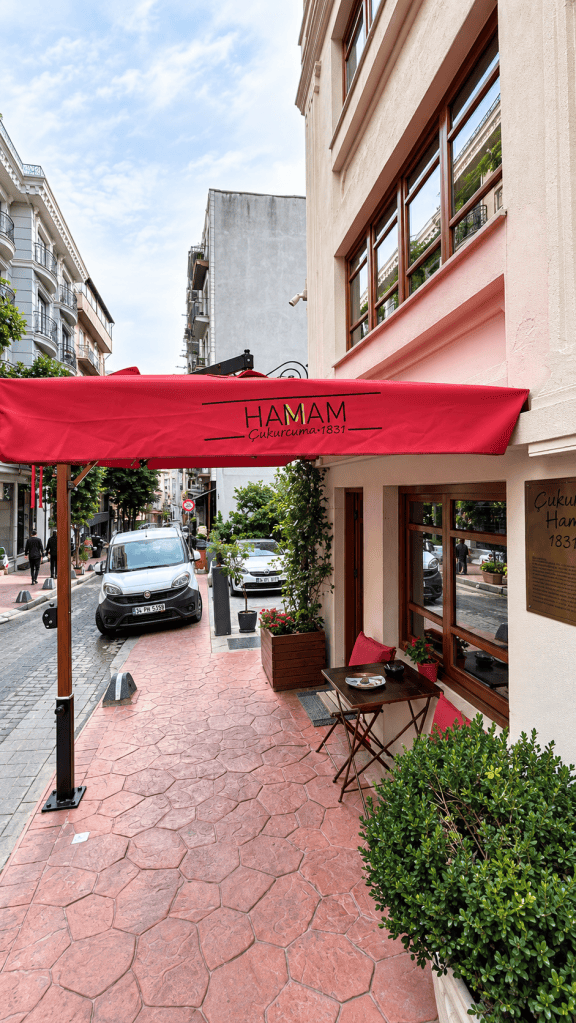
Eventually, after several days of Istanbul walking, we arrived at Çukurcuma Hamamı.
My feet had already lodged a formal grievance.
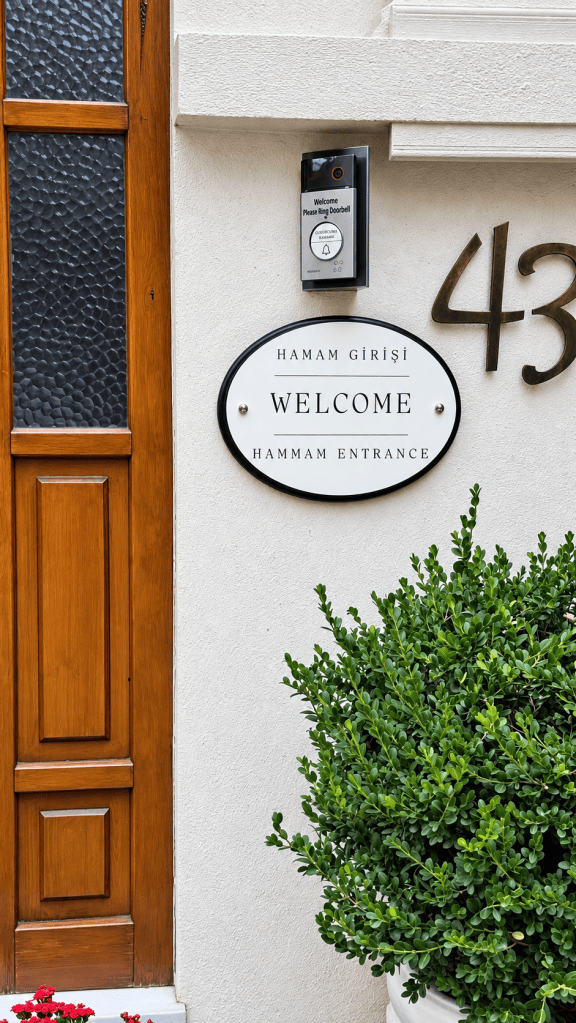
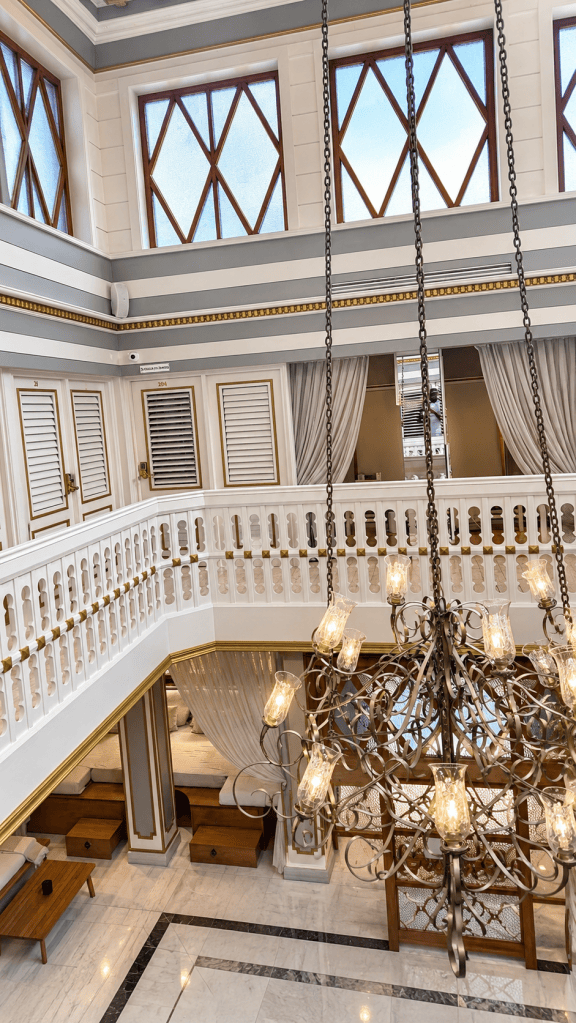
Inside, the city became quiet. Marble replaced cobblestones. Heat, water and steam replaced traffic and crowds. Light entered from above and scattered across the marble floor.
Then came scrubbing and massage.
For once, someone appeared to take my feet’s complaint seriously.
We emerged considerably cleaner and considerably more willing to continue walking.
There was ice cream.
Three scoops.
History is important, but one must maintain perspective.
And tonight we ended beneath the brick vaults of Sarnıç, surrounded by enormous circles of light. We ate well. Very well. And dessert arrived looking less like something one should eat than a small piece of contemporary architecture.
Somewhere during dinner, I realized Istanbul had answered the question I posed when we arrived.
The city had made its case.
Not because of any single mosque, palace, diamond, market or meal. And not because five days is remotely enough to understand a city that has been reinventing itself for thousands of years.
It was something about the accumulation.
The airport and the old telephone.
Sultans and porters.
Christian mosaics and Islamic calligraphy.
Diamonds and bedding cupboards.
The Bosphorus and the back streets.
Saffron and ice cream.
The call to prayer and the noise of traffic.
History and ordinary life continuing beside one another as though neither finds the other particularly remarkable.
Perhaps that is what I will remember most about Istanbul.
It doesn’t seem to discard its previous lives.
It carries them.
Tomorrow we leave for Antalya.
Five days ago, Istanbul was an invitation.
Tonight, it feels more like a conversation we have only just begun.
Every palace has a front door through which history likes to enter. But perhaps we understand power better when we wander through the rooms behind it.
Today took us to Topkapı Palace, and somewhere along the way Istanbul became less about buildings and more about the people who once inhabited them.
The palace is magnificent. Courtyards open into other courtyards. Domes, gardens, fountains and chambers unfold one after another. From its elevated position, the Bosphorus appears almost as part of the estate. It is easy to imagine the Ottoman sultans looking across the water and believing that the world belonged to them.
But palaces are designed to impress. Their beauty tells only part of the story.
Behind the ceremonial rooms were other lives: wives and concubines, servants, guards, officials and eunuchs. People whose lives existed within an elaborate hierarchy built around one man and the continuation of a dynasty.
And then I read the words Black eunuchs.
My thoughts immediately returned to slavery.
How can any human being think it is right to enslave another?
Perhaps the distance of centuries makes it easier to discuss slavery as history: trade routes, empires, laws, economics and customs. Standing in the place where enslaved people actually lived makes that abstraction much harder.
To enslave another human being is already to deny something fundamental about his humanity. But to take an enslaved boy or man and mutilate his body through castration so that he could occupy a role designed for him by others seems to me an even deeper act of dehumanization. His freedom had already been taken. Now something irreversible was being taken from his body as well.
And when those men were Black Africans, transported far from the places of their birth, the history became impossible for me to regard dispassionately.
Some eventually rose to extraordinary positions within the Ottoman court. They could become powerful, influential and trusted, sometimes operating remarkably close to the center of imperial authority.
There is a terrible irony in that.
A man could become privileged within the very institution that had first stripped him of his freedom.
Privilege did not undo enslavement. Influence could not restore what had been taken from him. Proximity to the Sultan did not somehow make the original violation humane.
And yet, somewhere among all those thoughts, I saw yellow.
A bed of yellow flowers growing quietly in the palace grounds.
I smiled.
I have been learning to see yellow—not because yellow makes difficult things disappear, but because beauty and darkness somehow continue to occupy the same world.
Here I was, walking through a place that had confronted me with slavery, castration, power and the extraordinary contradictions of religion, and there, completely indifferent to my troubled thoughts, were these small yellow flowers.
They explained nothing.
They excused nothing.
They were simply beautiful.
Perhaps seeing yellow was never about looking away from what is difficult.
Perhaps it is about refusing to let what is difficult become all that we see.
My thoughts returned to religion.
Elsewhere within the same palace were reminders of faith.
Abraham. John the Baptist. Jesus. Muhammad.
Names separated by centuries, yet connected by a remarkable spiritual genealogy.
It struck me that Judaism, Christianity and Islam are not strangers who happened to encounter one another across history. They belong to the Abrahamic family. Their theologies diverge, sometimes profoundly, but their stories repeatedly intersect. Abraham stands within all three traditions. Christianity emerged from Judaism. Islam came centuries later acknowledging Abraham, Moses, John the Baptist and Jesus among the prophets who preceded Muhammad.
Standing there, the family resemblance was difficult to ignore.
And perhaps that makes the history of religious conflict even more bewildering.
Human beings have fought, conquered and killed one another over religions whose sacred histories contain many of the same people.
Perhaps we have spent too much time emphasizing where the branches separate and too little remembering that some of the roots are shared.
And then, amid all these contradictions, I encountered something else that stopped me: the charity stone.
Those who had enough could leave money. Those who needed it could quietly take what they required.
No audience. No applause. No photograph of the giver presenting something to the recipient. No requirement that poverty perform its gratitude.
Just one human being leaving something for another.
I loved that.
Perhaps this was religion expressing itself in its simplest and most beautiful form—not through power, conquest or magnificent buildings, but through compassion.
There was dignity built into the arrangement. The person who left the money did not know who would receive it. The person in need did not have to stand before the giver and explain their poverty.
One gave without recognition.
The other received without humiliation.
Perhaps that is what faith was always supposed to look like.
And suddenly the contradiction of Topkapı became even more profound.
Within the same civilization were systems capable of enslaving human beings and traditions capable of protecting the dignity of a stranger. One diminished humanity. The other quietly restored it.
The problem was never that humanity did not know what goodness looked like.
We knew.
We simply did not always choose it.
Yesterday, walking through the Blue Mosque and Hagia Sophia, I found myself wondering how a world containing so many churches, mosques, temples and synagogues could still contain so much cruelty. With so many places built in honor of God, one might expect us to have become considerably better at being kind to one another.
Today the question followed me into the palace.
Religious traditions have existed alongside slavery throughout much of human history. People found ways to regulate it, justify it and live comfortably beside it. Others would eventually draw upon those same traditions to argue for human dignity and abolition.
Perhaps that is where the uncomfortable question lies.
Not simply in what religion teaches, but in the remarkable ability of human beings to reconcile what we profess to believe with what we are prepared to do to one another.
We can construct magnificent houses for God while sometimes treating God’s children abominably.
Perhaps the great contradiction of religion has never been what we profess to believe.
Perhaps it is what we permit ourselves to do to one another while believing it.
Eventually we left the palace.
And Istanbul did what Istanbul seems particularly good at doing.
It changed the subject.
We found ourselves back among ordinary streets and shops. Cobbled pavement beneath our feet. Cats wandering around as though they owned the neighborhood. Jewelry shops. Restaurants. People talking. People shopping.
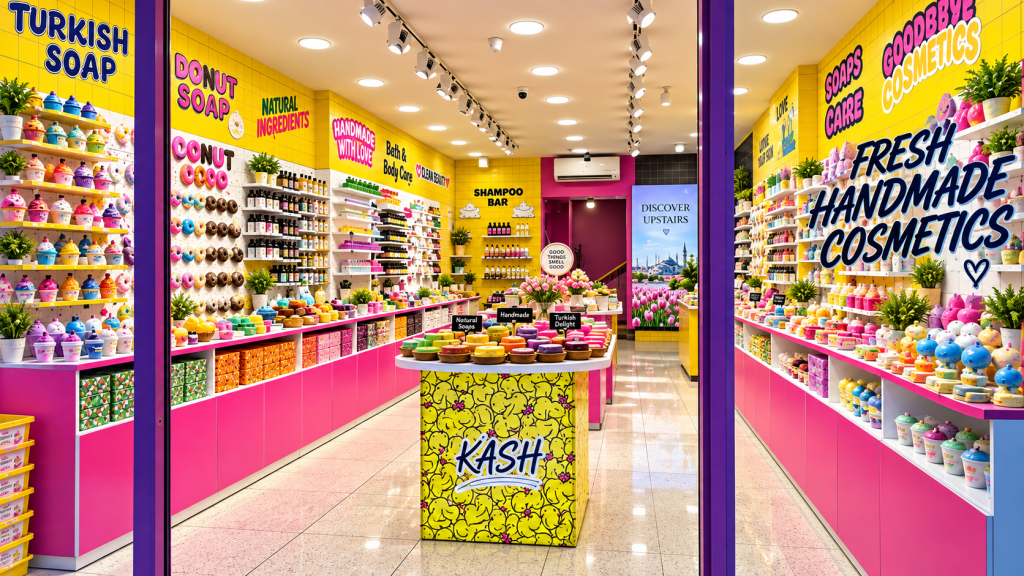
And then we wandered into a shop filled with handmade cosmetics.
Bright walls. Rows of colorful soaps. Creams and scrubs. Felted soaps in almost every imaginable fragrance. And, apparently, something called Turkish Delight Soap.
After sultans, harems, slavery, eunuchs and several centuries of Ottoman history, we were shopping for soap.
I had to smile.
History can be unbearably heavy.
And five minutes later, someone is deciding between lavender and Turkish Delight.
Perhaps that, too, is travel.
You move between the monumental and the mundane, between things that trouble the soul and things that simply make you smile. Neither experience cancels the other. Somehow they occupy the same day.
As we walked back through Istanbul, I kept thinking about the palace we had left behind.
The empire is gone.
The sultans are gone.
The people who once competed desperately to stand closest to power are gone.
Topkapı remains, but now ordinary people walk through its gates carrying cameras and water bottles, listening to stories about people who once believed their world would last forever.
Outside, Istanbul continues.
A cat crosses a cobbled street.
A shopkeeper waits for the next customer.
Yemi examines another bar of soap.
And perhaps history offers its quietest lesson there.
Power seeks to be remembered. Kindness does not require it.
After more than twelve thousand steps yesterday, my feet had lodged a fairly convincing protest, and I had every intention of listening to them. No ambitious itinerary. No long walking tour. No attempt to conquer another corner of Istanbul.
Istanbul, apparently, had other plans.
By late afternoon, the pull of the city became difficult to resist, and before long we were wandering again—not really touring, not following an itinerary, simply walking and seeing where the streets took us.
Perhaps that is when a city begins to reveal itself differently. You stop looking only for the things you came to see and begin noticing the things that are simply there.
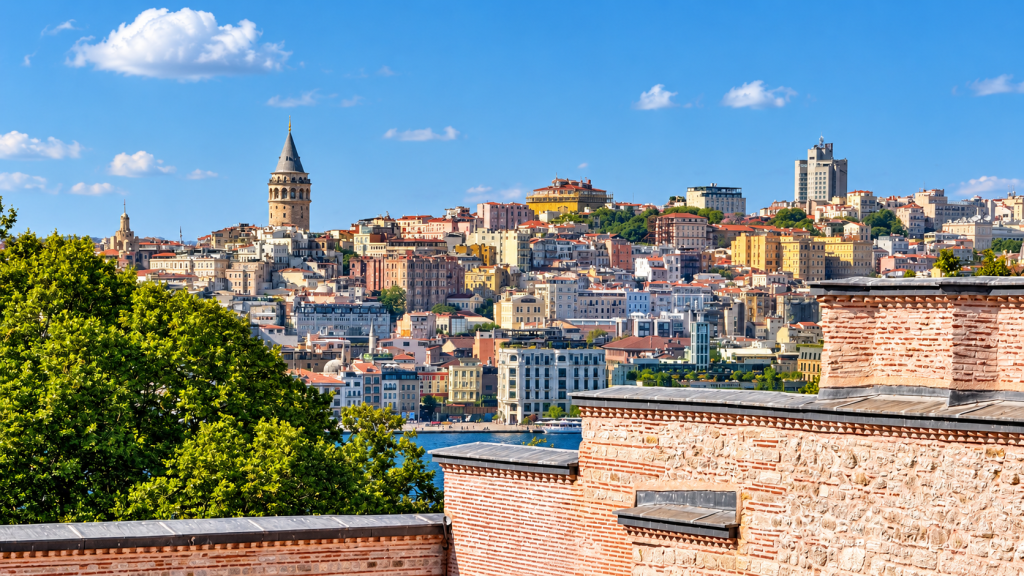
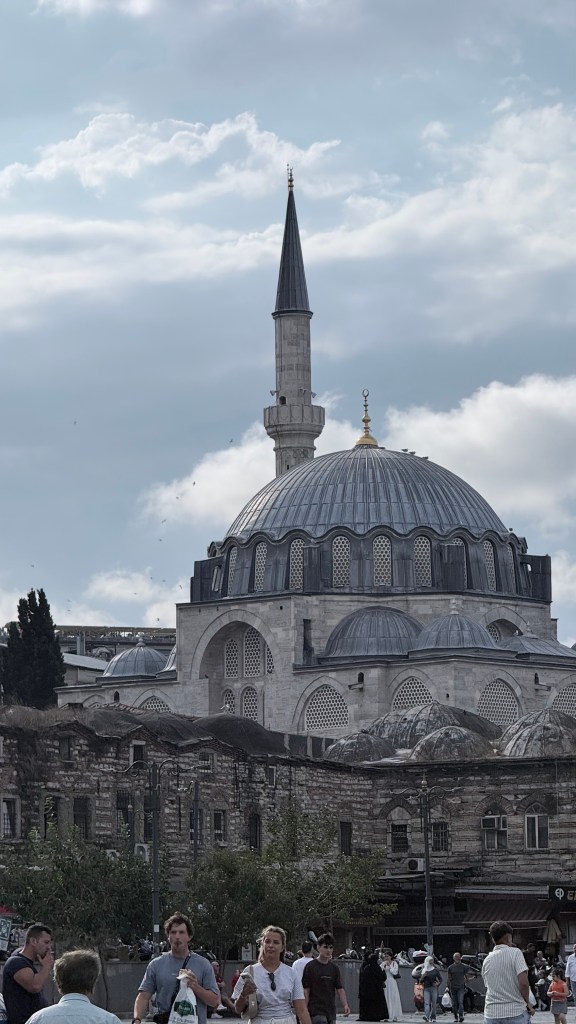
The Galata Tower appeared above the rooftops. Ferries moved constantly across the water. Mosques rose from the hills on the opposite shore. People crowded the bridge. Gulls circled overhead. Fishermen stood along the railings, seemingly indifferent to the millions of people moving around them.
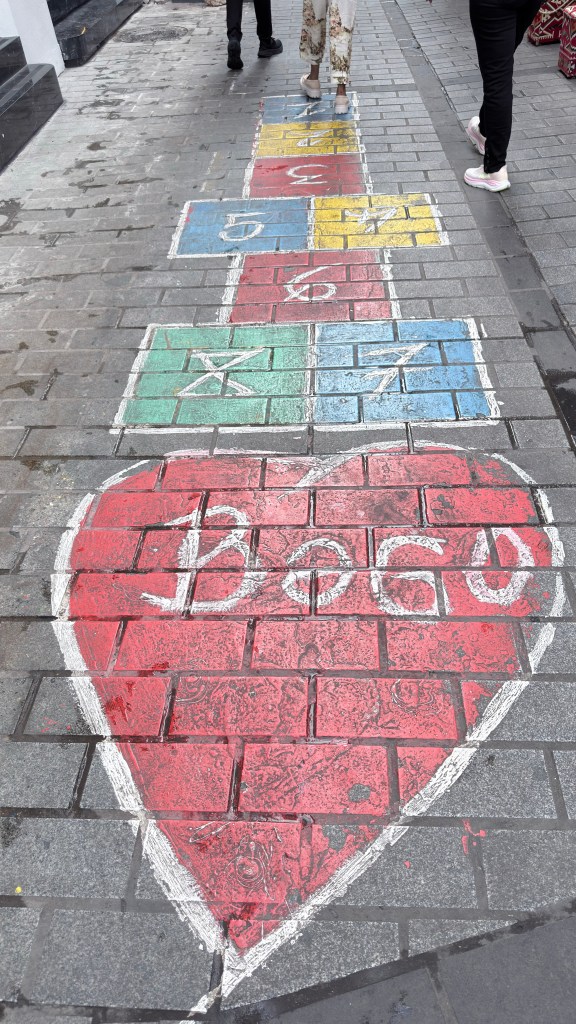
And somewhere amid all this history, someone had drawn a hopscotch court on the pavement.
I loved that.
Empires come and go. Children still play.
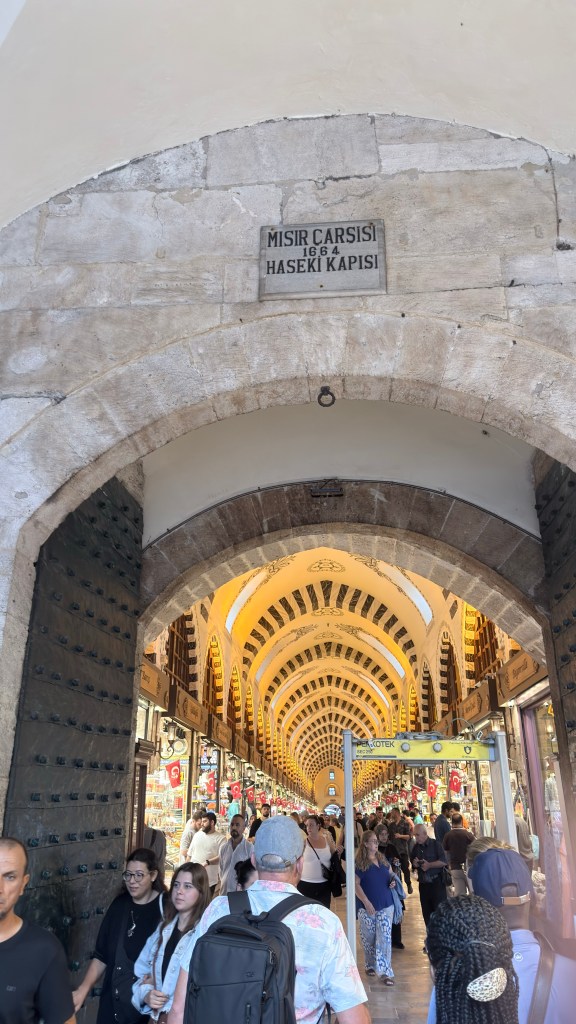
Eventually our supposedly aimless wandering brought us to the Spice Bazaar. Construction began at the end of the sixteenth century and the bazaar was completed in the seventeenth, but what interested me was not simply its age. It was how alive it remains.
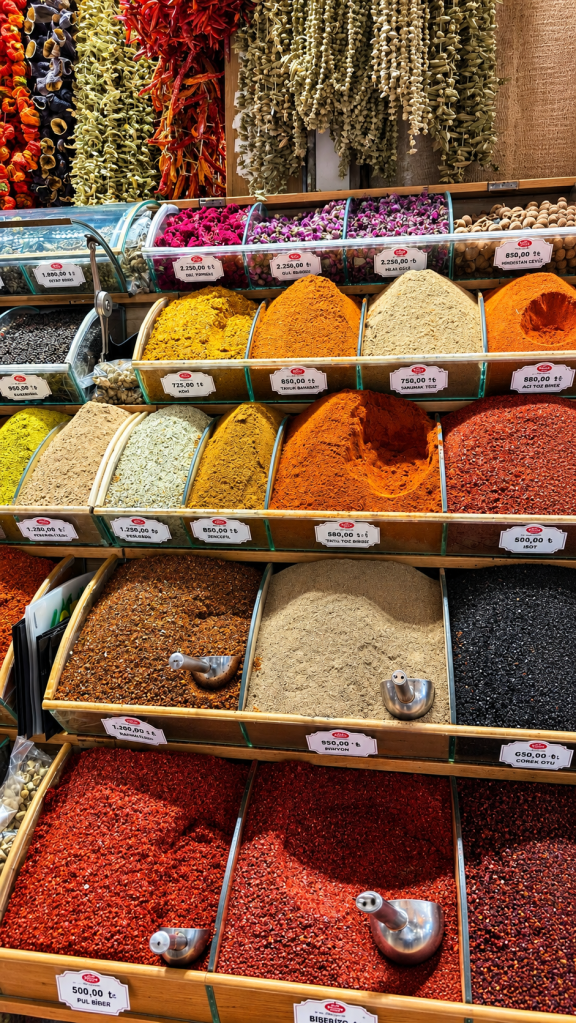
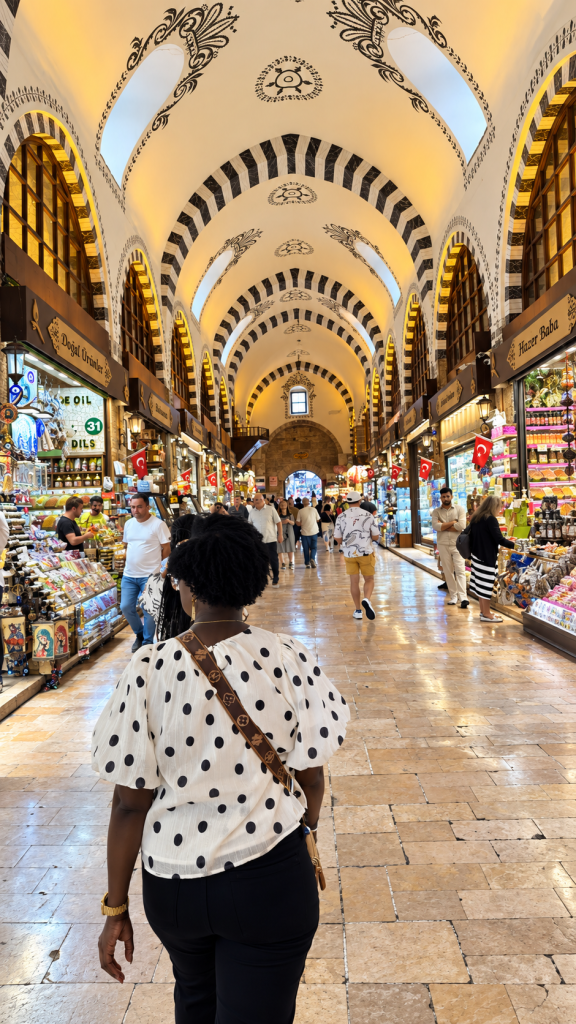
The vaulted ceilings and Ottoman decoration remind you that you are walking through history, but underneath them people are still doing essentially what people came there to do centuries ago: buying, selling, bargaining, talking, tasting and moving on. Spices overflow from stalls. Turkish delight competes for attention with teas and sweets. Shopkeepers call out to passing customers. Tourists stop to photograph everything.
It is not history preserved behind a rope.
It is history still earning a living.
That may be what I noticed most today. Yesterday Istanbul confronted me with its great monuments and the complicated histories of faith and empire. Today there was less need to interpret it. Istanbul was simply getting on with being Istanbul.
People ate. People shopped. Ferries crossed the water. Fishermen cast their lines. Children played. Somewhere someone was late for work. Somewhere else someone was sitting over tea with nowhere particularly urgent to be.
And people who had declared a rest day were somehow still wandering around the city.
By evening, however, I found the perfect compromise.
A dinner cruise.
My feet could finally remain stationary while Istanbul continued moving.
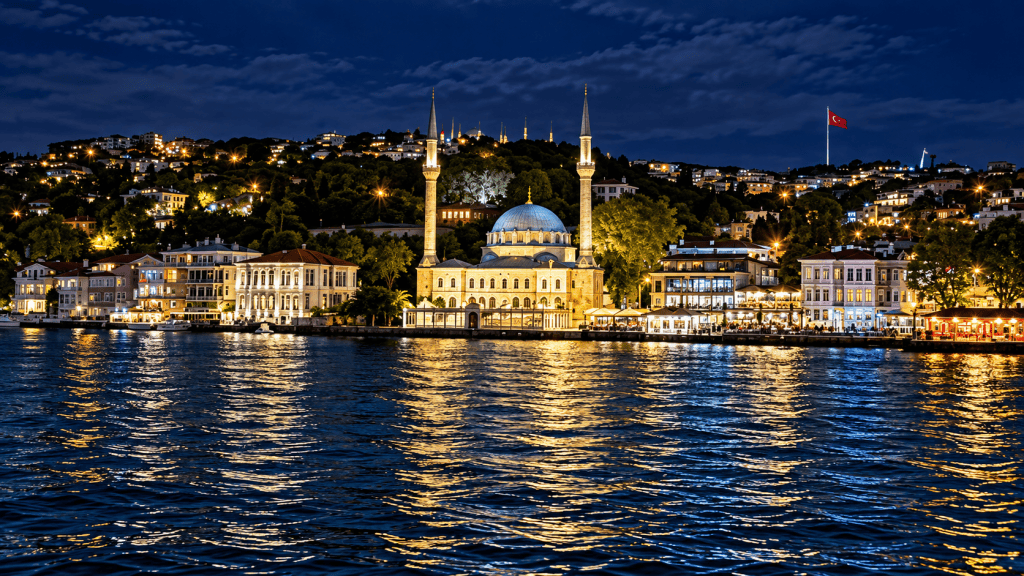
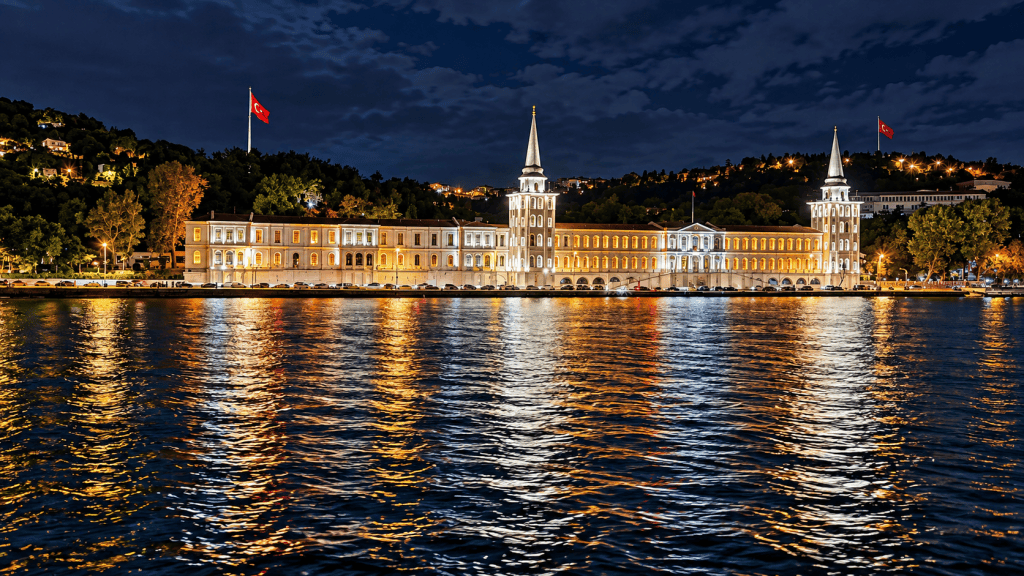
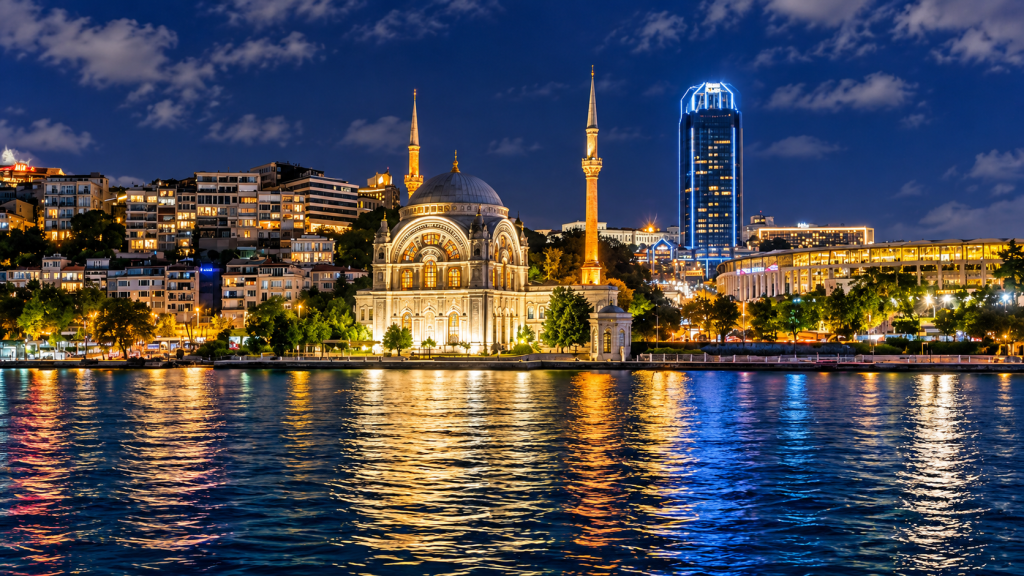
As daylight faded, we moved onto the Bosphorus and the city changed again. Buildings that had seemed crowded together from the streets separated into individual landmarks along the shoreline. Palaces glowed gold. Mosques emerged against the deepening blue. Fortresses stood illuminated among ordinary homes climbing the hillsides. Modern towers appeared behind buildings centuries older, each seemingly quite comfortable in the other’s company.
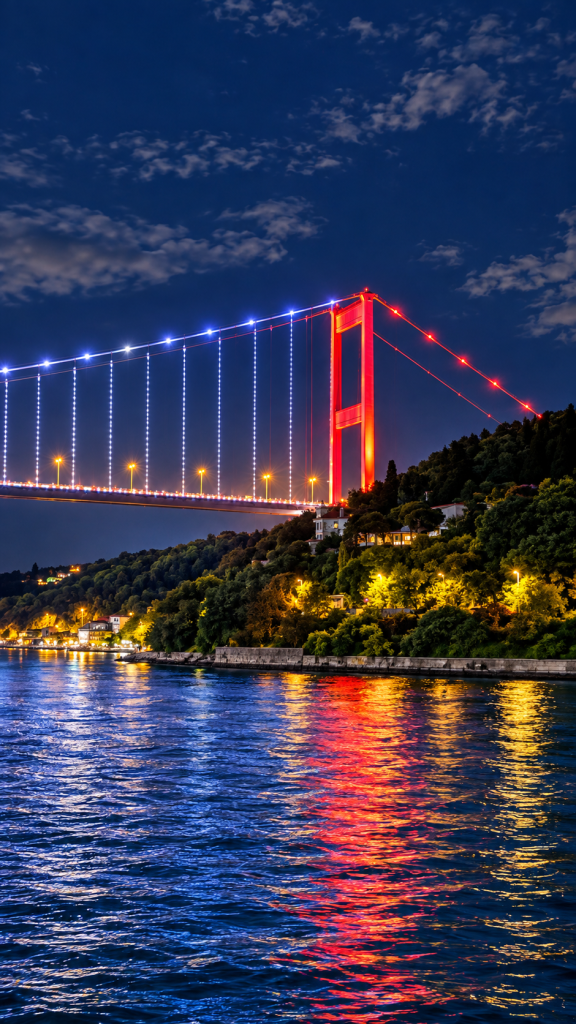
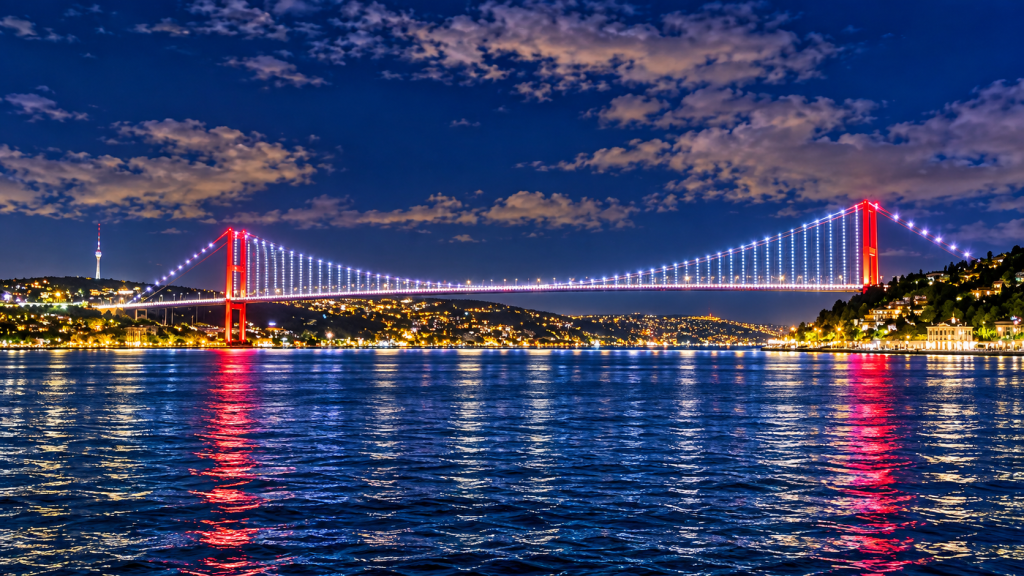
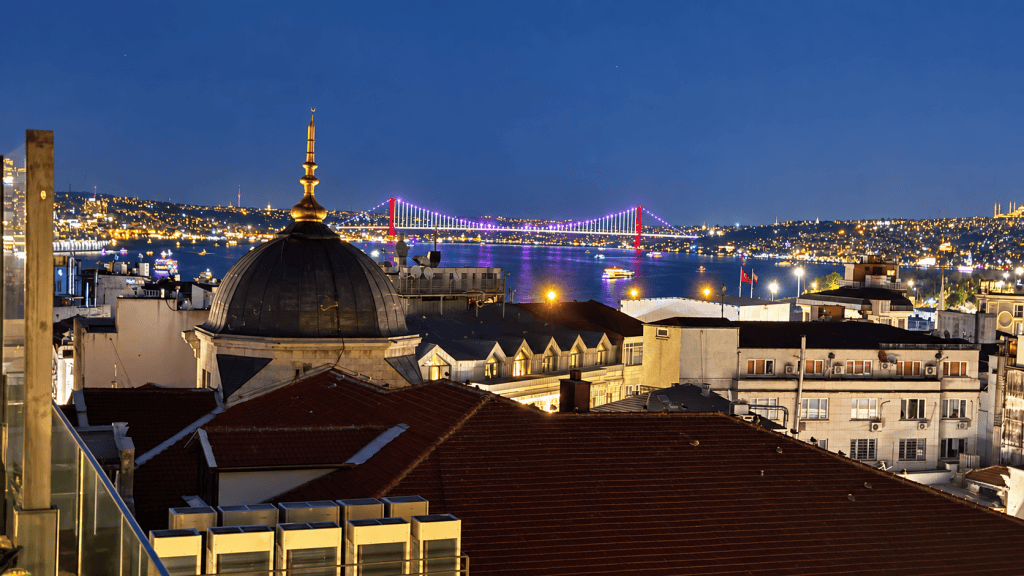
Then came the bridge.
Its red towers rose above the water, white lights tracing the suspension cables from one shore to the other. Beneath it, the Bosphorus refused to keep any of those colors to itself. Red, gold, white and blue broke apart across the moving surface and then disappeared behind us.
Perhaps that is why the city looks so different from the water. From the street you encounter Istanbul one building, one shop, one mosque, one crowd at a time. From the Bosphorus, you see them together.
The water becomes a moving gallery.
Ottoman palaces. Fortresses. Mosques. Waterfront mansions. Modern towers. Bridges. Hillsides crowded with ordinary homes.
Not arranged chronologically. Not separated into museum exhibits.
Just Istanbul.
Dinner was served while the city passed outside, followed by music and local Turkish dance. There was laughter and movement around the tables, and for a while the history lesson gave way to something equally important: people enjoying themselves.
I liked that too.
Cities cannot live entirely on their past.
By then I realized that our rest day had become something rather different from what I had imagined. We had left the hotel without much of a plan in late afternoon and ended up watching Istanbul glow from the Bosphorus while eating dinner and being entertained by Turkish dancers.
My feet, at least, had finally won their argument.
My camera had not rested at all.
Perhaps that is the lesson of a rest day in a city you are seeing for the first time. Rest does not necessarily mean doing nothing. Sometimes it simply means giving up the itinerary and allowing the day to decide what it wants to become.
By the time we returned to the hotel, we had walked more than 12,000 steps, and my feet were crying for help.
We began by climbing uphill toward the old city on a hot, muggy Istanbul morning. Tourists seemed to be everywhere. Cruise ships had emptied their passengers into the city, tour groups moved from monument to monument, and the narrow streets around Sultanahmet were alive with people speaking languages from every corner of the world.
Yesterday, Istanbul impressed me with its size.
Today, it impressed me with its age.
Istanbul sits between two continents, divided by the Bosphorus, with Europe on one side and Asia on the other. The Golden Horn cuts into the European side, and the Sea of Marmara lies below. Empires understood the significance of this geography long before tourists arrived with cameras and cruise ships.
We stood in what was once the Hippodrome of Constantinople, where chariots raced before enormous crowds. What is now an open public square was once one of the great gathering places of the Byzantine world. Ancient monuments still rise from it, survivors of civilizations that believed, as civilizations often do, that they would last forever.
Then came the Blue Mosque.
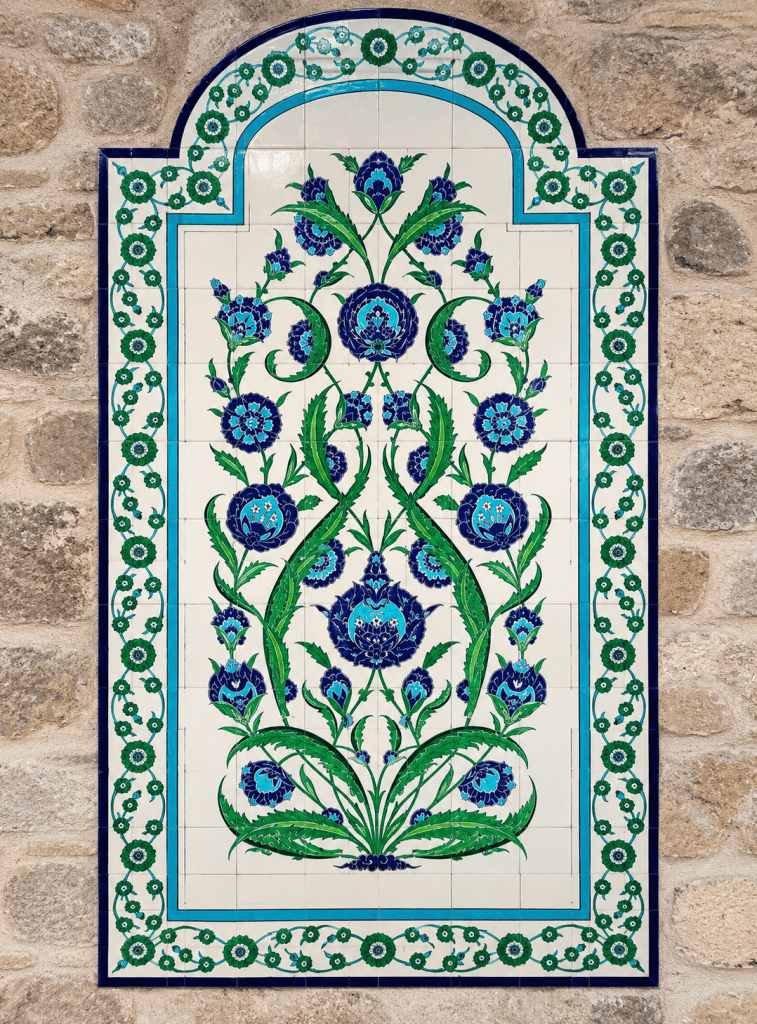
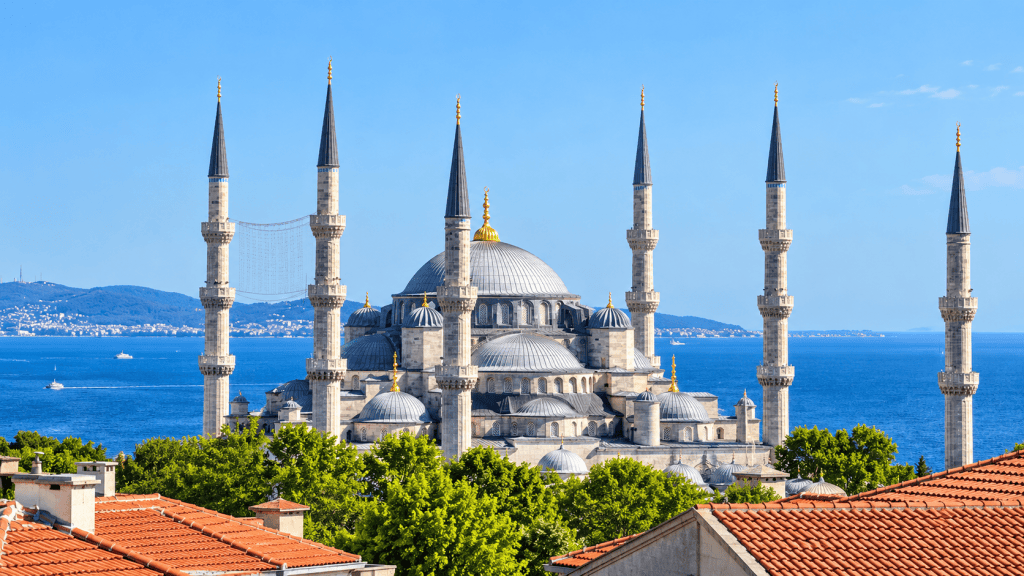
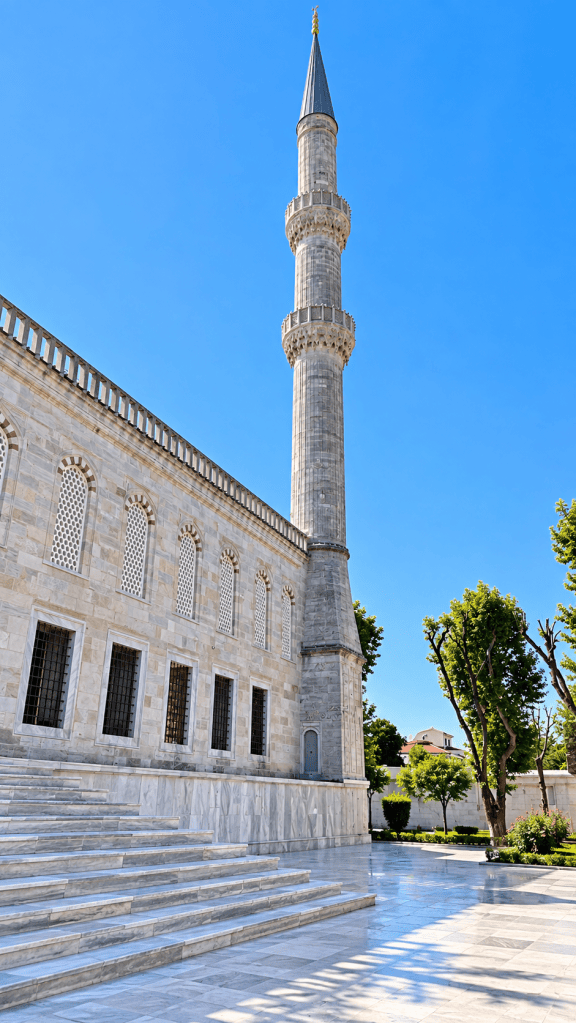
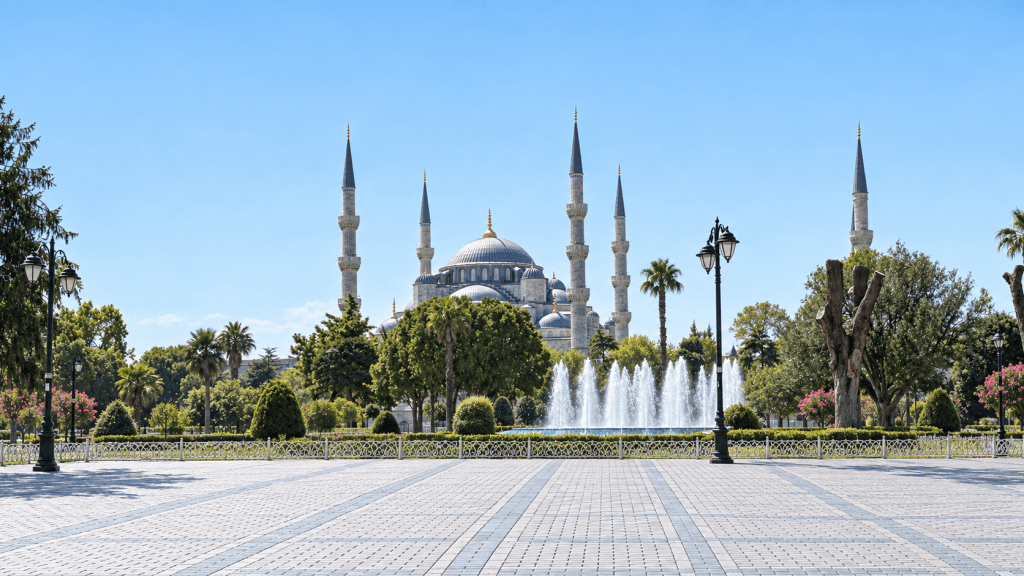
There are buildings that photographs prepare you for, and others whose scale only becomes apparent when you stand beneath them. The Blue Mosque belongs to the latter. Domes rise upon domes, framed by six minarets reaching into an impossibly blue sky. Inside, decoration replaces imagery—flowers, geometric patterns and calligraphy rather than human figures.
Our guide explained some of the differences between Islamic and Christian traditions, particularly the reluctance in Islam to depict God or prophets in places of worship. His explanations occasionally wandered into theology, and I found myself listening less for doctrine than for what it revealed about how differently human beings have tried to understand the same mysteries.
But it was Hagia Sophia that stayed with me.
Nearly fifteen centuries old, it has been a church, a mosque, a museum and now once again a mosque. Few buildings can tell the story of human civilization simply by allowing you to look at their walls.
And the walls speak.
Christian mosaics were covered after the Ottoman conquest when Hagia Sophia became a mosque. Centuries later, efforts were made to uncover and preserve them. But history does not always surrender itself cleanly. In places, the plaster protected what lay beneath it. In others, attempts to remove it damaged the mosaics themselves.
We stood before the great Deësis mosaic.
Christ remains at its center, with the Virgin Mary on one side and John the Baptist on the other. Large portions have disappeared, leaving irregular expanses where images once existed.
Strangely, I found the missing pieces almost as moving as those that survived.
You are not simply looking at Christian art. You are looking at what centuries of belief, conquest, preservation, destruction and changing ideas have done to the same wall.
The building itself carries other wounds. Earthquakes and centuries of structural movement have left their marks. Marble floors are cracked and uneven. Parts of the building seem almost to lean beneath the accumulated weight of history. Restoration continues even now.
Empires have risen around Hagia Sophia.
Empires have disappeared around it.
Christians have prayed there.
Muslims have prayed there.
Millions of tourists have walked through it.
And somehow the building remains.
Standing there, I began thinking about religion and conquest.
So much of human history has involved people marching beneath one religious banner or another, each convinced that God somehow belonged more to them than to the people on the other side.
And yet, with all the churches, mosques, synagogues and temples we have built across the world, you would think by now we might have learned to be a little kinder to one another.
Perhaps that is the greater monument still waiting to be built.
Fortunately, Istanbul does not allow one to remain philosophical for too long.
Eventually, hunger intervened.
We stopped for lunch at Galeyan, where the menu presented an impressive collection of kebabs. I settled on No. 7 — Alenazik: lamb served over eggplant and strained yogurt with garlic, butter and pepper.
After walking uphill through Istanbul in the heat, No. 7 required very little philosophical contemplation.
It disappeared.
Dessert followed—baklava with Turkish ice cream. The ice cream here has a distinctive dense, almost elastic texture, quite different from what we are accustomed to at home. Somehow baklava and ice cream after several thousand steps felt less like indulgence and more like medical necessity.
Then we went shopping.
At Bilgin’s, we found ourselves surrounded by leather jackets and receiving an enthusiastic education in Turkish leather. There was talk of lambskin, softness, durability, reversible jackets and techniques that apparently allow a jacket to be folded into remarkably small spaces.
Somewhere during the demonstration, education became commerce.
We bought leather jackets.
Then came the Grand Bazaar.
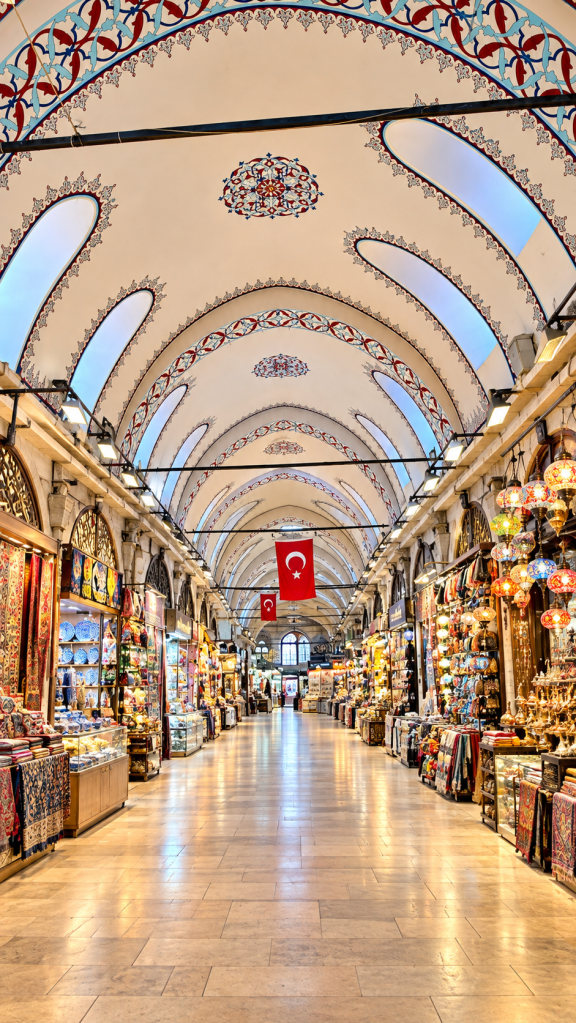
Nothing quite prepares you for it. Vaulted passageways stretch in every direction beneath painted ceilings, lined with jewelry, lamps, ceramics, carpets, spices, leather, sweets and almost anything else one might imagine. People flowed through the corridors in both directions while shopkeepers competed gently—and sometimes not so gently—for attention.
It is shopping, certainly.
But it is also theater.
Eventually we found ourselves in a spice shop, where jars of deep-red saffron sat on the counter like something considerably more precious than seasoning.
Which, apparently, it is.
I had always heard that saffron was the world’s most expensive spice, but seeing how it is sold helped explain why. Each tiny strand is part of a flower and must be harvested painstakingly. The best-known premium saffron is strongly associated with Iran, which dominates global production.
We tasted saffron tea.
After yesterday’s encounter with rakı, Istanbul was continuing my education one drink at a time.
Nearby were enormous bins of teas and dried flowers with wonderfully ambitious labels promising solutions for cholesterol, pain and probably several problems I didn’t know I had.
And then there were the sweets.
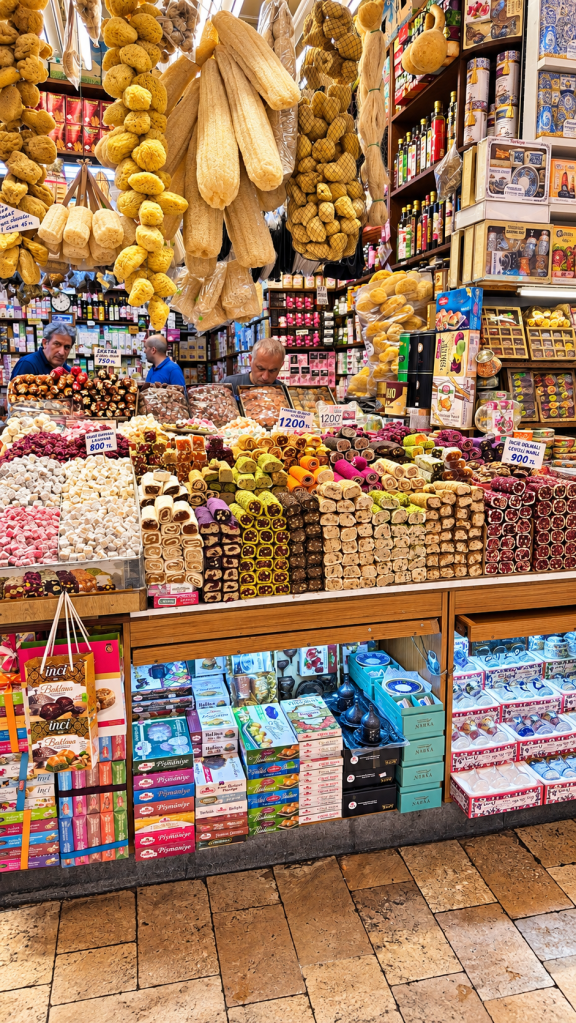
Rows of baklava. Pistachios. Rose petals. Chocolate. Turkish delight in colors that looked almost too beautiful to eat.
Almost.
We bought Turkish delight to take home to our daughters.
I liked that moment.
After a day spent contemplating emperors, religions, earthquakes, conquests and buildings nearly fifteen centuries old, something as ordinary as parents buying sweets for their children brought the day back to its proper scale.
Perhaps travel works that way.
We cross oceans searching for great monuments, and they deserve our attention. Today I stood inside buildings that have witnessed more history than I can easily comprehend.
But the memories we carry home are often smaller.
A cracked mosaic.
Sunlight against six minarets.
The smell of spices.
The taste of saffron tea.
Baklava melting into Turkish ice cream.
A leather jacket we probably hadn’t planned to buy.
Two boxes of Turkish delight for two daughters thousands of miles away.
And two very tired feet that had carried me through 12,000 steps of history.
Yesterday, Istanbul introduced itself.
Today, we walked into its past.
And my feet can confirm that we walked quite a long way into it.
It was still early, and for a few moments I simply listened.
There are five calls each day here, and after hearing the first one yesterday evening, waking to another this morning made me realize that this sound would become part of the rhythm of our days in Istanbul.
There is something particularly fitting about that in a city whose history has crossed religious boundaries almost as readily as its people cross the Bosphorus.
Once Constantinople, this was for centuries one of the great centers of Christianity. Then came the Ottomans and Islam. The buildings themselves carry the evidence. Churches became mosques. Mosques became museums. Some became mosques again.
And yet modern Turkey is a secular republic.
Perhaps contradiction is the wrong word.
Layers may be better.
Before leaving the hotel, I found myself noticing some of the objects around us.
On one wall hung an old-fashioned telephone—wood and brass, rotary dial, receiver dangling from its cord. I don’t know its history, or whether it belonged to this building in an earlier life, but in a place that had already lived for more than a century before becoming our hotel, somehow it didn’t feel merely decorative.
It felt like an echo.
And then there was a statue I had noticed earlier.
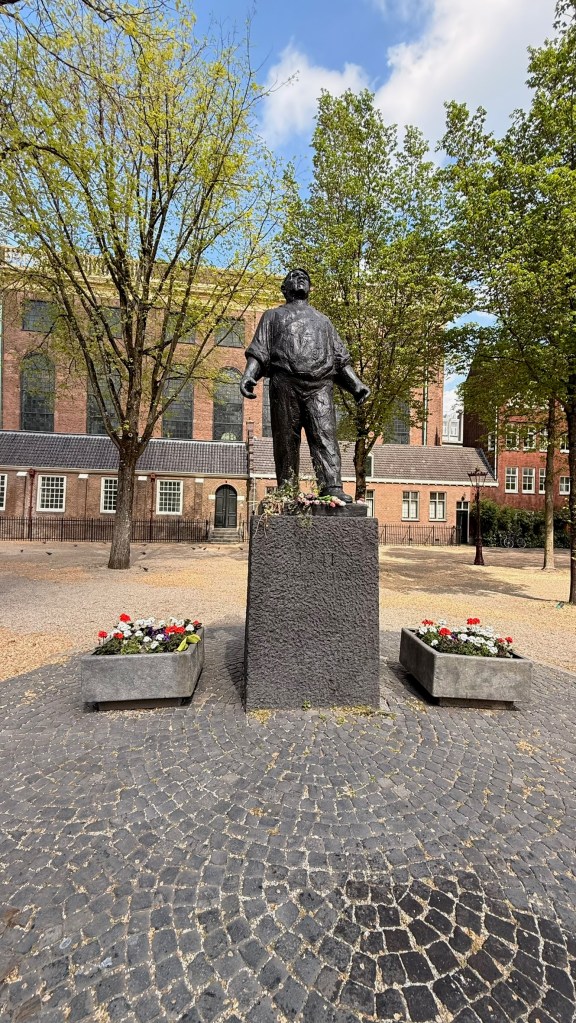
It depicted a man almost doubled over beneath an enormous load. Before knowing anything about it, I had already given him my own name: the human camel.
A camel, after all, is a beast of burden, built to carry enormous weight across difficult terrain. Looking at this bent figure, I couldn’t escape the comparison. Except here, the beast of burden was a human being.
Later I learned that he was a hamal—one of Istanbul’s traditional porters. For centuries, men like him carried goods on their backs from the waterfront into the city’s markets, navigating streets too narrow and steep for other forms of transport.
Suddenly the statue meant something different.
Istanbul’s palaces tell us about the sultans who ruled it. Its mosques tell us about faith. Its fortresses tell us about conquest.
But someone still had to carry the load.
Perhaps that bent man tells another history of Istanbul—the history of the ordinary people upon whose backs great cities are built.
Outside, the scale changed again.
We left these smaller echoes of the past behind and took to the Bosphorus, where history was written not in telephones and statues, but in palaces, fortresses and continents.
The Bosphorus is not a river. It connects Asia to Europe. It is a natural saltwater strait, not a river or man-made canal, connecting the Black Sea with the Sea of Marmara and ultimately the Mediterranean. It has a fascinating two-layer current: generally southward at the surface and northward below because of differences in salinity and density.
That geographical fact suddenly seemed extraordinary when experienced from the water.
To one side, Europe.
To the other, Asia.
And we were sailing between them.
Most of Turkey—about 97 percent of it—is actually in Asia, something easily forgotten when thinking of Istanbul as a European city. Today we would cross over and, for a little while at least, stand on another continent.
History lined both shores.
Ottoman palaces appeared along the waterfront. Magnificent old wooden mansions—yalıs—sat close to the water, reminders of a time when position on the Bosphorus was itself a statement of wealth and power. Today, some command extraordinary prices.
Then came the fortresses.
At one of the narrowest points of the Bosphorus stands Rumeli Hisarı, built by Sultan Mehmed II as he prepared to conquer Constantinople. Looking at its massive walls, I wondered how long construction had taken.
Years seemed reasonable.
The answer was four months.
Thousands of men, working day and night.
There are moments when history becomes easier to understand not through dates but through ambition. Standing there more than five centuries later, looking at those walls from the water, four months told me almost everything I needed to know about how badly Mehmed wanted Constantinople.
And then there was modern Istanbul.
Bridges now span the water that once required ferries to cross. The first Bosphorus bridge opened in 1973 and offered a new way of moving between Europe and Asia.
Apparently Istanbul responded by producing more traffic.
Much more traffic.
A lady on a local radio joked that in Istanbul there is little need for therapy because the traffic itself is therapeutic.
I’m not entirely convinced that therapeutic is the word I would choose.
I come from Lagos.
I know traffic.
But Istanbul is certainly making a respectable effort.
And perhaps that is what I am beginning to understand about this city.
Yesterday, everything seemed bigger.
Today, everything seems layered.
Christian and Muslim.
Ancient and modern.
Sultans and porters.
Palaces and ordinary homes.
Fortresses and suspension bridges.
Europe on one shore.
Asia on the other.
And between them, the Bosphorus—carrying ferries, tankers, fishermen, tourists and centuries of history back and forth across the same water.
Yesterday I wrote that first impressions are invitations.
Istanbul Airport seemed almost impossibly large. Corridors stretched into the distance, the parking structure was equally imposing, and before we had even properly arrived, I found myself wondering whether there was a bigger airport anywhere in the world.
Outside, the theme continued.
The roads were wide and remarkably clean. The bridges were enormous. Everything seemed somehow supersized.
It took nearly an hour to reach our hotel, the Orient Occident, and Istanbul gradually revealed itself through the car window. Traffic everywhere—not quite Lagos traffic, perhaps, but enough cars to make the comparison inevitable. The streets were alive with pedestrians. The air was hot and muggy, almost tropical.
And then came a sound that immediately reminded me that I was somewhere different.
The call to prayer.
It rose above the traffic and the noise of the city, broadcast from loudspeakers, ancient words carried over a thoroughly modern metropolis.
That juxtaposition may be my earliest impression of Istanbul: the old and the new apparently having no difficulty occupying the same space.
Even our hotel tells that story.
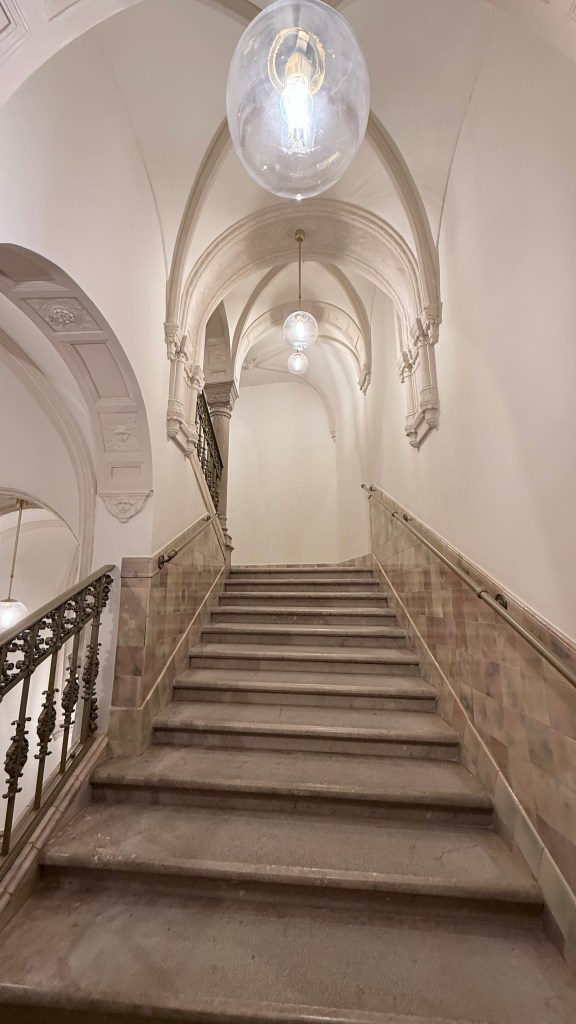
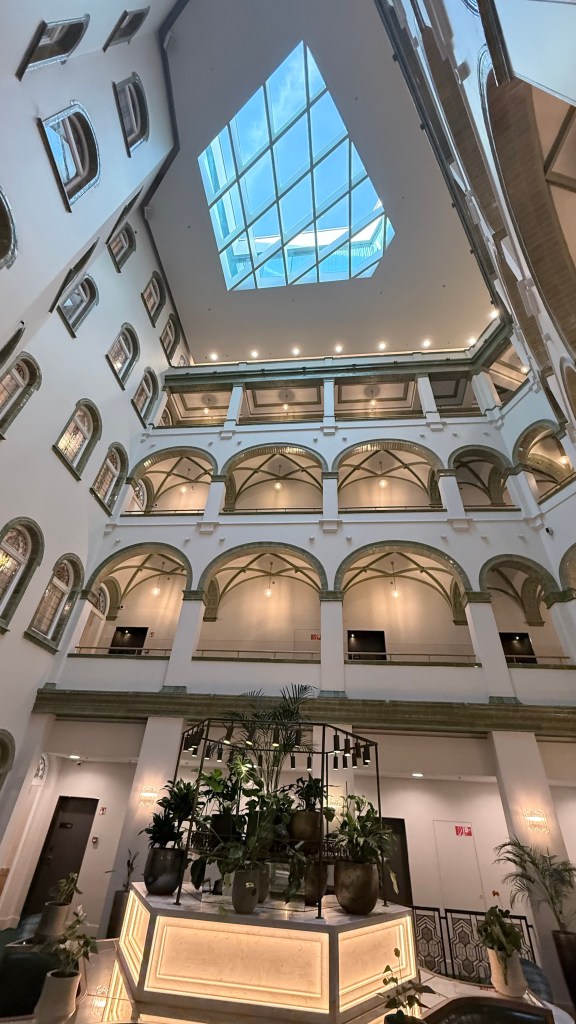
The building is about 120 years old, although it became a hotel only recently. Before the restoration, its spaces housed an assortment of small businesses: a curtain shop, tiny stores tucked between columns, someone who apparently made and sold spoons, another shop devoted to remote controls and repairs for radios and electrical devices.
I smiled listening to the story.
A luxury hotel today. A spoon maker yesterday.
Perhaps that is Istanbul.
We haven’t really seen anything yet. Somewhere beyond our hotel are Hagia Sophia, the Blue Mosque, Topkapi Palace, the Grand Bazaar and the Bosphorus. Tomorrow we begin discovering them.
But first impressions matter.
And on this first evening in Turkey, Istanbul already felt enormous, crowded, warm, ancient and modern all at once.
By dinner, it seemed only appropriate to try something Turkish.
When I wondered aloud what I should drink, I decided against the familiar and ordered rakı.
It arrived clear. Then water was added and, almost magically, the drink turned cloudy white before my eyes. I was fascinated. The resulting color, I discovered, is sometimes described as aslan sütü—“lion’s milk.”
The fascination lasted longer than my enthusiasm for the taste.
Anise.
Very definitely anise.
Perhaps a little too much anise for me. I was glad I tried it, but I suspect rakı and I may remain acquaintances rather than become close friends.
After dinner, I stepped outside with my camera.
And there was Istanbul again—this time illuminated against the night. Across the dark waters of the Bosphorus, one of those enormous bridges I had noticed on the drive from the airport was now transformed, its lights suspended between two continents and the city climbing the hills beyond it.
I took a couple of photographs.
It seemed an appropriate way to end my first evening in Turkey.
I had arrived thinking about scale—the enormous airport, the bridges, the roads, the traffic and the crowds. But by nightfall, Istanbul had begun revealing itself through smaller things: the call to prayer floating above the streets, stories hidden inside a 120-year-old building, a glass of rakı changing color when touched by water, and a bridge glowing across the Bosphorus.
Perhaps first impressions aren’t conclusions at all.
“To sit beside the sea is to hold a mirror to the soul.” — Greek Proverb
“Some landscapes speak in silence—this beach whispered peace to my spirit.” — Simply O.
Few places take your breath away quite like Myrtos Beach on the island of Kefalonia. Curving gracefully between towering limestone cliffs, its pristine white pebbles meet waters painted in impossible shades of turquoise, sapphire, and cobalt. It is one of Greece’s most photographed beaches—and standing there, it is easy to understand why.
From the viewpoint high above, the scene appears almost unreal. The sea glows with a brilliance that seems borrowed from an artist’s palette, while the cliffs stand as ancient guardians over a shoreline sculpted by wind, water, and time. Nature here has achieved a harmony so perfect that it feels less like a destination and more like a revelation.
Yet what struck me most was not the color of the water or the grandeur of the landscape. It was the stillness.
Even with the gentle rhythm of the waves rolling ashore, there was a profound quietness that settled over the spirit. The beach seemed to ask nothing of its visitors—no agenda, no achievement, no urgency. Only presence.
In a world that constantly demands our attention, Myrtos offers something increasingly rare: permission to simply be.
As I gazed across the Ionian Sea, I was reminded that some of life’s greatest gifts cannot be purchased, scheduled, or possessed. They can only be experienced. A sunset. A conversation. A moment of gratitude. A shoreline where the sea meets eternity.
Travel often teaches us through movement, but occasionally it teaches us through stillness. Myrtos Beach was one of those places.
A sanctuary carved by wind, sea, and time, it reminded me that peace is not always found in reaching a destination. Sometimes it is found in pausing long enough to hear the whisper of the waves and remembering that we are part of something far greater than ourselves.
For a brief moment on the shores of Kefalonia, the world seemed content simply to breathe.
The journey begins aboard a British Airways flight to London, tucked into the quiet cocoon of business class as the familiar feeling of enchanted travel slowly takes hold. There is a particular sensation that comes just before departure — the feeling that life, for a brief moment, has loosened its grip on routine.
I can almost taste the leaving.
Oh London, here I come again.
Three visits within a single year, and still you remain a city that leaves its imprint on the soul. There is something about London that never exhausts itself. Every visit feels incomplete in the best possible way, as though the city is gently reminding you that no single lifetime is enough to know it fully.
And perhaps that is the lesson.
To travel is not to conquer a place, but to accept that some cities will always remain partially undiscovered. I feel as though I would need three lifetimes to truly see all that London holds — its history, contradictions, quiet corners, and layered humanity. But I do not have three lifetimes. So I am learning, slowly, to be content with fragments.
This time London is only a passageway, a familiar threshold before the next chapter begins.
Ahead lies Amsterdam — my first visit to the Netherlands — and the beginning of a river journey that will carry us patiently and unhurriedly through Europe, from Amsterdam to Budapest along the Rhine, Main, and Danube. There is something fitting about beginning such a journey not by rushing across continents, but by surrendering to the slow movement of water.
For now, though, sleep calls. Somewhere beyond the Atlantic, morning is already beginning.
See you on the other side of the pond.
⸻
Somewhere between departure and arrival, a quiet shift begins. Not in the body — but in the way time is felt.
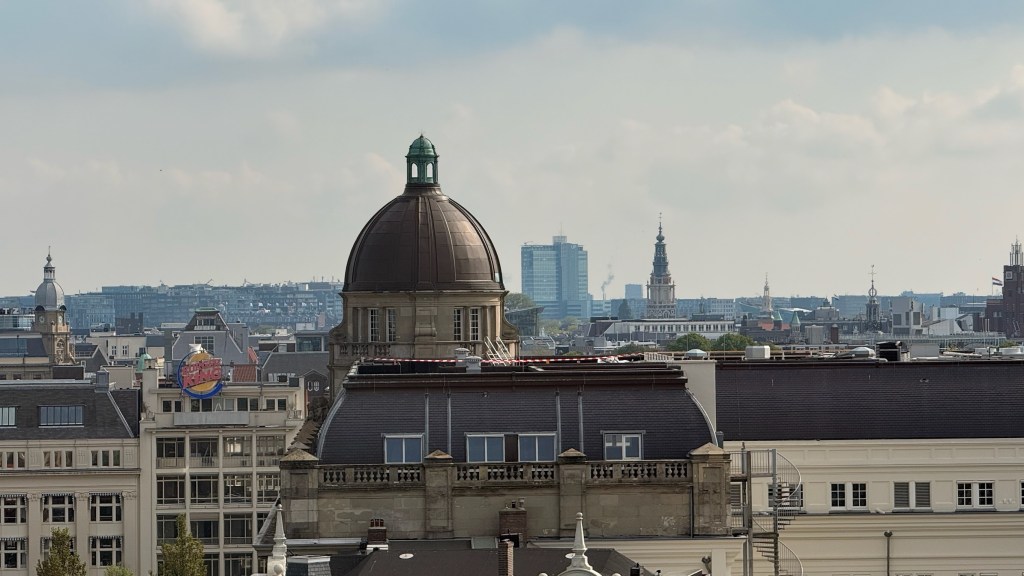
The approach into Amsterdam stirred immediate curiosity. From the sky, the Netherlands appeared impossibly ordered — ribbons of water, geometric fields, and clusters of homes arranged with quiet precision. Even before landing, there was a sense that this country had learned how to live in conversation with water rather than in opposition to it.
Amsterdam does not rush to introduce itself.
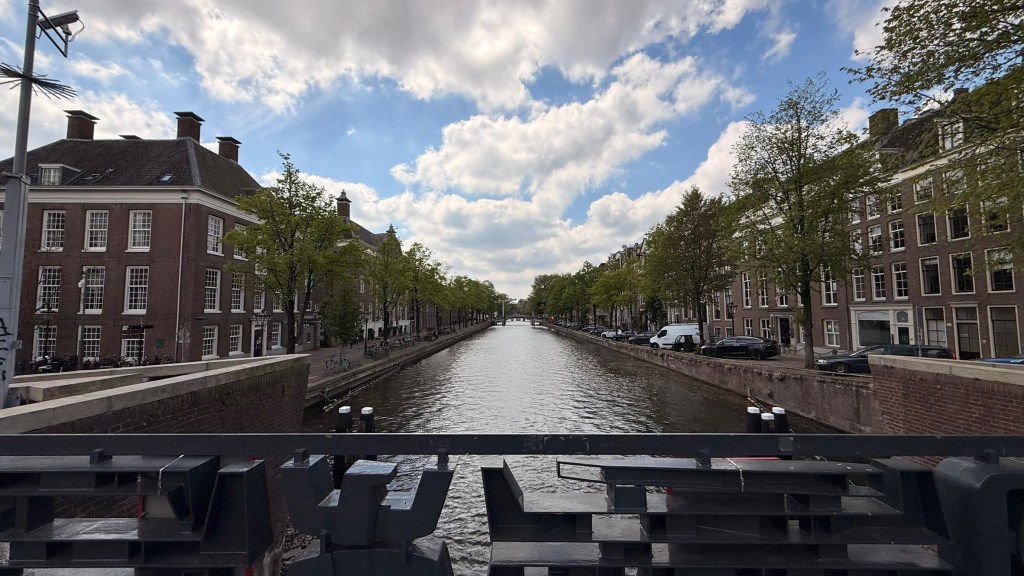
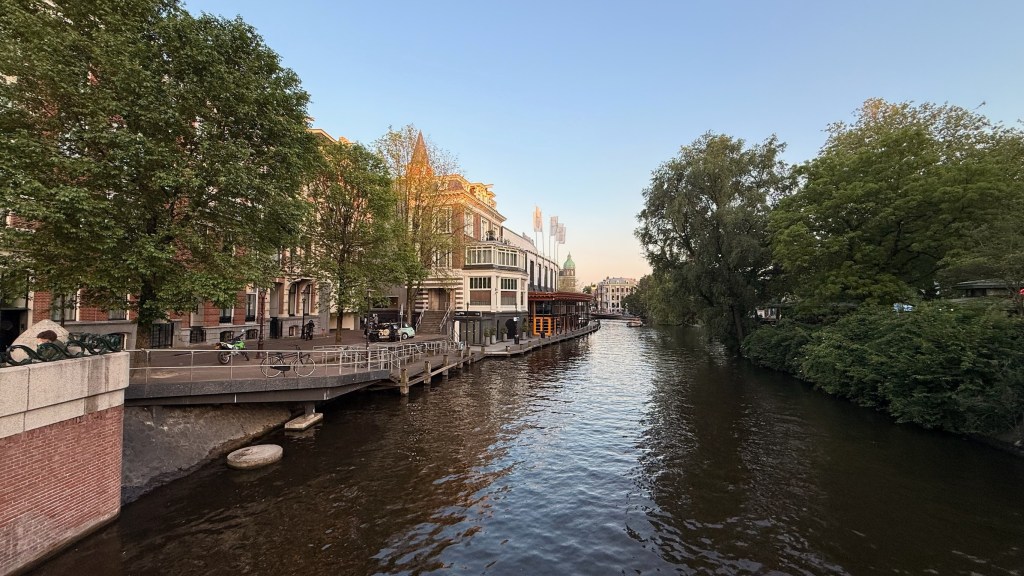
The canals move with a stillness that feels intentional, as if the city has already decided that urgency has no place here. Bicycles pass with quiet confidence, bridges hold centuries of footsteps, and the narrow houses lean gently into one another like old companions who have long stopped keeping count of the years.
We arrived not to a spectacle, but to a rhythm.
There is something disarming about a place that does not try to impress you. It simply is — layered, lived in, and quietly certain of its place in the world.
Our journey now truly begins: Amsterdam to Budapest by river cruise — travel beyond the extraordinary.
The first days in Amsterdam offered not spectacle, but reflection.
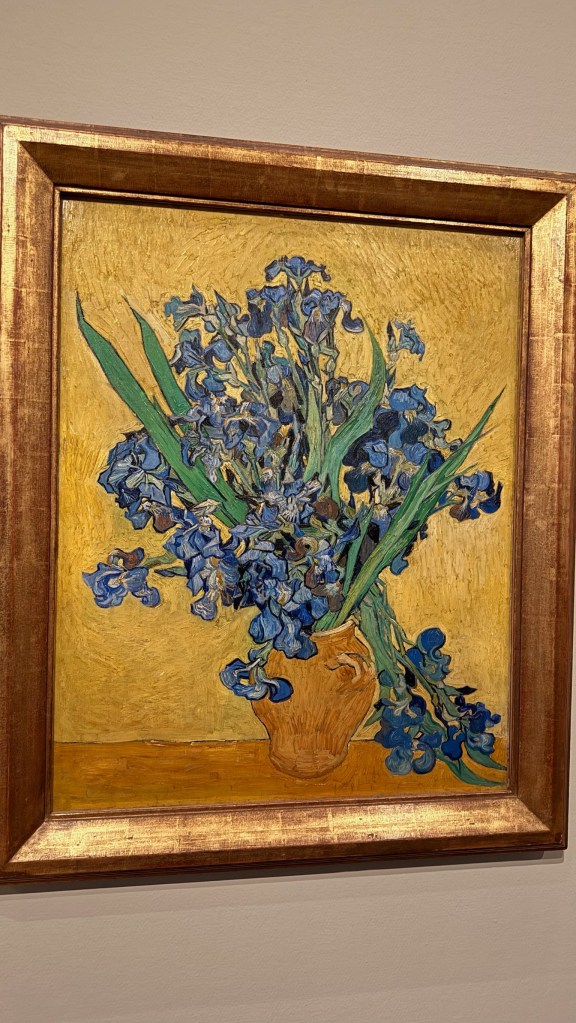
At the Van Gogh Museum, I found myself unexpectedly drawn to the color yellow. One particular wall inscription lingered in my mind:
“Yellow is the closest to light. In its utmost purity, it always implies the nature of brightness.”
Standing before Van Gogh’s work, yellow no longer felt like merely a color, but a form of emotional language — warmth, longing, hope, and perhaps even survival itself painted onto canvas.
Later, at the Anne Frank House, the emotional landscape shifted entirely. Few places confront the human condition so directly. Within those hidden rooms exists both a testimony to the goodness that can emerge from humanity and a warning of the terrible consequences when hatred takes root and people begin to see others as less than themselves.
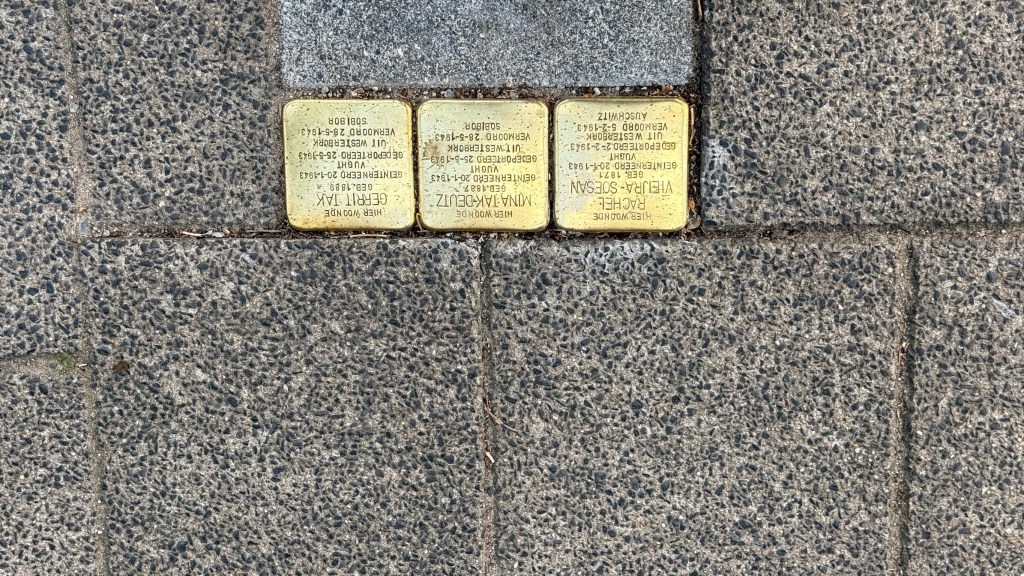
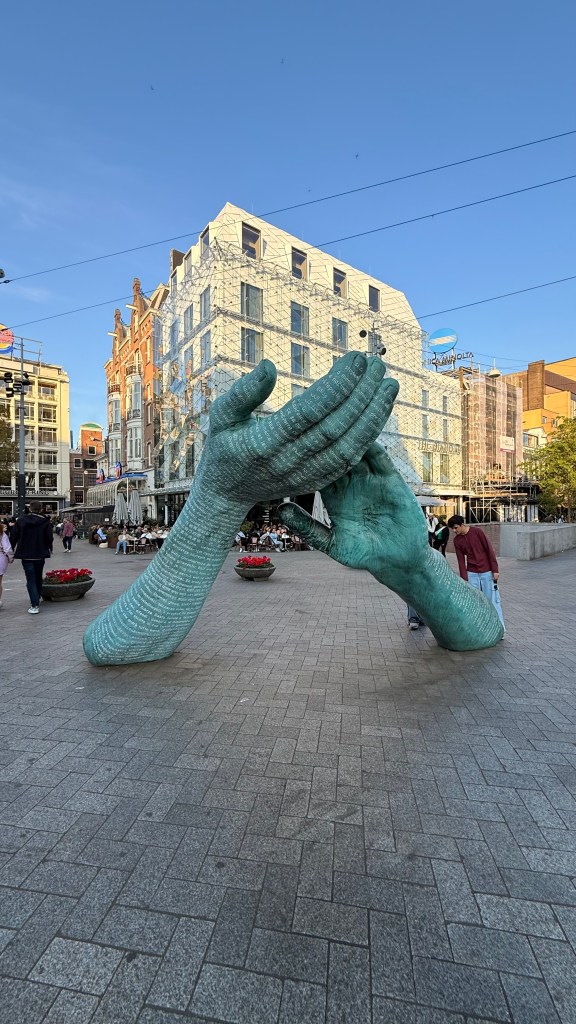
Nowhere was this confrontation more sobering than at the NATIONAAL HOLOCAUST NAMENMONUMENT, where the names of more than 102,000 Jews, Sinti, and Roma from the Netherlands murdered during the Holocaust are preserved in stone because they were never given graves.
It is impossible to stand there unmoved.
The monument does more than remember the dead. It reminds the living that personal grievances, fear, and division must never be given enough space to overcome our shared humanity.
Later in the evening, standing near the water, I watched the light settle into the canals. No announcement. No crescendo. Just a soft transition from day into something slower.
And I realized then — this journey will not be about distance.
It will be about attention.
⸻
“The real voyage of discovery consists not in seeking new landscapes, but in having new eyes.” — Marcel Proust
Reflection : Some places don’t ask to be seen. They ask to be noticed.
Simply O
Day 2 — A Floating Home Called
Joy
There is a subtle difference between arriving at a destination and settling into a journey.
Today, after a late checkout from the Amsterdam Marriott Hotel, we made our way to the MS Joy, the ship that will quietly carry us through Europe for the next two weeks. Somewhere between stepping onto the gangway and placing our bags inside the cabin, the realization settled in:
This was no longer simply a trip.
This was now home — at least for a little while.
The embarkation process was remarkably smooth, almost understated. Unlike the layered chaos often associated with large ocean cruises, this felt calm, measured, and personal. Within fifteen or twenty minutes we were already in our room, luggage unpacked, looking out toward Amsterdam from a ship that suddenly felt both unfamiliar and reassuring.
One of the first things I noticed was the rhythm of the passengers themselves.
Most appeared to be over sixty, many American, though now and then different accents drifted through conversations in the lounge and corridors — small reminders that travel gently gathers together lives that might otherwise never intersect.
Then came the mandatory safety drill, though even that seemed softened by the atmosphere onboard. It is difficult to feel overly alarmed while standing with a champagne glass in hand as crew members calmly demonstrate emergency procedures. Tauck, it seems, has mastered the art of making even practical necessities feel civilized.
Later we met another traveler who casually mentioned she had completed fifteen land tours with Tauck over the years. Fifteen.
At first it sounded astonishing, but then again, perhaps it was not. Retirement, when embraced fully, can become less about stopping and more about finally having enough time to follow curiosity wherever it leads. She had been retired for more than a decade, and there was something quietly reassuring about seeing someone who had so thoroughly settled into this slower rhythm of living.
Dinner followed — elegant without being excessive — accompanied by good conversation and the gentle ritual of choosing a wine for the evening. Outside, Amsterdam lingered quietly beyond the windows.
And then came the unexpected moment of the day.
Hailstones in May.
For a brief few minutes, tiny pellets of ice fell from the sky, bouncing softly against the deck before melting almost instantly upon contact. It felt oddly symbolic — winter making one final appearance before surrendering completely to spring.
Soon afterward, the ship grew quieter.
Tomorrow the river truly begins.
For now, though, sleep feels like its own kind of voyage.
⸻
“A journey is best measured in friends, rather than miles.” — Tim Cahill
Reflection — Some journeys begin with movement. Others begin with learning how to slow down enough to belong to the moment.
Simply O
Day 3 — Water, Memory, and the Weight of Time
This morning began with our first real immersion into Amsterdam beyond the quiet rhythm of its canals and neighborhoods. A guided sightseeing tour introduced us to a city that seems to balance history and modernity with remarkable ease, where centuries-old buildings coexist naturally with bicycles, cafés, and the ordinary movement of daily life.
The highlight of the morning was a visit to the Rijksmuseum, one of the world’s most celebrated museums since opening its doors in 1885. Walking through its galleries felt less like moving through a museum and more like entering a conversation across centuries.
There were many paintings, of course, but it was the works of Rembrandt van Rijn that seemed to hold the room differently. His paintings carried an unusual understanding of light and darkness — not merely visually, but emotionally. Faces emerged from shadow. Human expressions felt unfinished, complicated, deeply alive.
And yet, I found myself thinking less about the paintings themselves and more about the man behind them.
How could someone whose work would one day fill museums and shape the artistic imagination of generations die broke and without a formal burial place? There was something sobering in that realization. Fame, legacy, recognition — all of it can arrive long after the artist himself is gone.
Perhaps another lesson in humility.
Later, we boarded a private canal boat for luncheon, gliding through Amsterdam’s concentric seventeenth-century waterways. Seeing the city from the water changed everything. From the canals, Amsterdam reveals itself slowly — leaning homes, narrow bridges, hidden gardens, and windows left curiously uncovered, as though the city itself had little interest in hiding from the world.
We later learned that this openness traces back centuries to Dutch Protestant culture, where open curtains became a quiet declaration that one had nothing sinful to conceal. Even the windows here seem shaped by history.
Travel has a curious way of expanding both wonder and perspective simultaneously. As much as it allows one to see the world, it also quietly reveals how little of the world one has actually seen.
And then there were the bicycles.
They were everywhere.
Not decorative additions to city life, but the bloodstream of the city itself. They moved with confidence and relentless momentum, weaving through streets and intersections with little patience for hesitation. Crossing the road became a kind of choreography requiring vigilance and instinct in equal measure. Some bicycles hung along canal bridges; others carried flowers, baskets, or traces of the personalities of their owners.
The bicycles move through Amsterdam less like vehicles and more like instinct.
At one point I was reminded of a saying often shared about aging:
After sixty, life tends to divide itself into three decades — the go-go years, the slow-go years, and the no-go years.
As I watched fellow travelers, cyclists, and pedestrians moving through the city, I realized many of us already belonged, knowingly or unknowingly, to one of those groups.
And perhaps travel itself becomes one way of resisting the narrowing of life — an insistence that curiosity still matters.
The afternoon carried us onward by coach toward the German border and the region surrounding Nijmegen. Along the roads stood traditional Dutch windmills, some more than a century old, quiet reminders of a country shaped by ingenuity and its constant negotiation with water.
This is a nation that did not merely settle beside water — it learned to negotiate with it.
We learned how the Dutch transformed geography itself, closing off the great saltwater inlet of the Zuiderzee in 1932 and turning it into the freshwater lake now known as the IJsselmeer. Even the rivers seem carefully managed here. The Rhine enters the Netherlands and then divides into multiple branches, each carrying its own name and identity before eventually finding the sea.
Perhaps living below sea level teaches a people to become inventive.
The windmills themselves were never merely picturesque symbols. They powered industry, helped drain land, and accelerated shipbuilding. Dutch innovation transformed trade routes, commerce, and eventually finance itself. From tulip speculation emerged one of history’s earliest market bubbles — tulip mania — another reminder that human ambition and excess are hardly modern inventions.
But this landscape also carries memories of war.
We passed through areas connected to the Dutch Water Line, where land was intentionally flooded to slow invading armies, and eventually toward Nijmegen, where the scars of the Second World War still echo quietly through memorials and bridges.
One bridge in particular lingered in my thoughts — illuminated by forty-eight lights, each representing lives lost there during the war. Nearby, an annual memorial march continues in remembrance.
It struck me again how much of Europe carries history not as something distant, but as something still woven directly into the landscape itself.
Here, beauty and memory rarely stand far apart.
⸻
“We travel, initially, to lose ourselves; and we travel, next, to find ourselves.” — Pico Iyer
Reflection: The older I become, the more I realize that travel is not only about discovering new places, but about understanding how deeply connected human ambition, suffering, beauty, and memory truly are.
Simply O.
Day 4 — Cologne, Perfume, Power, and Passing Moments
Today we did not push the boundaries of the itinerary or ourselves. There was something comforting about moving more slowly, allowing the day to unfold without urgency. We started later than usual with a leisurely walk into the heart of Cologne, a city where history seems to linger quietly between cathedral spires, riverbanks, museums, and bridges.
One of the more unexpected discoveries of the day was learning the story behind Eau de Cologne itself.
More than three centuries ago, an Italian perfume maker named Johann Maria Farina settled in Cologne and created what is regarded as the world’s first modern perfume, naming it “Eau de Cologne” in honor of the city that became his home. We were shown samples connected to the original fragrance — the scent that eventually traveled across Europe and helped make Cologne famous.
Farina once described it as:
“A spring morning after the rain: oranges, lemons, grapefruit, bergamot and blossoms…”
And somehow, standing there listening to those words, one could understand why poets and aristocrats alike became captivated by it. The fragrance seemed less like perfume and more like an attempt to bottle freshness itself — sunlight after rain, memory transformed into scent.
The company, remarkably, remains family-run to this day, now in its eighth generation.
Later came the obligatory museum visit, this time to the Museum Ludwig. Among the modern works, I found myself especially drawn to the installations of Yayoi Kusama — mirrors reflecting endlessly into themselves, spaces where repetition blurred the boundary between reality and illusion. There was something strangely meditative about it, as though infinity itself had briefly been folded into a room.
But the emotional and visual center of Cologne remains its cathedral.
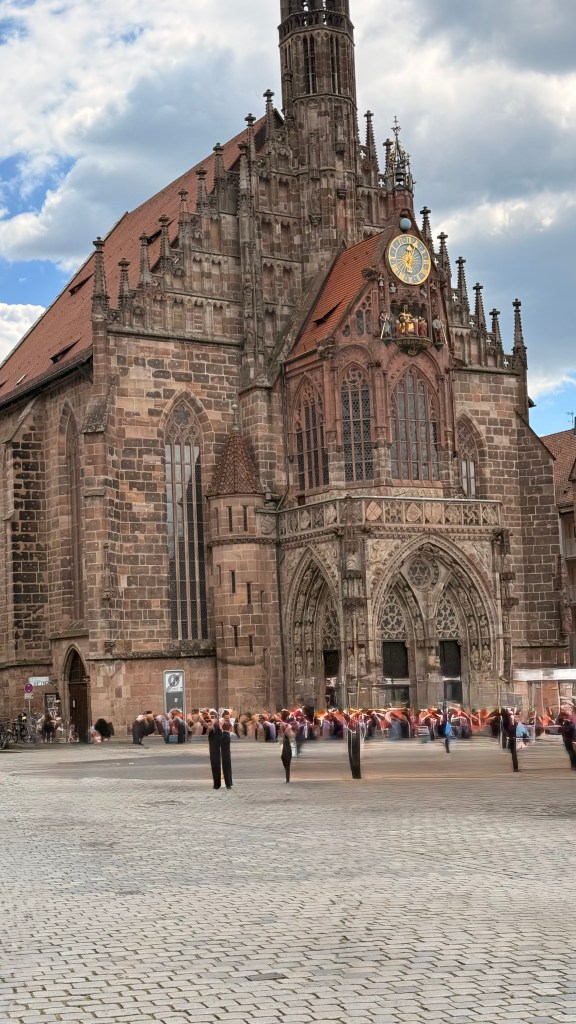
The Cologne Cathedral took more than six hundred years to complete. Standing beneath its immense Gothic towers, it becomes difficult not to feel small in the best possible way. The cathedral carries not only architectural grandeur but centuries of devotion, conflict, survival, and faith. Tradition holds that it houses the relics of the Three Wise Men — the Magi — whose journey toward Bethlehem became one of the enduring stories of Christian tradition.
Europe, I am beginning to realize, does not separate history from daily life. It simply builds around it.
Nearby stands the great bridge over the Rhine, once destroyed by the Germans during the Second World War to slow advancing Allied forces. Today, the bridge has transformed into something entirely different — a love bridge lined with thousands upon thousands of padlocks left behind by couples hoping to symbolize permanence in a world where so little truly lasts.
The contrast felt deeply human.
War and romance. Destruction and devotion. History constantly reinventing itself.
The story of Agrippina the Younger also surfaced during the day, another reminder that ambition, political maneuvering, and the pursuit of power are hardly modern inventions. Empires rise, schemes unfold, rulers manipulate one another, and eventually nearly all are met by the same ending. Time humbles everyone eventually.
And yet, perhaps the most enduring image of the day had nothing to do with emperors, cathedrals, perfume, or war.
It was a child playing in the cold with enormous soap bubbles floating through the air.
In the middle of brisk weather and grey skies, he seemed entirely unconcerned with history, politics, or the weight of the world. He chased the bubbles with complete absorption and joy, and for a moment I was unexpectedly carried back toward my own childhood — toward that brief season of life when wonder came easily and tomorrow rarely entered the mind.
Perhaps that is another quiet gift of travel.
Not only discovering new places, but recovering forgotten parts of oneself.
Eventually the rain intensified, and we made our way back toward the ship through chilly streets and damp air, grateful for warmth, dry clothes, and the familiar comfort of returning onboard.
Tomorrow, the river changes character.
Ahead lies the scenic corridor of the Rhine Gorge.
And so tonight, sleep comes easily.
⸻
“The world is full of magic things, patiently waiting for our senses to grow sharper.”
— W. B. Yeats
Reflection
Sometimes the grandest memories of travel are not the monuments themselves, but the fleeting human moments that quietly unfold beside them.
Simply O.
Day 5 — Castles, Rain, and the River of Legends
I woke early this morning, long before most of the ship had fully stirred to life. Coffee in hand, I made my way to the upper deck with one mission in mind:
To find Lorelei.
The weather, however, had other ideas.
It was wet, windy, and surprisingly cold for May, the kind of cold that settles into your fingers and reminds you that rivers answer to no itinerary. But I refused to let the weather dull my enthusiasm. From roughly eight in the morning until nearly half past eleven, I remained on the deck in alternating cycles of determination and retreat — photographing castles in the rain, then ducking briefly inside to warm up before heading back out again.
Eventually the sun appeared in fragments, scattered between clouds and mist. I did not complain. After hours in the cold, even brief sunlight felt like a gift.
Today we sailed through what many consider the scenic heart of the journey: the Upper Middle Rhine Valley, a UNESCO World Heritage Site famous for its extraordinary concentration of medieval castles, vineyards, and river villages.
And there were castles everywhere.
Perched high above cliffs. Hidden among vineyards. Standing watch over bends in the river as they have for centuries.
At times the scenery felt almost theatrical, one castle appearing on the left bank only for another to emerge moments later on the right. Someone aptly referred to this stretch as “Castle Ping Pong,” and once the phrase entered my mind, I could not unsee it.
Photographically, this was the day I had quietly anticipated from the beginning of the trip.
I mounted the 70–200 lens onto my Canon EOS 5DS R, set the autofocus to AI Servo, and spent hours tracking castles through mist, rain, and shifting light. I suspect I photographed nearly every named castle we passed.
But the true object of pursuit was still Lorelei.
At approximately 8:30 in the morning, on the port side of the ship near kilometer marker 555, we passed the legendary Lorelei Rock itself. According to German folklore, Lorelei was a beautiful maiden who sat atop the rock combing her golden hair, luring distracted sailors toward destruction with her singing.
This morning, however, she did not appear.
No golden hair. No singing voice. Only her name painted quietly upon the river marker as the Rhine moved steadily onward beneath grey skies.
And somehow, that felt fitting too.
Legends often survive precisely because they remain partly unseen.
After the long cold morning on deck came one of the more comforting moments of the day: a warm glass of traditional Rüdesheimer coffee prepared carefully by the ship’s crew. The warmth alone felt restorative.
Later we arrived in Rüdesheim am Rhein. Guests had the option of boarding a small train to lunch at the historic Rüdesheimer Schloss, but we chose instead to walk leisurely through town. The pace felt appropriate for the day.
Lunch conversation drifted naturally toward retirement, purpose, and the strange adjustment of stepping away from careers that once consumed so much of life. What struck me most was how few regrets seemed present among those who had already crossed fully into retirement years ago.
Again and again, the same realization surfaced:
The hardest part is not retirement itself. The hardest part is making the decision to let go.
And slowly, I feel myself arriving there too.
The afternoon brought a visit to Siegfried’s Mechanical Music Cabinet, a museum filled with intricate mechanical musical instruments, some dating back to before the First World War. Entire orchestras once operated mechanically, long before modern electronics transformed music forever. Watching those instruments perform felt strangely moving — technology from another era still carrying melody forward through time.
The weather remained stubbornly cold and damp, causing many guests to abandon plans for bicycle excursions. Instead, we chose a slower path, eventually taking a cable car high above the vineyards and river below.
From above, the Rhine curved through the landscape with quiet authority, winding through towns and hills in a way that reminded me faintly of the Thames in London — though older somehow, more layered with memory and legend.
The higher we climbed, the colder the air became.
We stepped off briefly at the summit, walked through the chilly wind, and took a few photographs overlooking the valley before making our way slowly back down toward town and eventually the ship.
By five in the evening we were back onboard.
A two-hour nap followed — one of those deep travel sleeps earned only after cold air, walking, photography, and long hours outdoors.
Dinner later that evening was excellent, followed by a simple Cointreau and Coke before I headed directly to bed.
Tomorrow, the journey continues.
But tonight, after castles, rain, legends, and rivers, rest felt entirely deserved.
⸻
“There is nothing more beautiful than the way the river flows, ignoring all explanations and theories.” — Marty Rubin
Reflection Some of the most memorable travel days are not the warmest or easiest ones, but the days when discomfort quietly gives way to wonder.
Simply O.
Day 6 — Locks, Waterways, and the Quiet Genius of Engineering
Today began more slowly.
After nearly fifteen thousand steps the previous day — castles, hills, cable cars, rain, and cobblestones — both body and feet demanded a quieter pace. So we allowed ourselves the luxury of sleeping later than usual before eventually making our way to a light lunch onboard.
By now, the rhythm of river cruising is beginning to settle into us.
Not rushed. Not idle. Simply unhurried.
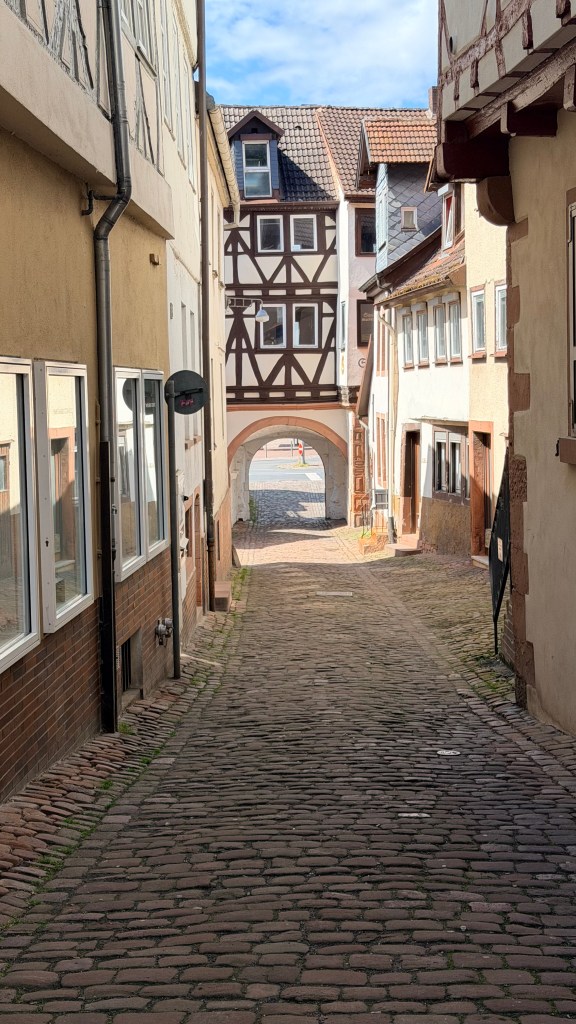
Later in the day, the ship made an unscheduled stop in the charming town of Miltenberg, one of those places that seems to exist comfortably outside modern urgency. Cobblestone streets stretched in every direction, lined with timbered buildings and centuries of accumulated history.
One detail stood out immediately: flood barriers positioned throughout the town, engineered so they can reportedly be erected within minutes whenever the river rises. Living beside rivers in Europe means living not only with beauty, but also with memory and preparedness.
We wandered slowly through the town center, passing the old town hall, the Giant Inn, the local history museum, the main bridge, and the Würzburg Gate. Somewhere along the way, I stopped at a perfumery and purchased a couple of fragrances — perhaps an appropriate continuation after our earlier encounter with the history of Cologne perfume.
But today was not really about towns.
Today was about canals, locks, elevation, and the astonishing infrastructure quietly carrying us across Europe.
By the end of this journey, we will have passed through sixty-eight locks.
Thirty-four of them lie along the Main River alone as the ship gradually rises through a carefully engineered staircase of water toward the Main-Danube Canal and eventually the Danube itself.
I had never fully appreciated before how much river cruising is also an engineering story.
The idea itself dates back centuries. As far back as the year 793, Charlemagne attempted to create a navigable water route linking major European river systems. His early canal project ultimately failed after heavy rains caused the excavation to collapse.
And yet the dream endured.
The modern Main-Danube Canal — the 171-kilometer stretch we travel today — was finally completed in September 1992 after generations of planning and engineering.
The Danube itself, the longest river in the European Union, stretches approximately 2,850 kilometers from Germany’s Black Forest all the way to the Black Sea. Even the kilometer markers reflect the river’s scale and perspective: they begin at the Black Sea as kilometer zero and count backward upstream toward the source.
River cruising, I am learning, is not merely scenic travel.
It is a moving lesson in human ingenuity.
The locks themselves function like giant water elevators. One by one, ships enter these enclosed chambers as gates close behind them. Water begins entering slowly — at first almost imperceptibly — before building into a powerful controlled surge. Gradually the ship rises until the water level matches the next section of canal, the forward gates open, and a green light signals permission to continue onward.
Then the process repeats.
Again and again.
Watching it unfold never quite loses its fascination.
At times the system resembles a staircase made not of stone, but of water and steel, lifting ships across changing elevations through the heart of Europe toward the Black Sea.
And then there are the bridges.
Low bridges often signal the approach of a nearby town, the ship gliding carefully beneath them with surprising precision. From the comfort of the cabin, one can even watch villages drift by quietly on the television feed, though I still prefer standing near the windows or deck whenever possible.
As I watched yet another lock chamber fill this evening, I found myself wondering why rivers do not simply flow naturally into one another according to gravity alone. Of course they once did. But over centuries humanity learned not merely to navigate rivers, but to shape, redirect, elevate, and control them.
For better or worse, human beings possess a relentless instinct to reshape the world around them.
Yet here, at least, that ingenuity feels constructive rather than destructive.
These waterways connect nations, histories, economies, and cultures through movement rather than division.
Still, one question lingered in my mind:
What happens when winter arrives and the water freezes?
Perhaps every great engineering achievement remains, in some way, still subject to nature’s final authority.
The evening ended quietly — dinner, a little trivia onboard, and then back to the room as the ship continued its patient passage through lock after lock under the night sky.
And just as I wrote at the beginning of the day:
Today was about canals, locks, and low bridges.
But perhaps, beneath all of that, it was also about humanity’s enduring desire to connect worlds that once seemed impossibly far apart.
⸻
“A river cuts through rock not because of its power, but because of its persistence.” — James N. Watkins
Reflection : Travel through Europe’s waterways reveals not only the beauty of nature, but also the extraordinary lengths humanity has gone to in order to move, connect, trade, and dream across it.
Simply O.
Day 7 — Stone, Light, Wine, and the Contradictions of Civilization
This morning began quietly with the now-familiar rhythm of locks and canals, though that belonged more to yesterday’s story than today’s. Today was about architecture, wine, memory, and the strange contradictions that seem to follow civilization everywhere.
As we sailed deeper into Bavaria, the vineyards appeared almost sculpted into the hillsides, as though nature and human ambition had entered into some long-standing agreement centuries ago. Rows of vines flowed down the slopes in perfect order, too deliberate to feel accidental, yet somehow still harmonious with the land itself.
Perhaps that was fitting, because today would become as much about wine as architecture.
Every region we pass through seems convinced it produces the finest wine in the world. From Europe to Africa, from the Americas to Australia, each carries its own traditions, its own soil, its own certainty. And perhaps they are all right in their own way. Taste, like memory and beauty, often belongs more to the person experiencing it than to any objective truth.
After a light breakfast we disembarked at Würzburg, where the day unfolded through cathedrals, medieval streets, wine cellars, and stories layered across centuries.
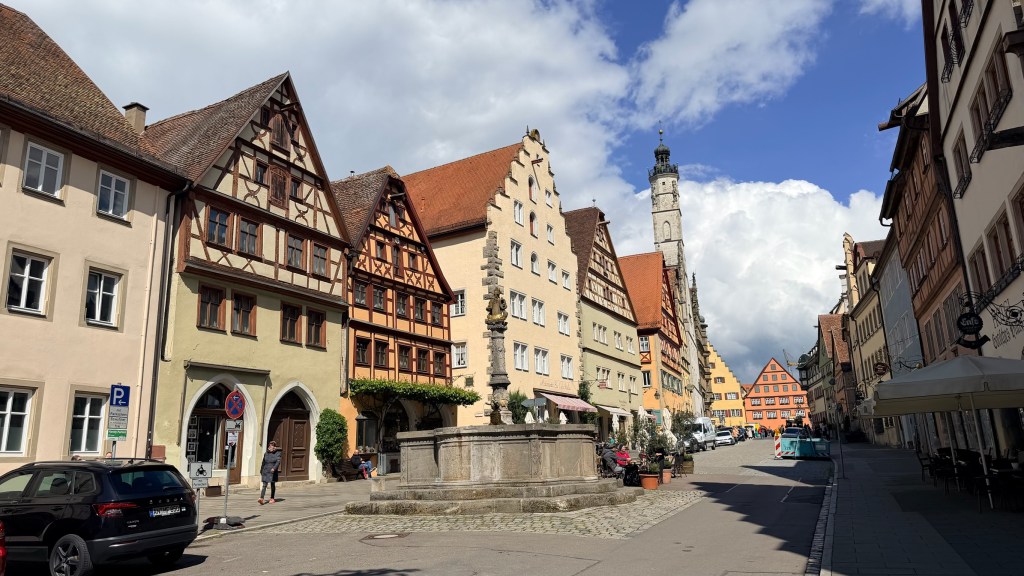
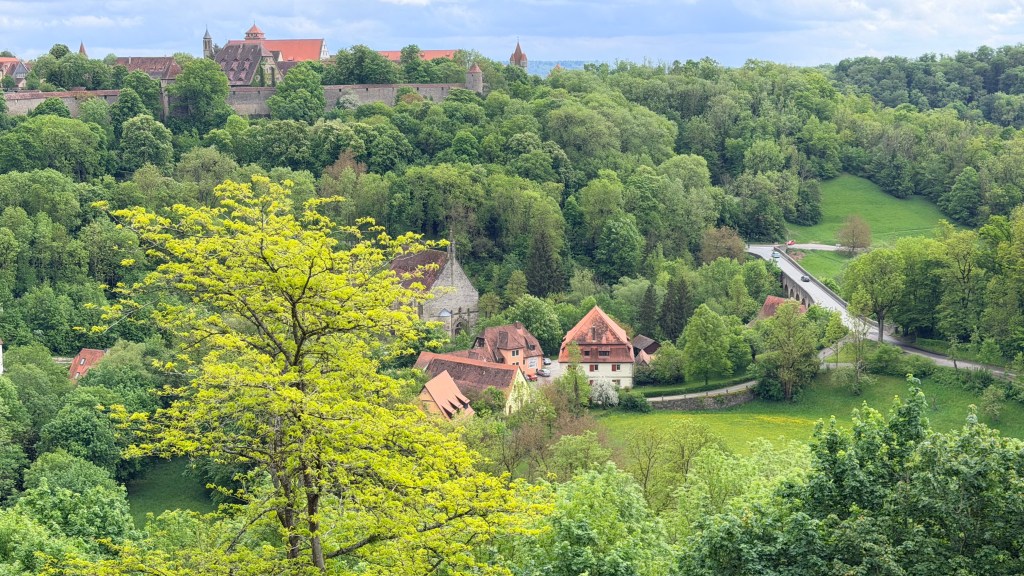
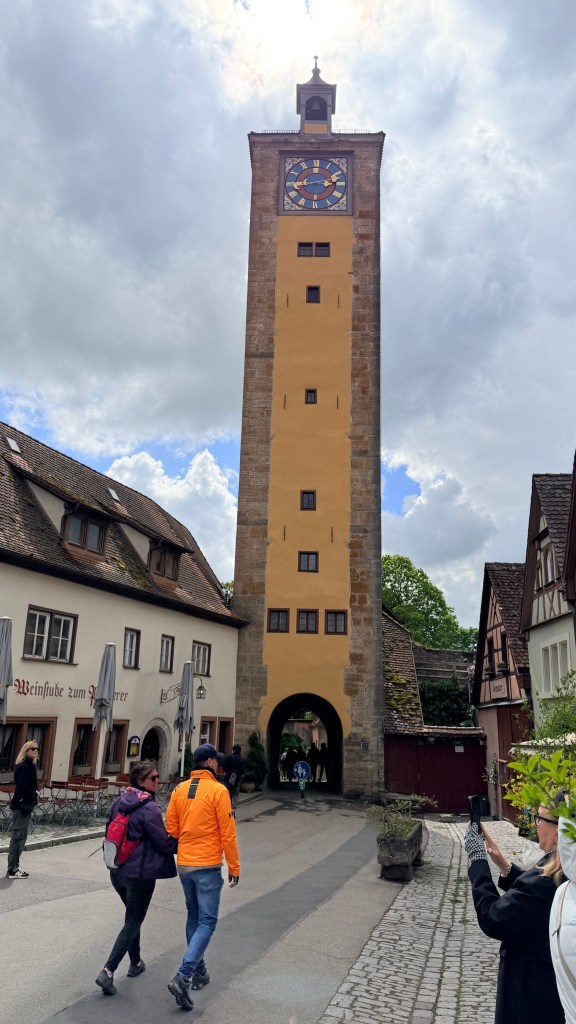
The drive toward Rothenburg ob der Tauber was picturesque in the way only rural Europe seems capable of being — green fields stretching into the distance, vineyards glowing beneath soft light, church towers rising unexpectedly from quiet villages. It felt less like driving through a region and more like passing through a painting.
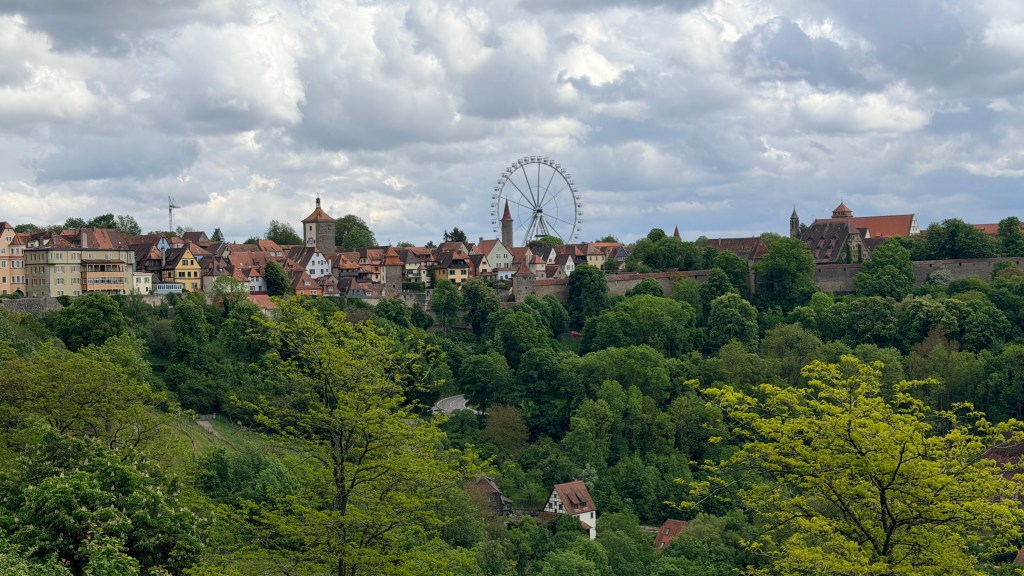
Rothenburg itself seemed suspended somewhere between history and fairytale.
The streets were ancient enough that one felt every century beneath their feet. Thick cobblestones tested even the cushioning of HOKA shoes, a reminder that if one walks through a 600-year-old town, one also walks on 600-year-old roads.
Yet despite the beauty, the stories carried weight.
We learned how the town survived largely because history and commerce eventually moved elsewhere, leaving it frozen in time. We heard of war, destruction, and the uneasy relationship between beauty and politics during the Second World War. Once again, Europe revealed its familiar contradiction: breathtaking beauty standing beside painful memory.
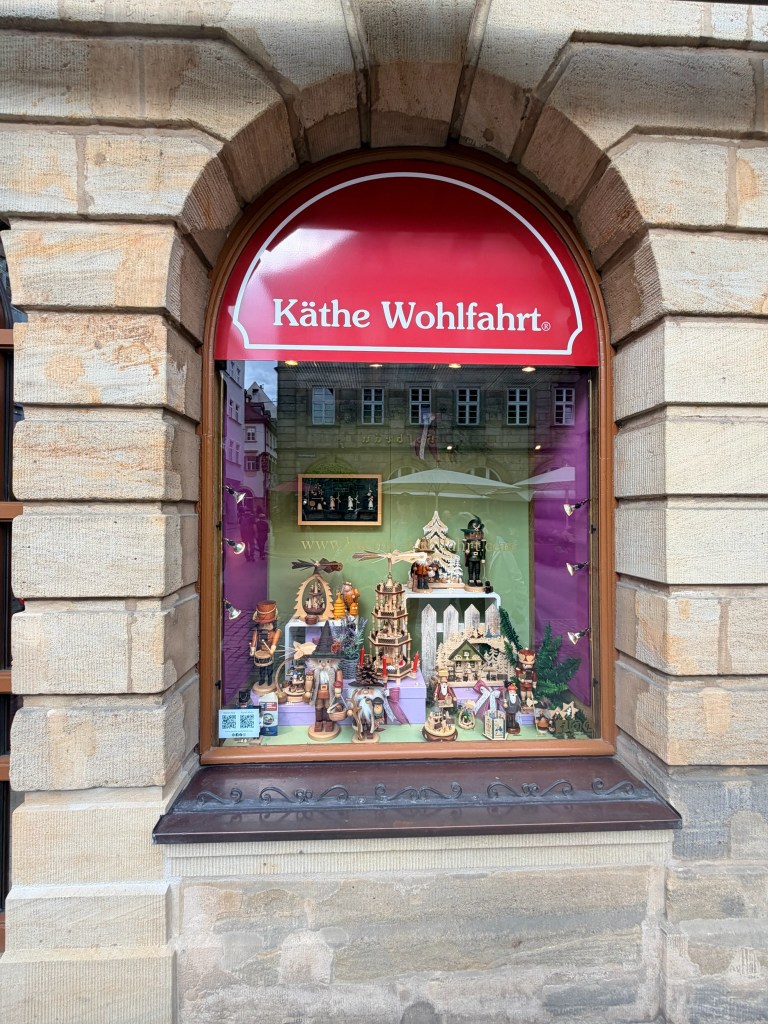
Tucked into one corner of the town was the inspiration for Pinocchio, almost hidden quietly among the medieval streets. Nearby, Christmas seemed permanently alive here. Rothenburg is often called the birthplace of Germany’s Christmas traditions, and even in spring one could imagine snow falling softly through these narrow lanes, lights glowing warmly against timber-framed houses.
Then came the churches.
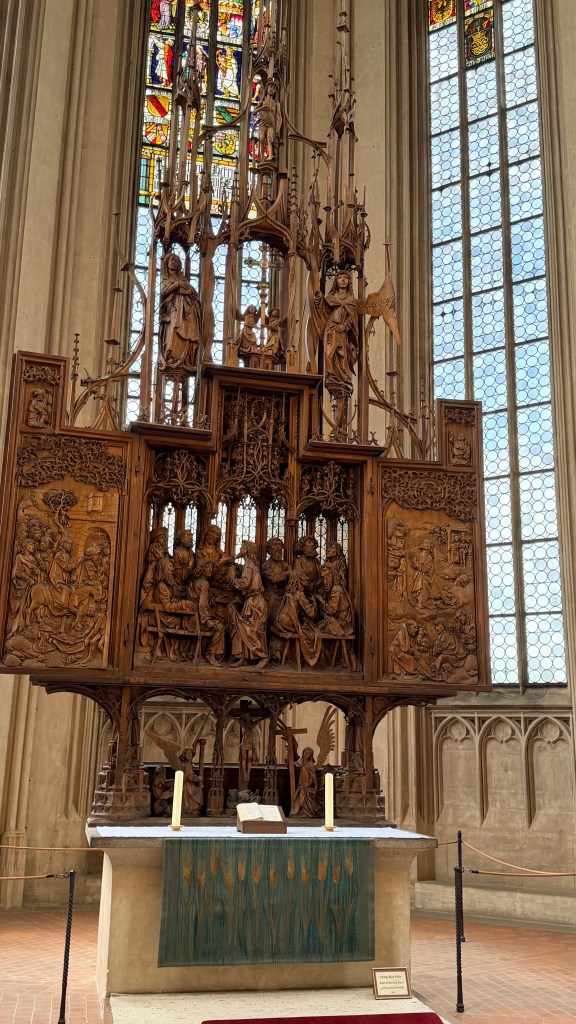
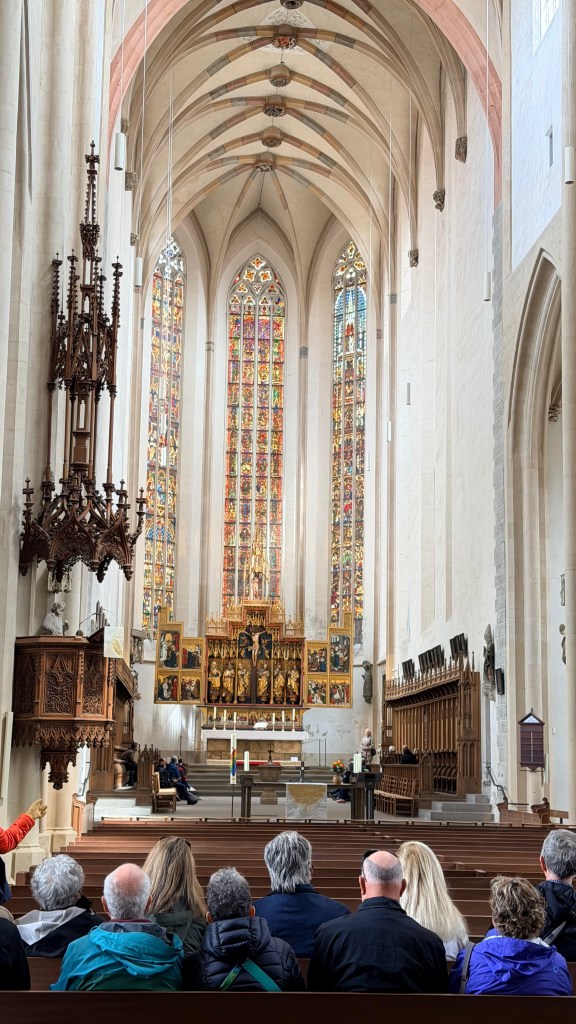
Today’s lectures and visits carried us from Romanesque architecture to Gothic and finally Baroque — thick protective walls evolving into soaring ceilings, stained glass, flying buttresses, and finally the theatrical grandeur of Baroque ornamentation. It became clear that architecture is never simply about buildings. It is about how civilizations understand God, power, beauty, and themselves.
Inside one church, I found myself unexpectedly moved by the nativity sculptures and the silence surrounding them. For centuries people have entered such spaces carrying grief, fear, hope, illness, uncertainty, and burdens invisible to others. Standing there quietly, I hoped perhaps I too could leave some small baggage behind.
I was also intrigued to learn that Wilhelm Roentgen, the inventor of the X-ray machine, once taught here. Somehow that felt symbolic. This journey increasingly feels less like sightseeing and more like an X-ray itself — revealing hidden layers beneath places, histories, and even within oneself.
And then came the difficult thought that lingered throughout the day.
In a country filled with churches and cathedrals, how did such darkness once emerge? How did hatred survive in places built for worship?
The question stayed with me as we moved through cities repeatedly scarred by war and rebuilt again through memory and human resilience. Perhaps one of history’s great contradictions is that religions meant to elevate humanity have at times also divided it. The same institutions built to save souls have sometimes participated in losing them.
Yet by evening, the mood softened.
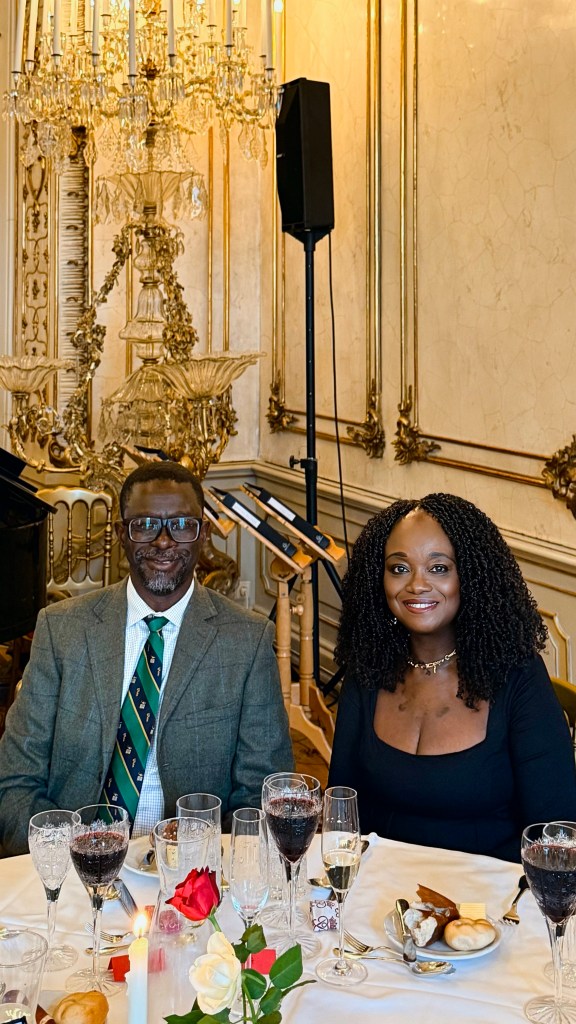
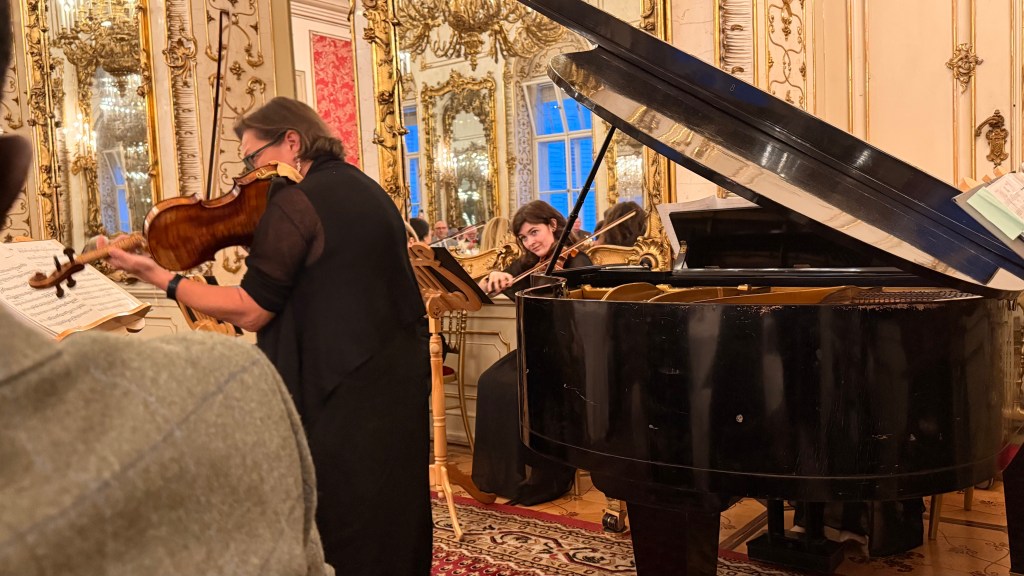
After dinner we were entertained by an astonishingly gifted 21-year-old violinist who carried us effortlessly from Pirates of the Caribbean to Elton John’s Lion King, from personal compositions to Louis Armstrong’s What a Wonderful World.
And perhaps that became the true conclusion of the day.
After all the reflections on war, religion, destruction, architecture, and human frailty, music entered quietly and restored something simple and universal.
The theme of the evening was beautifully stated:
“Where hate ends, music begins.”
And for a little while, as the violin echoed through the ship and the rivers of Europe continued carrying us eastward through the darkness, it truly did feel like a wonderful world.
Simply O.
Simply O.
Day 8 — Bamberg, Memory, and the Architecture of Humanity
Today we started later.
Our feet finally demanded rest after days of pacing cobblestone streets and centuries-old floors worn smooth by generations long gone. Yet beneath the physical fatigue another theme had quietly begun to emerge throughout this journey — the unsettling realization of the evil ordinary people are capable of when fear, power, ideology, and war combine.
This morning my thoughts drifted repeatedly toward Benjamin Berell Ferencz.
Born into poverty in the collapsing ruins of the Habsburg Empire to illiterate parents, raised in immigrant hardship, and shaped within a multilingual world, he would eventually become a Harvard-trained lawyer, a U.S. Army investigator, and ultimately the youngest prosecutor at the Nuremberg Trials — leading what became the largest murder trial in human history despite never having tried a case before.
Later he would help lay the intellectual foundation for the International Criminal Court in The Hague, dedicating his life to the belief that law, imperfect as it may be, must stand against humanity’s instinct toward destruction.
Ferencz believed that war itself unleashes evil.
Not that human beings are inherently monstrous, but that war systematically dehumanizes people until atrocities become imaginable, then acceptable, then routine.
How else, one wonders, do ordinary men march fellow human beings toward extermination?
And yet despite witnessing evidence of horrors almost beyond comprehension, Ben Ferencz remained remarkably optimistic about humanity until the very end of his life. That may be the most astonishing thing about him.
A man who spent his life documenting evil still believed in human goodness.
The “smallest giant,” as many called him, understood perhaps better than most that remembrance itself is a moral responsibility.
Germany, to its credit, does not entirely look away from its past. Again and again throughout this journey, one encounters reminders — memorials, preserved ruins, plaques, stories, bridges, rebuilt cities, and names carved into stone — almost as if the country is consciously warning future generations that there are lines civilization must never cross again.
So we began this morning in a reflective and somewhat somber mood as the ship carried us onward toward Bamberg.
And then the city appeared.
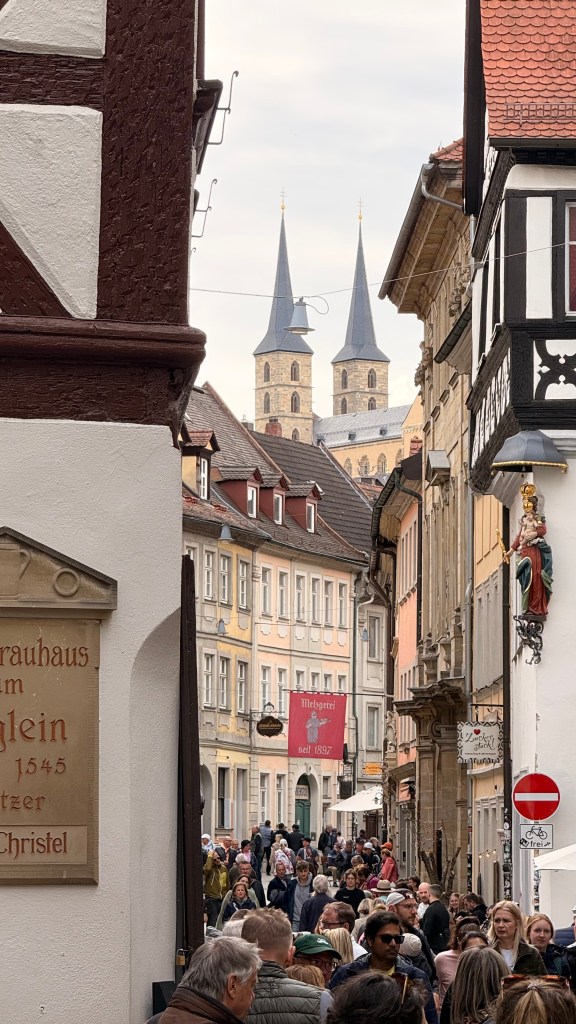
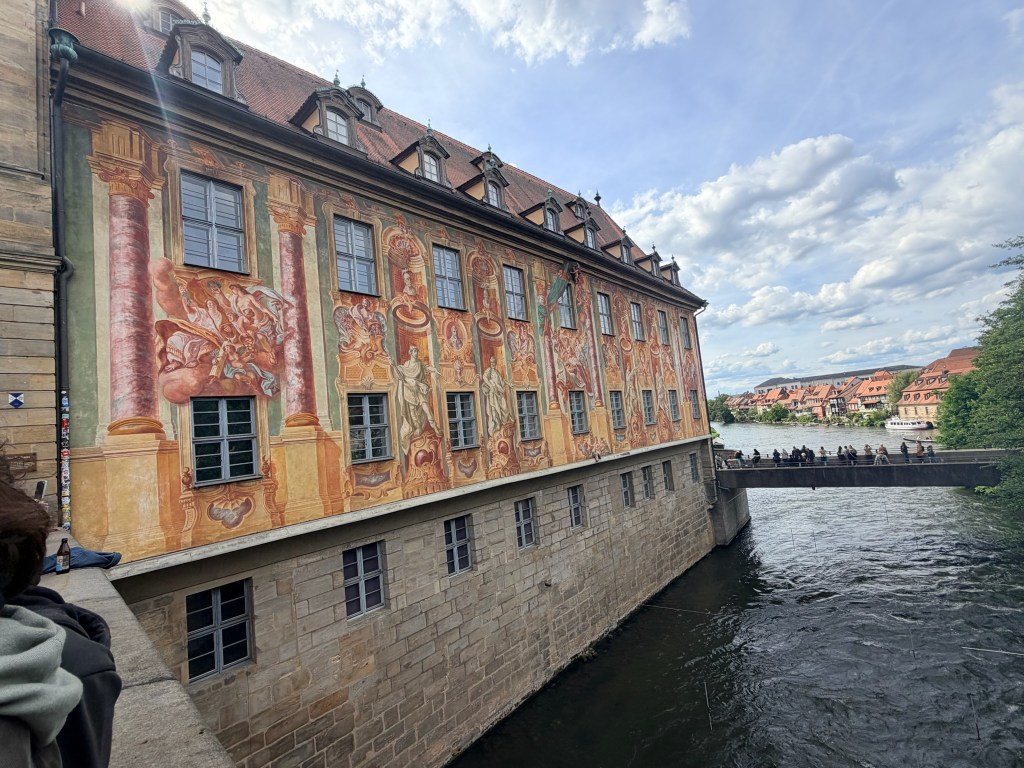
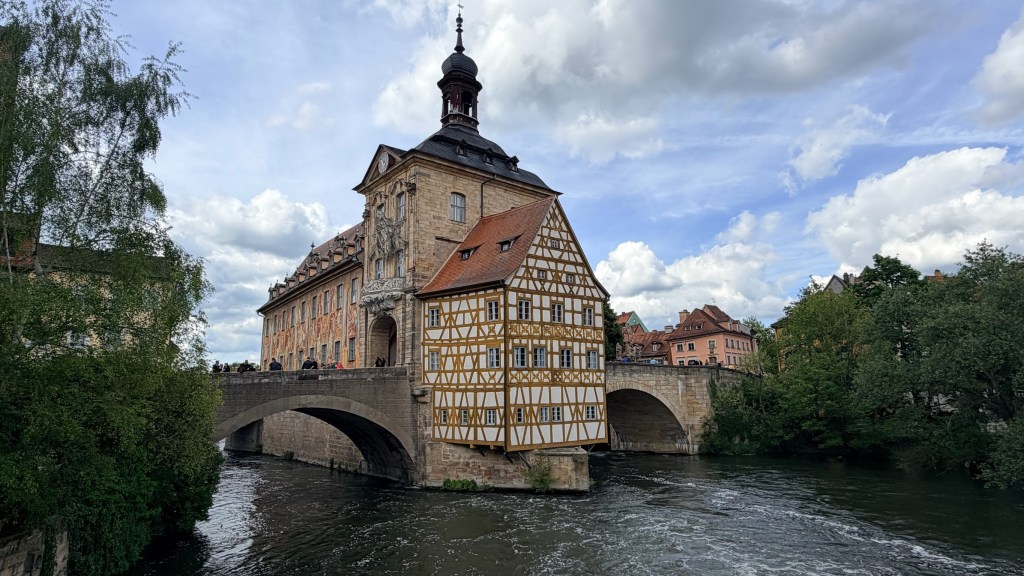
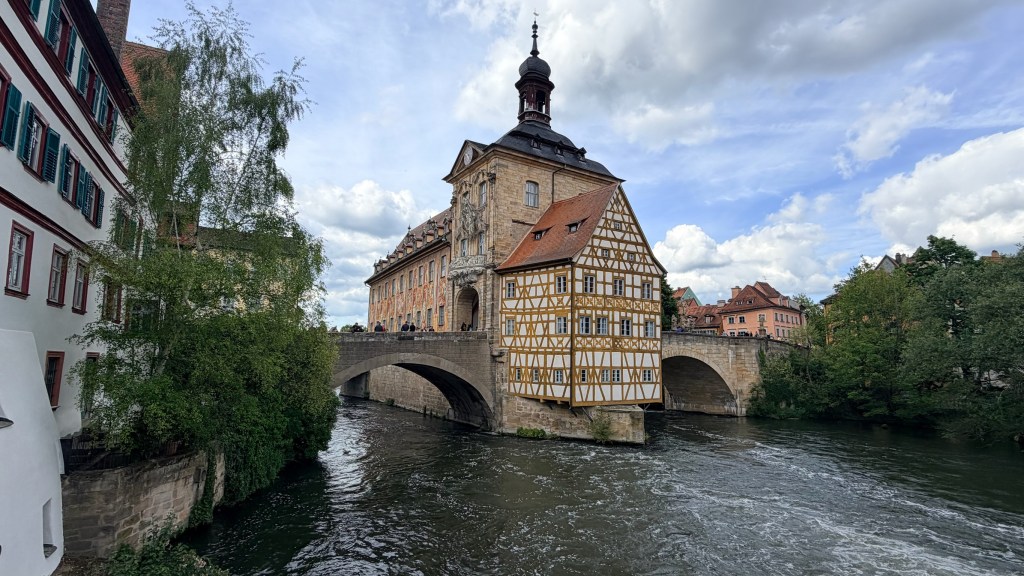
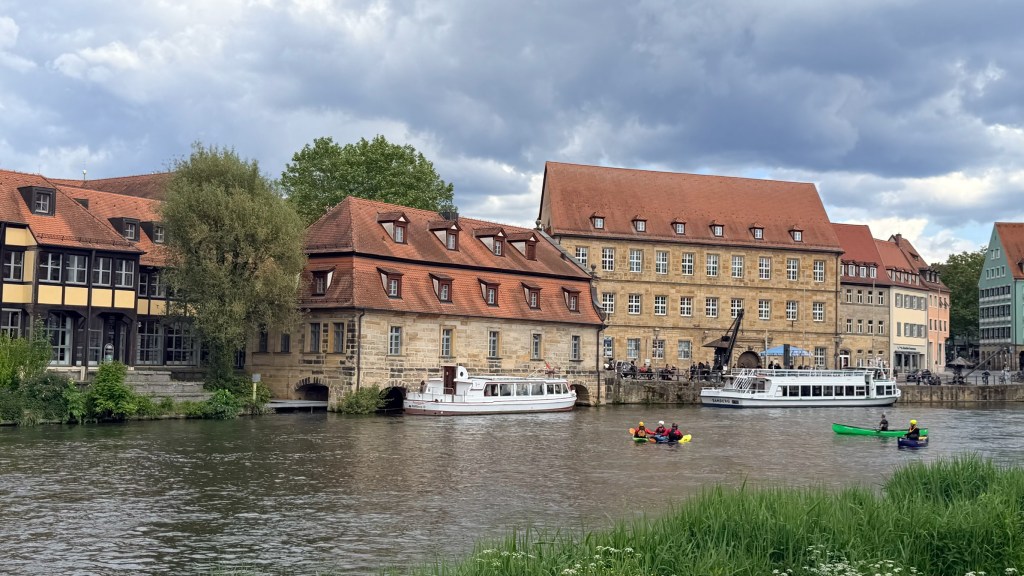
Bamberg feels almost impossibly preserved. Built across seven hills and often called the “Franconian Rome,” the city rises out of the river landscape with cathedrals, monastery towers, bridges, and medieval rooftops layered across centuries.
The older I become, the more I realize that Europe’s greatest charm may not simply be its beauty, but its age.
America often feels young, kinetic, forward-looking. Europe feels remembered.
Its cities do not merely exist in the present; they visibly carry the accumulated weight of what came before them.
Walking through Bamberg, one quickly sees that the city itself is structured almost like a medieval worldview made physical.
High above the hills stood the churches, monasteries, and cathedral — the domain of spiritual and political authority ruled for centuries by Prince-Bishops. Below lay the commercial center where merchants, craftsmen, fishermen, and traders carried out daily life beside the waterways. Beyond that stretched the agricultural lands and vineyards that sustained the city itself.
Faith above. Commerce below. Fields surrounding it all.
A civilization organized not only geographically, but philosophically.
And remarkably, much of that structure still survives today.
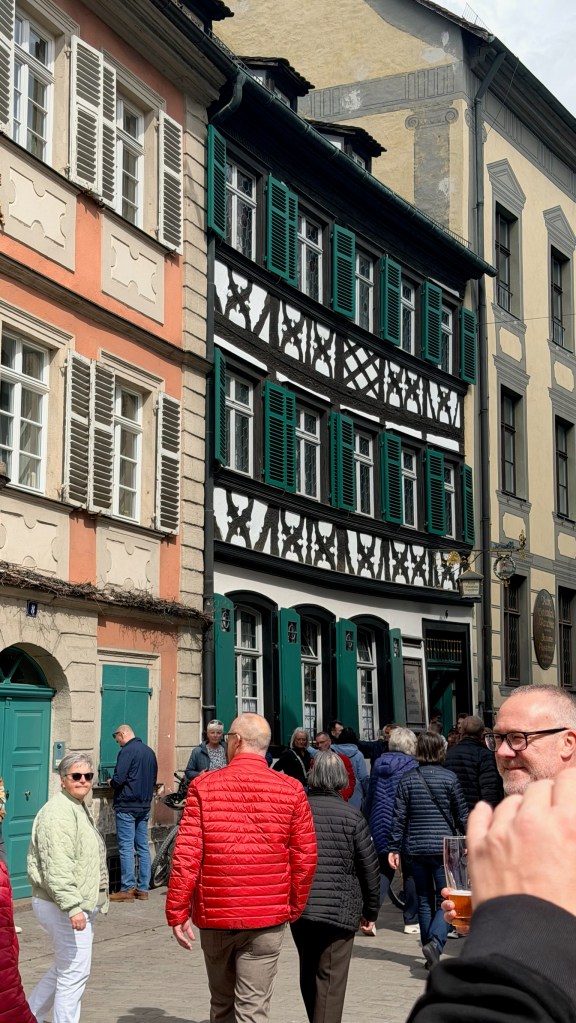
The churches still dominate the skyline. The markets still cluster near the river. The old timber-framed merchant houses still lean over narrow streets and canals.
History here does not feel erased. It feels layered.
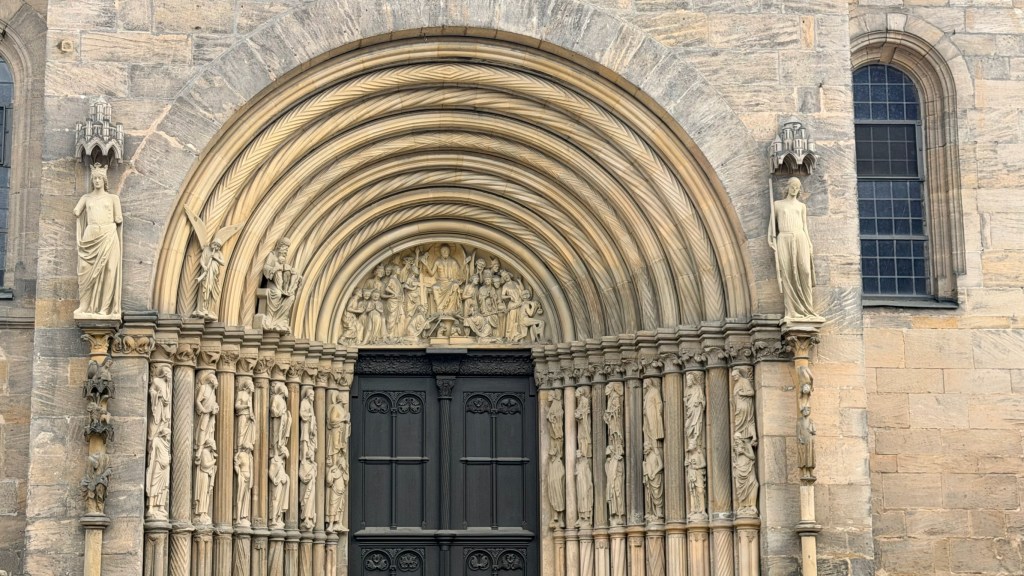
The cathedral itself tells the story of Europe’s evolution through stone.
The Romanesque sections speak in thick walls, rounded arches, and small windows — architecture designed for permanence, protection, and endurance. Then came the Gothic additions with pointed arches and soaring verticality, architecture reaching upward toward heaven itself.
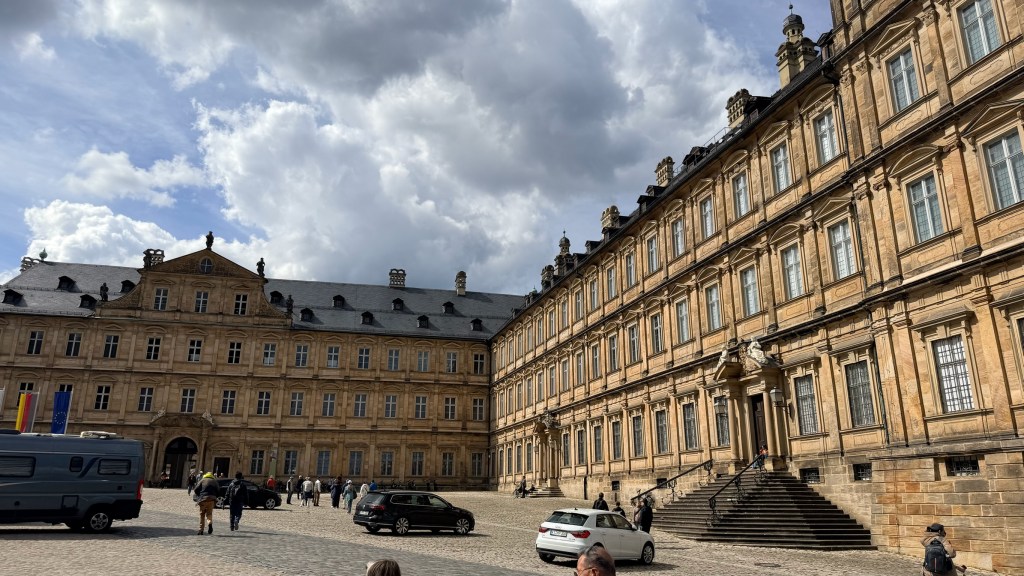
And finally the Baroque era arrived.
Baroque architecture feels almost theatrical — wealth, spectacle, ornamentation, and power carved into stone.
One Prince-Bishop apparently became so consumed by construction projects that he once admitted in a letter that he and his family had become “victims of the building worm.” Money eventually ran out before all the projects could be completed, which ironically preserved Bamberg’s layered architectural identity: Romanesque beside Gothic, Renaissance beside Baroque, centuries standing shoulder to shoulder.
Europe often feels this way: not frozen in time, but accumulated through time.
At the cathedral itself, the conversation shifted from architecture to something more unsettling.
One façade depicted the Last Judgment — Christ seated centrally while kings, bishops, wealthy men, and even a pope appeared among the damned being dragged toward hell by devils in chains.
The symbolism was impossible to ignore.
No earthly authority, not even religious authority, guaranteed moral innocence.
Eight hundred years later, the observation still feels painfully relevant.
Inside the cathedral stood another symbolic contrast: one elegant female figure representing the triumphant Church, while opposite her stood a blindfolded representation of Judaism — theology and power encoded into stone.
Again I found myself confronting the paradox that has quietly followed us throughout this trip:
How could societies capable of building such transcendent beauty also produce exclusion, persecution, conquest, and war?
Perhaps because human beings themselves contain both impulses simultaneously.
The same civilization capable of composing Bach, building cathedrals, and carving saints into marble also marched millions into destruction within living memory.
And yet somehow humanity continues rebuilding.
That thought stayed with me as we crossed Bamberg’s bridges and wandered its medieval streets. Along the river stood old merchant houses where goods once arrived by boat. Smoke beer breweries still produce flavors born centuries ago when malted barley was dried over open flames. Tiny canals flowed quietly beneath bridges once crowded with traders and fishermen.
Even the city’s survival carries historical irony.
Unlike many German cities devastated during World War II, Bamberg emerged relatively untouched, preserving over a thousand years of architectural continuity. Walking through it feels almost like entering a preserved memory of medieval Europe itself.
At one overlook, Bamberg’s rooftops and cathedral towers stretched across the hills in layered waves of history, each century leaving visible traces behind.
And perhaps that is what all civilizations ultimately attempt: to leave evidence that they existed.
Some leave cathedrals. Some leave palaces. Some leave laws. Some leave music. Some leave warnings.
Ben Ferencz left a warning.
That civilization is far more fragile than we imagine. That ordinary people are capable of extraordinary cruelty under the right conditions. But also that memory itself may be one of humanity’s greatest safeguards.
As evening settled over Bamberg and the river reflected the fading light, I found myself thinking about how Europe constantly holds beauty and sorrow side by side.
Cathedrals beside memorials. Music beside memory. Rivers beside ruins. Faith beside human failure.
And perhaps maturity itself is learning to hold both truths simultaneously without looking away from either.
Tomorrow the river carries us onward again.
But Bamberg lingers. Not simply as a beautiful city — but as a reminder that history is never entirely past, and humanity is always capable of becoming either better or worse depending on what we choose to remember.
“Peace is not the absence of conflict, but the presence of justice.” — Benjamin Ferencz
Simply O.
Day 9 — Nuremberg: Where Memory Refuses to Stay Silent
Yesterday we reflected on the “little giant,” Benjamin Ferencz. Today, we stood in the place where his work became part of history.
This morning we arrived in Nuremberg, a city nearly a thousand years old, yet remembered by much of the world for perhaps its darkest twelve years. That is one of history’s cruel imbalances: centuries of art, trade, faith, music, and ordinary life can be overshadowed by the brief season when evil was allowed to grow.
And when evil is allowed to grow, it flowers.
Nuremberg began not in darkness, but in story. Its first recorded mention dates back to 1050, connected to the freeing of a young woman named Sigena, whose release from servitude was recorded in a document signed by the Holy Roman Emperor. A city whose documented beginning was tied to freedom would, centuries later, become tied to laws that stripped others of freedom, citizenship, dignity, and life.
That contradiction stayed with me.
The rivers have always flowed through these lands, but they do not wash away the weight of history. Perhaps that is not their role. Perhaps their role is simply to carry us beside memory, leaving us to decide whether we will learn from it.
We began with the Nazi Party Rally Grounds, where scale itself was weaponized. The buildings were designed not merely to gather people, but to overwhelm them. Everything was meant to diminish the individual and magnify the leader — columns, flags, lights, music, crowds, marching bodies, and architectural imitation of ancient Rome.
The goal was not discussion. It was devotion.
People who had been humiliated by economic collapse, unemployment, and national defeat were invited into a mass identity where the individual became nothing and the “people” became everything. It is frightening how seductive belonging can become when dignity has been wounded.
The unfinished Congress Hall, modeled after the Roman Colosseum, was never completed. Yet even unfinished, its ambition remains chilling. It was meant to appear even larger through reflection on the lake, doubling spectacle through illusion. Again and again, one sees how authoritarian movements understand theater, symbolism, and emotion.
Evil rarely announces itself first as evil.
It often arrives dressed as order, pride, restoration, grievance, and belonging.
Later we entered Courtroom 600 at the Palace of Justice, where the Nuremberg Trials took place. The room itself is smaller than imagination expects, but the moral weight of it is enormous. Here, after the war, the world attempted something extraordinary: not revenge by firing squad, but judgment by law.
That distinction matters.
There had been calls for swift execution. But the decision was made to hold trials — imperfect, difficult, controversial, but trials nonetheless. Evidence would be presented. Defense attorneys would be provided. Charges would be specified. The accused would be judged not as abstractions, but as individuals responsible for choices made within a machinery of cruelty.
In that courtroom, the world saw concentration camp footage publicly presented as evidence. One can only imagine the silence that must have followed. Images so horrific that even language becomes inadequate.
And yet law stood there.
Fragile perhaps. Late certainly. But present.
This is where men were tried for conspiracy against peace, crimes of aggression, war crimes, and crimes against humanity. This is where the architecture of accountability began to take modern shape. This is where the idea emerged more clearly that there are crimes so vast they offend not only nations, but humanity itself.
That is why Benjamin Ferencz returned so strongly to my thoughts.
As the youngest prosecutor at Nuremberg, he stood before the world with evidence of mass murder and insisted that law must answer barbarism. He had seen what human beings could do when war removed the restraints of conscience, yet he still believed in justice. He still believed humanity could learn.
I find that remarkable.
A man who saw the worst of mankind still chose hope.
Walking through Nuremberg’s old city afterward, the contrast was almost disorienting. Medieval walls still stand. The old market square still gathers people. Churches still rise into the sky. The beautiful fountain, protected during the war, still remains. The city carries Albrecht Dürer, ancient walls, Christmas markets, sausages, bridges, and everyday life alongside the memory of rallies, racial laws, trials, and destruction.
This is Europe again: beauty and sorrow side by side.
The persistent question remains for me: how does such evil grow in places filled with cathedrals, churches, and religious language? How does mankind repeatedly betray the simple creed to do unto others as we would have done to ourselves?
Perhaps religion alone cannot save us from ourselves.
Faith may point toward goodness, but human beings must still choose it. Cathedrals can dominate skylines while hatred quietly enters hearts. Ritual can coexist with cruelty. Civilization can appear refined on the surface while moral decay spreads underneath.
That may be the hardest lesson of Nuremberg.
Evil does not always begin with monsters. Sometimes it begins with ordinary people surrendering their judgment, their empathy, and their courage.
Germany remembers this history publicly. It does not entirely hide from it. The rally grounds remain not as monuments to glory, but as warnings. Courtroom 600 remains not as a relic, but as testimony. Students, soldiers, police officers, and visitors come here to learn how such things happened, with the hope that knowledge may become resistance.
Whether humanity has truly learned the lesson remains uncertain.
But memory at least gives us a chance.
As we left Nuremberg, I thought again about the river. It keeps moving, indifferent and constant, carrying ships past old cities and wounded histories. It cannot cleanse the past. But perhaps it can carry witnesses toward understanding.
Today was heavy.
But some places are supposed to be heavy.
They remind us that civilization is not protected by beauty, intelligence, architecture, religion, or culture alone. It is protected only when ordinary people refuse to surrender their humanity.
⸻
Reflection: When evil is allowed to grow, it flowers. But when memory is preserved, perhaps humanity is given one more chance to uproot it.
Simply O.
Day 10 — Descent, Dynasties, and the Weight of Memory
Today the river changed direction — not geographically, but emotionally.
After days of climbing through canals and locks toward the continental divide, we began our descent eastward toward the Black Sea. There was something symbolic about it. The ship no longer struggled upward against elevation but surrendered gently to gravity, descending lock by lock along the Danube — that ancient artery that has carried traders, armies, emperors, pilgrims, and ideas across Europe for centuries.
The Danube is more than a river. It is a moving archive of civilization.
Flowing nearly 1,800 miles from Germany toward the Black Sea, it touches or borders ten countries, once serving as the frontier of the Roman Empire and now connecting modern Europe in a completely different way. Standing on deck this morning with only coffee for company, watching the mist lift from the water, I found myself thinking about continuity — how rivers outlive kingdoms, wars, ideologies, and even nations themselves.
Earlier in the journey we crossed the continental divide — that subtle geographic threshold where waters choose their destiny: one direction toward the North Sea, the other toward the Black Sea. There was no dramatic announcement from nature itself, only a quiet monument beside the canal. Yet the symbolism lingered. Sometimes the most important turning points in life are nearly invisible while they are happening.
By midmorning we arrived in Regensburg, one of Germany’s oldest and best-preserved medieval cities. The Old Town felt less like a museum and more like a place where history still breathes through stone. We walked past the great Stone Bridge spanning the Danube — begun in the 12th century and scarred repeatedly by wars, including destruction during World War II to slow advancing Allied forces. Nearby stood St. Peter’s Cathedral, whose construction stretched across centuries, another reminder that Europe often built not merely for one generation, but for many yet unborn.
That may be what fascinates me most here.
In America, we often think in decades. In Europe, history is measured in centuries.
Even the ordinary details carried stories. An old salt storehouse reminded us that Roman soldiers were once partly paid in salt allowances — from which the word salary is derived. Medieval towers rose above narrow streets, built by wealthy merchant families competing not unlike modern billionaires, except their ambition was measured vertically in stone rather than digitally in stock valuations.
And then there was the palace of Thurn & Taxis.
Originally part of a Benedictine monastery, the sprawling palace became the residence of the princely family that built one of Europe’s earliest postal empires. Their wealth began not through conquest or inherited monarchy, but through communication itself — organizing the movement of messages across Europe centuries before modern postal systems existed. Over time, that enterprise evolved into forests, estates, palaces, influence, and generational continuity so deep it almost feels geological.
The palace reportedly contains over 500 rooms — more than Buckingham Palace.
Yet oddly enough, amidst all the marble staircases, mirrors, chandeliers, tapestries, and gilded halls, what stayed with me most were the wooden pebble-patterned floors near the exit. Something about them felt human and grounding after so much grandeur.
Perhaps because beneath all inherited wealth lies the same human reality: people trying to preserve themselves against time.
One thought kept returning to me throughout the day: how profoundly the family we are born into shapes the trajectory of our lives. Yes, talent matters. Effort matters. Determination matters. One can rise, succeed, even become wealthy. But walking through places like this makes one realize how difficult it is to recreate the layered generational continuity that some European families have accumulated across centuries.
And yet history is never entirely fixed.
One of our guides turned out to be of Nigerian heritage — a first-generation immigrant in medieval Bavaria. I smiled at the irony. It is often said there is a Nigerian in every country in the world. If you look hard enough, you are almost certain to find one.
The world keeps mixing itself together.
Later we visited Walhalla, King Ludwig I’s great hall of fame overlooking the Danube, modeled after the Parthenon in Athens. Filled with busts and memorials to philosophers, scientists, artists, rulers, and cultural figures of the German-speaking world, it revealed something deeper than nationalism alone. Nations do not merely inherit memory; they curate it. They build monuments to tell future generations who mattered and why.
But perhaps the most powerful monuments are not built from marble.
Perhaps they are rivers.
The Danube remembers everything. The Romans. The emperors. The wars. The floods. The traders. The refugees. The music. The silence.
And tonight, as our ship continues its gradual descent eastward toward the Black Sea, it carries us too — briefly — into that long current of memory.
Simply O.
Day 11 — Salzburg: Salt, Music, Genius, and the Unfinished Lessons of History
This morning began early in Passau.
After days of castles, canals, locks, cathedrals, and cobblestones, comfortable shoes have become less of a recommendation and more of a creed. A light breakfast, coffee, and then a two-hour coach ride toward Salzburg — a city I had long associated with Mozart, The Sound of Music, and that familiar line from childhood: “The hills are alive…”
But before leaving the ship, the river reminded us again that water controls this journey. Because of low water levels on the Danube, the ship sat noticeably lower than usual. I could almost feel the bottom of the river beneath us, and we had to disembark from the top deck. Even in modern luxury travel, nature still has the final word.
The drive into Austria was beautiful — green fields, churches, villages, mountains, and that unmistakable Alpine atmosphere. Yet even here, history was never far away. We passed near Braunau am Inn, the town where Adolf Hitler was born, another reminder that ordinary towns can inherit unbearable historical weight. A place may have centuries of life before and after one dark association, yet history often remembers what wounds deepest.
Salzburg, thankfully, offered a gentler welcome.
And my feet were grateful.
The cobblestones finally gave way to kinder walking surfaces, and the city unfolded with Baroque elegance, mountain air, narrow streets, church towers, music, and café windows. Salzburg is one of those places where geography and culture seem inseparable. Water, salt, and the Alps meet here — and out of that meeting came wealth, beauty, power, and music.
Salt was king.
Long before gold became the symbol of wealth, salt sustained life, preserved food, fueled trade, and made fortunes. Salzburg’s very name carries the story: Salz meaning salt, and Burg meaning fortress. Humankind can live without gold, but not without salt.
For centuries, the prince-archbishops of Salzburg ruled an ecclesiastical principality whose wealth came largely from salt — the “white gold” stored, taxed, traded, and transported along the Salzach River. The city’s position at the intersection of Alpine routes and river commerce helped it become not only wealthy, but cultured.
Once again, the old theme returned: water moves goods, salt creates wealth, power builds monuments, and time turns all of it into history.
Of course, Salzburg is also Mozart.
Standing in the room where Wolfgang Amadeus Mozart was born was unexpectedly moving. Here was another genius whose talent far exceeded the ordinary boundaries of human ability, yet whose life was short, complicated, and financially insecure. I have found myself thinking this repeatedly on this journey — Rembrandt, Van Gogh, Mozart — that genius in one realm does not always translate into mastery of life itself.
Perhaps that is part of why later generations romanticize them.
Haydn once said that posterity would not see such talent again in a hundred years. But the true Mozart cult seems to have flowered later, during the Romantic era, when the image of the unappreciated genius dying young became almost irresistible.
And I wondered: how do we recognize the prodigious talents of our own time while they are still among us? Or do we only know how to worship genius once it is safely gone?
Yet, as much as Mozart dominates Salzburg, I found myself equally intrigued by another native son: Christian Doppler.
Mozart gave the world music that still stirs the soul. But Doppler gave science a principle that underlies radar, astronomy, and medical ultrasound. As a physician, I could not help but pause over that. What would modern medicine be without ultrasound? How many lives have been touched by an idea born in the mind of a man whose name many tourists may barely notice?
Perhaps history remembers beauty more easily than usefulness.
After so much walking, sustenance became necessary. We stopped at Mozart Café, and I had apple strudel — because some decisions require no debate. Salzburg may belong to Mozart intellectually, but apple strudel claimed its own small victory today.
The Sound of Music followed us everywhere: Mirabell Gardens, bridges, steps, hills, songs, and memories. The funny thing is that Austrians themselves seem less enchanted by the film than the rest of the world, but for many of us, Salzburg arrives already wrapped in melody.
And then there is Silent Night, born from this region — another reminder that music sometimes travels farther than armies, empires, or wealth.
Still, the persistent question returned as we passed churches, cathedrals, monasteries, and religious monuments:
How much suffering has been inflicted under the cover of religion?
It is not an easy question. Faith has inspired mercy, beauty, music, art, sacrifice, and hope. But human beings have also used religion to dominate, exclude, divide, and destroy. Europe keeps forcing this contradiction into view. Cathedrals rise toward heaven, yet the ground beneath them carries the memory of war.
We build. We bomb. We rebuild.
And still we ask whether we have learned.
By evening we returned to the ship in Aschach, a small village on the Danube. Even there, another church stood in view, quiet and watchful. After seeing so many cathedrals and churches on this journey, one might imagine the world should be free of cruelty by now. But utopia remains distant.
Perhaps the lesson is not that sacred buildings make us good.
Perhaps they simply remind us what goodness asks of us.
Tonight, as the Danube carries us onward, Salzburg lingers in my mind as a city of contrasts: salt and song, genius and poverty, faith and power, mountains and memory.
And somewhere between Mozart’s birthplace, Doppler’s legacy, apple strudel, and the echo of “Silent Night,” I was reminded again that travel does not simply show us places.
It asks us what we are willing to see.
Reflections:
Between cathedrals and ruins, symphonies and scars, humanity keeps searching for harmony — and perhaps that search itself is what keeps hope alive.”
Simply O.
Day 12 — Melk Abbey, the Wachau, and the Pilgrimage I Did Not Expect
This morning we landed in Melk.
By now, I thought perhaps enough had been said about churches, cathedrals, abbeys, and sacred spaces. Europe seemed determined to prove me wrong.
High above the town stood the famed Benedictine Abbey of Melk, nearly 900 years old, overlooking the Danube with the confidence of a place that has watched centuries pass beneath it. From below, it seemed almost to command the landscape — not aggressively, but insistently, as though reminding the town, the river, and every traveler passing through that something higher remained.
The climb toward the abbey felt symbolic even before we entered. The floors leading upward were lined with golden squares, guiding the eye and the feet toward heaven. On the descent, blue guided us back down toward the river. Gold upward. Blue downward. Heaven above. Water below.
It was impossible not to notice the symbolism.
Inside, the abbey church was overwhelming — gilded gold everywhere, marble, frescoes, light, ornamentation, and Baroque imagination at full force. This was not architecture designed merely to shelter worship. It was designed to astonish. To make peasants, pilgrims, rulers, monks, and visitors feel, even briefly, that they had stepped into heaven on earth.
And perhaps that was the point.
In a world once filled with plague, poverty, hunger, short lives, and uncertainty, the church offered not just doctrine, but visual hope. The gold did not need to be solid. The jewels did not need to be real. What mattered was that they shimmered. They lifted the eye. They suggested that beyond suffering there might still be glory.
At that moment I realized I could no longer avoid religion on this journey.
I was not merely on a river cruise through Europe.
I was on a pilgrimage.
Not a pilgrimage of certainty, but one of discovery and self-awareness. A journey through the ways human beings have tried to understand God, death, suffering, beauty, learning, power, and hope.
Melk Abbey made that unavoidable.
The Benedictines built not only a church, but a world. Prayer, study, teaching, hospitality, administration, music, manuscripts, and memory all lived within those walls. The library, with its thousands of books, represented the mind of the abbey. The church represented its heart. Together, they revealed something profound: faith and knowledge were not always enemies. For centuries, monasteries preserved both the soul and the intellect of Europe.
Afterward, we walked through the small town of Melk, where dessert shops and quiet streets sat beneath the shadow of the abbey. Everywhere one turned, the abbey remained visible, almost calling the town homeward and upward.
Then the day softened into the river.
We sailed through the Wachau Valley, one of the most beautiful stretches of the Danube. Vineyards climbed the hillsides in terraces. Castles and ruins appeared above the river. Villages tucked themselves along the banks. Apricot orchards, wine country, old churches, and fortified towns seemed to pass by like scenes from a painted scroll.
This valley is famous for its Marille apricots, its Riesling, its Grüner Veltliner, and its quiet ability to make cultivated land feel natural. Human hands shaped these hills over centuries, yet somehow the result does not feel imposed. It feels like partnership.
The Wachau reminded me that human activity is not always destructive. Sometimes we terrace hills, plant vineyards, build villages, preserve monasteries, and create beauty that deepens rather than diminishes the landscape.
By evening, the tone changed again.
After days of walking shoes, rain jackets, camera straps, and cobblestones, it felt good to dress up — ladies in heels, men in jackets, everyone stepping for a moment into the elegance of imperial Vienna.
We departed by coach for Vienna, where dinner and entertainment awaited us at Palais Pallavicini, a neo-classical palace built in 1784.
And then came Vienna at night.
After a day immersed in monasteries, history, faith, and reflection, the evening unfolded into something altogether different — elegance, music, and light.
The palace felt like stepping into another century. Crystal chandeliers shimmered above us, gold-lined mirrors reflected candlelight in every direction, and the room itself seemed to breathe with the memory of imperial Vienna.
Dinner was beautifully Austrian — Viennese schnitzel, fine Wachau wines, warm conversation, and the quiet satisfaction that comes after a full day of discovery. Yet the true centerpiece of the evening was the music.
A classical performance followed dinner, and for a moment the centuries seemed to collapse into one another. Mozart, Strauss, opera, violin, piano — all echoing through ornate halls where emperors, diplomats, artists, and dreamers once gathered. There is something profoundly moving about hearing classical music in Vienna itself. Not through headphones or recordings, but alive in the city where so much of it was born.
And perhaps that was the perfect ending to a day centered around faith, beauty, and human longing.
In Melk Abbey, gold ceilings attempted to create heaven on earth for weary peasants seeking hope beyond suffering. In Vienna that evening, music seemed to accomplish something similar — lifting the human spirit, if only for a little while.
The ship sailed ahead while we dined, and later we rejoined it in Vienna, the lights of the city glowing around us.
From Melk’s golden abbey to the vineyards of the Wachau, from apricot valleys to palace music in Vienna, today felt like a movement between worlds — sacred, natural, cultivated, imperial.
And perhaps that is Europe’s gift.
It does not let you see life in only one dimension.
It gives you heaven painted in gold, rivers dressed in blue, vineyards carved into hills, libraries filled with memory, and music waiting at the end of the road.
Some days during travel are memorable because of what you see.
Others remain with you because of what you feel.
This was both.
“Some journeys take us across geography; the deeper ones carry us through memory, beauty, faith, and the unfinished work of understanding ourselves.” — Simply O.
Simply O.
Day 13 — Vienna: Empire, Music, and the View from Above
Today belonged to Vienna.
After days of river towns, abbeys, vineyards, locks, and medieval streets, Vienna arrived with a different kind of presence. It did not whisper history. It staged it.
Austria may be a small country today, with a little over nine million people, but Vienna still carries the memory of empire. Nearly two million people live here now, yet beneath the rhythm of a modern capital remains the echo of the Habsburgs — palaces, boulevards, opera houses, cafés, museums, monuments, and music.
We began by coach, moving through a city layered with grandeur. The Ring Road told its own story: once the site of old city walls, later transformed into an imperial boulevard lined with museums, theaters, government buildings, parks, and former homes of wealthy families. Vienna seems to understand the power of presentation. Even its architecture feels orchestrated.
And then there was music.
Johann Strauss composed The Blue Danube here — a waltz so beloved it feels almost like Austria’s unofficial national anthem. Mozart came from Salzburg but made Vienna part of his destiny. Beethoven lived and worked here. The Vienna State Opera, the Musikverein, the Philharmonic, the New Year’s concert — everywhere, music seems less like entertainment and more like identity.
Vienna does not merely remember music.
It breathes it.
From there, we visited Schönbrunn Palace, the great summer residence of the Habsburg dynasty. Built to rival Versailles, the palace has about 1,400 rooms and carries the weight of monarchy, ambition, family, diplomacy, and spectacle. It was shaped most famously by Maria Theresa, the formidable 18th-century ruler whose father had the rules changed so she could inherit power.
She was extraordinary — the only female Habsburg ruler, mother of 16 children, political strategist, reformer, and matriarch of a dynasty that stretched across Europe. Marie Antoinette was one of her daughters. Walking through Schönbrunn, one could feel how family, politics, marriage, and empire were all woven together.
But palaces also reveal a paradox.
They display beauty while hiding burden.
Behind the mirrors, gilded rooms, chandeliers, portraits, and formal salons were expectations few of us can imagine: dynastic duty, arranged marriages, fragile heirs, political alliances, public grief, and private loneliness. Royal life was not merely luxury. It was performance, obligation, and sometimes captivity dressed in silk.
After Schönbrunn, we returned to the city center for lunch at the Albertina. I enjoyed veal liver with jasmine rice, followed by apricot-infused crepes — a reminder that even in a city of empire, the simple pleasure of a good meal can hold its own place in memory.
Then came the walking.
Over 13,000 steps.
Vienna on foot revealed what the coach could only introduce: cafés, cathedrals, grand squares, side streets, shop windows, museums, monuments, and the persistent elegance of a city that has perfected the art of lingering. There were more churches, of course. Europe never seems to let me walk far without confronting faith, stone, and memory again.
By evening, Vienna offered one final gift: the famous Ferris Wheel at the Prater.
The Wiener Riesenrad, featured in The Third Man with Orson Welles, carried us slowly above the city. After a day spent inside imperial rooms and walking beneath monumental façades, it felt fitting to rise above it all. From up there, Vienna softened. The palaces, streets, rooftops, lights, and shadows merged into one living composition.
Some cities are best understood from the ground.
Vienna needs both — the close view and the elevated one.
On the ground, it is empire, music, architecture, cafés, and memory.
From above, it becomes something gentler: a city still turning, still performing, still carrying its past into the present.
Tonight, as I think back on the day, Vienna feels like a grand waltz — measured, elegant, occasionally melancholy, but always moving.
From Schönbrunn’s imperial rooms to Strauss’s music and the slow turn of the Ferris Wheel, Vienna reminded me that history does not always march.
Sometimes, it dances.
“Vienna does not simply preserve its past; it teaches memory to move — in music, in architecture, in light, and in the slow turning of a wheel above the city.” — Simply O.
Day 14 — Slovakia: Borders, Burdens, and the Weight We Choose to Carry
Today we arrived in Slovakia — our penultimate stop before Budapest — and I found myself curious not simply about another city, but about a nation shaped by shifting borders, empires, wars, occupation, and reinvention.
Bratislava sits quietly along the Danube, but its history is anything but quiet.
The morning began as many have on this journey: canals, locks, and the steady movement of the river. I had jokingly declared myself finished with canals days ago, yet the Danube continues to refuse my dismissal. Every day it introduces something new.
Today I noticed the walls.
The concrete embankments and canal structures lining portions of the river carry a rough, pebble-filled texture — exposed aggregate concrete, designed to withstand currents, debris, weather, and time. The stones protect the softer structure beneath them. Functional engineering, yes, but also strangely beautiful. The rugged texture blends naturally into the landscape, almost disguising human intervention.
And I could not help wondering whether people are much the same.
Perhaps we also develop rough surfaces over time — scars, disappointments, griefs, and hard-earned wisdom — not to hide who we are, but to protect the softer parts beneath.
I had said I was done with canals.
The Danube apparently disagreed.
For once, the weather blessed us. We sat out on deck beneath open skies, sipping Bloody Marys.
A little early perhaps.
But why not?
Travel has a way of loosening rules that seemed rigid back home.
Later we set off on foot through Bratislava’s historic center before beginning a steady climb toward Bratislava Castle. There they were again — the ever-present cobblestones, beautiful to photograph and less beautiful beneath tired feet.
By now my feet and toes had begun staging what felt like a Shakespearean protest:
“What rest wilt thou grant us?”
Yet upward we climbed.
At the summit the reward was waiting — a sweeping panorama of the Danube stretching across borders and landscapes that once divided worlds.
Standing there, I thought about Slovakia itself.
For much of its history Slovakia existed inside someone else’s story: the Austro-Hungarian Empire, Czechoslovakia, Nazi occupation, Soviet influence, communism, the Iron Curtain, and finally independence.
Listening to our guide describe world wars, occupations, Cold War tensions, and political upheaval, I was reminded again that Europe carries memory differently.
History here does not merely sit in museums.
It lives in streets.
It lives in buildings.
It lives in memorials.
It lives in ordinary conversations.
And again I found myself unable to escape the shadow of the First and Second World Wars. Their presence seems to follow us from city to city. The reminders are everywhere — not as celebrations of conflict but as acts of memory.
Perhaps remembering cruelty is itself a form of protection.
As a physician, however, another layer of observation quietly accompanied me today.
Throughout this trip I have watched fellow travelers in various seasons of life. Some still move with ease and energy, though beginning to feel the first subtle whispers of age. Others move more slowly, carefully navigating stairs and uneven streets.
And I recognize something of myself in both groups.
I carry my own scars.
Perhaps that is why I noticed it so clearly.
We truly are given only one life.
Only one body.
Only one journey through time.
Watching an 86-year-old traveler from New Zealand on what she described as her final major journey touched me more than I expected. I found myself thinking less about endings and more about blessings.
What a gift it is to still be curious at 86.
What a gift to still desire to see what lies beyond the horizon.
What a gift simply to continue moving forward.
I realized something today:
Travel is not only discovery.
It is detoxification.
Somewhere along this journey I seem to have been putting down baggage I did not realize I was carrying.
Schedules.
Responsibilities.
Expectations.
Worries.
Old burdens.
My soul feels lighter.
More enchanted.
More aware.
More honest.
Yet alongside that freedom comes another feeling growing quietly in the background:
Home.
No matter how elegant the ship, how beautiful the cities, or how wonderful the meals, there remains a longing for familiar things — your own bed, your own kitchen, the meals whose recipes live not in books but in memory.
Perhaps that longing is not weakness.
Perhaps it is simply gratitude.
Travel teaches us what the world offers.
Home reminds us who receives us when we return.
Tonight dinner unfolded into five courses accompanied by regional wines, ending with a dessert wine from the Hungary–Slovakia region.
A fitting ending.
Tomorrow Budapest awaits.
My feet are still protesting.
I suspect they have not yet forgiven me.
But pilgrimage was never meant to be effortless.
And somewhere between gold squares, cobblestones, castles, rivers, and roads, I continue searching for whatever higher calling first sent me out into the world.
“The journey is not only about seeing new places; it is also about setting down old burdens and discovering how lightly the soul was meant to travel.” — Simply O.
Day 15 — Budapest: Bridges, Beauty, and the Last Miles of Pilgrimage
Finally, we arrived in Budapest this morning.
There are certain cities that announce themselves quietly, and others that seem to rise from the river as though they had been waiting for your arrival all along. Budapest felt like the latter.
Soon after docking we entered the city, admiring castles, grand facades, Parliament rising beside the Danube, and monuments layered with centuries of history. We even passed the now famously named Michael Jackson Tree, adorned with photographs and memories of an unexpected connection between a global icon and this city.
Budapest immediately felt different.
Perhaps it was the scale.
Perhaps the beauty.
Perhaps the knowledge that this was our final major stop — the culmination of days spent drifting through Europe along rivers, locks, cathedrals, and history.
Or perhaps it was simply that every pilgrimage eventually reaches a place where you begin looking backward as much as forward.
Lunch today was unapologetically Central European.
Slow-roasted leg of pork.
Beef tenderloin.
Grilled foie gras.
Duck confit.
Baked potatoes.
Braised cabbage.
Lecsó.
Pickles.
Enough food to make one seriously consider remaining perfectly still for the remainder of the afternoon.
Instead, we did the exact opposite.
We walked.
And walked.
And walked.
By the end of the day we had broken our current step record, approaching 16,000 steps.
My feet and toes again protested with theatrical outrage.
I could almost hear them speaking:
“Good sir, have we not served thee faithfully?”
Yet onward I continued.
I reminded them that this was a spiritual journey.
I promised them relief later.
Perhaps after I return home.
Perhaps.
As our guides introduced Budapest, I learned that Budapest itself is something of a reconciliation.
Buda and Pest once existed as entirely separate cities — one built upon hills and old royal power, the other spread across flatter land as a center of commerce and life.
Two places.
Two identities.
One city.
And as I listened, I found myself wondering whether we ourselves are also made of separate cities.
The younger self.
The older self.
The ambitious self.
The reflective self.
The person we were.
The person we are becoming.
Perhaps life itself is the slow construction of bridges between those worlds.
The Chain Bridge became more than architecture today.
It became metaphor.
Bridges appear everywhere in Budapest — beautiful, elegant structures connecting land separated by water. Yet history reminded us that bridges are fragile things.
Wars destroyed them.
Occupations scarred them.
Politics divided people around them.
And still they were rebuilt.
Again and again.
Perhaps that is what resilience looks like.
Not remaining untouched.
But rebuilding after being broken.
Budapest itself carries layers of memory much like the rest of Europe.
The Mongol invasions.
The Ottoman occupation.
The Habsburgs.
World Wars.
Nazis.
Soviets.
Communism.
Revolution.
Freedom.
At times I found myself thinking that Europe does not hide its wounds.
It remembers them.
And perhaps remembering itself becomes a form of healing.
Later we wandered through the city center, taking in streets alive with music and movement. We paused for pastries and conversation and simply existed in the rhythm of the city.
No schedules.
No deadlines.
No meetings.
No urgency.
Just presence.
As evening approached, we returned to the ship.
I sat quietly for a while realizing that another ending had arrived.
Tomorrow morning we leave the ship and begin the next chapter of this journey with an overnight stay at the beautiful Paris Udvar Hotel.
Another beginning hidden inside an ending.
Travel keeps teaching me this lesson.
Endings are rarely endings.
They are bridges.
And perhaps that is why Budapest feels so fitting.
Because after all these miles, all these cities, all these reflections, I am beginning to understand that life itself may simply be a series of crossings.
And tomorrow, I cross another bridge.
“The destination is rarely the final lesson. Sometimes the bridge that carried you there was the lesson all along.” — Simply O.
Simply O.
Day 16 — Budapest, Homeward Pull, and the Grace of Return
Today marked the end of another journey.
There is always a strange feeling at the close of travel — part gratitude, part fatigue, part longing. After days of rivers, locks, cathedrals, palaces, cobblestones, bridges, and history, I began to feel the pull of home.
Home to familiar surroundings.
Home to familiar food.
Home to routine.
Though perhaps I am learning that the lack of routine has become my new routine — one shaped by flexibility, freedom, curiosity, and movement.
There is a saying that home is where the heart is. But I have come to believe that distance makes the heart grow fonder. No matter how far we travel, something within us still turns back toward what matters most: family, love, familiar rooms, familiar meals, and the quiet grace of belonging.
Before leaving Budapest, I roamed the city one more time, camera in hand, hoping to capture a few final memorable shots. This city deserves lingering. It sits so beautifully along the Danube, with Buda rising in hills and Pest stretching outward in elegant boulevards, bridges joining the two like illuminated threads.
Later in the day, I photographed around town — including Fisherman’s Bastion and the Parliament — hoping the images will reveal their full beauty after post-processing. My feet had done their part on this journey, and my toes had certainly made their complaints known, but I pressed on. After all, this had become more than a trip. It had become a pilgrimage.
Our stay at Párisi Udvar felt like a final gift.
The interior was as beautiful as it was grand — almost dreamlike. Stained-glass ceilings, ornate arches, mosaic tiles, carved stone, dramatic staircases, and layers of detail everywhere the eye landed. It is not simply a hotel. It began life as a luxury shopping arcade and commercial passage in the early 20th century, and its architecture blends Art Nouveau, Neo-Gothic, Moorish, Islamic, and Venetian influences into something extraordinary.
I can almost certainly say I have not seen a more intricate hotel interior — and that is saying a lot, given the number of hotels I have visited.
What moved me most was that the building had been restored after decades of decline. It became beautiful again without erasing its history. In that sense, it was almost a physical example of the theme that followed us across Europe: beauty rising from brokenness.
When I return home, the next work begins — sorting through photographs, choosing the best, shaping them into a keepsake worthy of the journey.
But perhaps what made this journey most meaningful is that I did not travel alone. I traveled with a woman who has brought deep meaning to my life. For that alone, I am deeply grateful and blessed.
I often speak of grace, and in my own story, that word could not be more true. I have known God’s unmerited and undeserved favor.
So, until the next journey…
See you soon on the other side of the Atlantic — the ocean I fondly call the pond.
“Some journeys end with a flight home; the deeper ones return with gratitude, memory, and a clearer sense of grace.” — Simply O.
🎉 A Reflection on My Sister’s 60th Birthday Celebration 🎉
The Manor at Bickley, Bromley — St. Andrew’s Day, November 30th
I had the privilege of attending my sister’s 60th birthday celebration on St. Andrew’s Day, November 30th, at the serene and charming Manor at Bickley in Bromley, London. The weather was brisk and characteristically English — cold enough to make you question your life choices, yet perfectly in keeping with the season. But even that chill could not dull the warmth of the occasion. My sister was radiant, surrounded and supported by her three lovely daughters, who stood proudly by her throughout the event.
The evening itself was unforgettable. Guests were welcomed with generous servings of finger foods and pies, leading into an abundant spread of dishes that reminded us of home — smokey jollof rice, white rice with designer stew, and of course, the ever-present swallow selections. And then came my personal favorite: a steaming bowl of spicy pepper soup, perfectly suited for the cold weather outside. Hot tea and coffee flowed freely, fortifying everyone against the brisk London night.
My sister danced her heart out, joined by family, friends, and loved ones who traveled from near and far just to celebrate her. Even those who couldn’t attend sent their heartfelt messages, prayers, and support. And while everyone did their part to honor her on the dance floor, I must mention Temitope — the undisputed dancing queen of the family. Though she began the night modestly, once she warmed up, she lit up the room with her energy, ably supported by Tayme. My nieces and nephews were also in attendance, impeccably dressed and glowing — but none of us could rival the elegance of the three sculptured dresses worn by the celebrant herself. She understood the assignment.
My sister called, and we all showed up — because that is what family does.
And speaking of family, I was blessed with the best company at my table. I was flanked by my brothers Gbenga and Leke, and their adorable wives Nada and Margaret, whose warmth, laughter, and easy companionship added richness to the evening. We ate together, toasted together, and enjoyed the kind of fellowship that reminds you why family bonds are priceless.
The refreshments flowed generously — Irish cream for the ladies, a variety of single-malt selections, and, unbeknownst to me, a box of Cointreau, my favorite, tucked away just behind my seat. It wasn’t discovered until long after the party had ended — perhaps a blessing in disguise, as the bar had already provided more than enough delightful, alcohol-infused cocktails to keep spirits high.
The music was absolutely banging — an electric mix of 80s and 90s classics blended seamlessly with Nigerian hits that have now become global staples. At this stage, no one should be surprised to hear Afrobeats at parties in every corner of the world. It was a soundtrack worthy of the celebration.
Yes, African timing made its appearance, as always. But in the end, none of it mattered.
What mattered was the love, the laughter, the dancing, and above all, the celebration of a woman who has lived 60 meaningful years — filled with achievements, memories, grace, resilience, and triumph over many of life’s challenges.
Sister, I raise my glass to you.
I wish you many more years of joy, abundance, and—above all—peace.
The grace of God that has carried you this far will continue to go ahead of you, surround you, and sustain you.
Your faith will continue to light your path.
Amen.
Processed with Lensa with Magic CorrectionProcessed with Lensa with Magic CorrectionProcessed with Lensa with Magic CorrectionProcessed with Lensa with Magic CorrectionProcessed with Lensa with Magic CorrectionProcessed with Lensa with Magic CorrectionScreenshot
Processed with Lensa with Magic CorrectionProcessed with Lensa with Magic CorrectionProcessed with Lensa with Magic Correction