What a day.
By the time we returned to the hotel, we had walked more than 12,000 steps, and my feet were crying for help.
We began by climbing uphill toward the old city on a hot, muggy Istanbul morning. Tourists seemed to be everywhere. Cruise ships had emptied their passengers into the city, tour groups moved from monument to monument, and the narrow streets around Sultanahmet were alive with people speaking languages from every corner of the world.
Yesterday, Istanbul impressed me with its size.
Today, it impressed me with its age.
Istanbul sits between two continents, divided by the Bosphorus, with Europe on one side and Asia on the other. The Golden Horn cuts into the European side, and the Sea of Marmara lies below. Empires understood the significance of this geography long before tourists arrived with cameras and cruise ships.
We stood in what was once the Hippodrome of Constantinople, where chariots raced before enormous crowds. What is now an open public square was once one of the great gathering places of the Byzantine world. Ancient monuments still rise from it, survivors of civilizations that believed, as civilizations often do, that they would last forever.
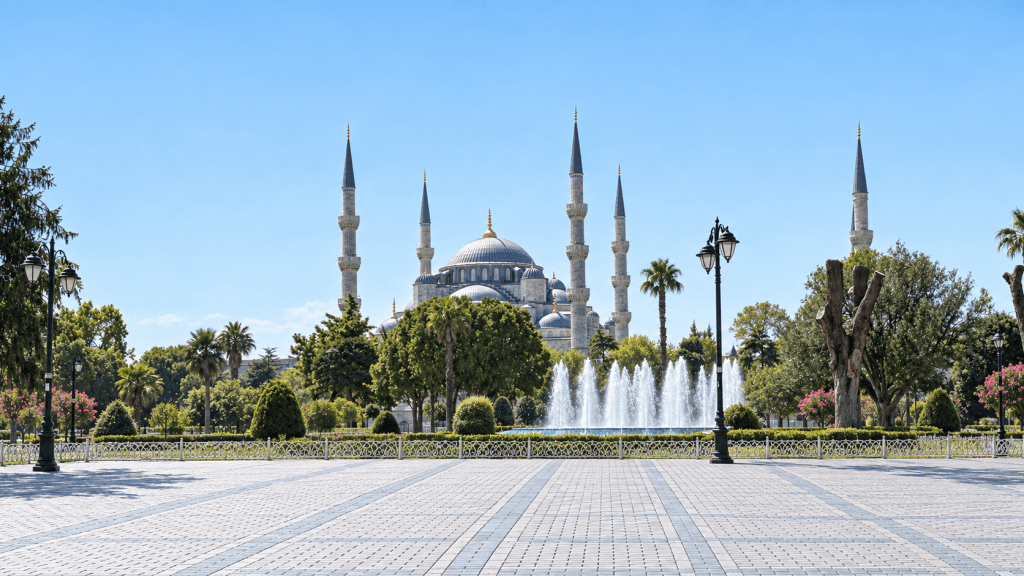
Then came the Blue Mosque.
There are buildings that photographs prepare you for, and others whose scale only becomes apparent when you stand beneath them. The Blue Mosque belongs to the latter. Domes rise upon domes, framed by six minarets reaching into an impossibly blue sky. Inside, decoration replaces imagery—flowers, geometric patterns and calligraphy rather than human figures.
Our guide explained some of the differences between Islamic and Christian traditions, particularly the reluctance in Islam to depict God or prophets in places of worship. His explanations occasionally wandered into theology, and I found myself listening less for doctrine than for what it revealed about how differently human beings have tried to understand the same mysteries.
But it was Hagia Sophia that stayed with me.
Nearly fifteen centuries old, it has been a church, a mosque, a museum and now once again a mosque. Few buildings can tell the story of human civilization simply by allowing you to look at their walls.
And the walls speak.
Christian mosaics were covered after the Ottoman conquest when Hagia Sophia became a mosque. Centuries later, efforts were made to uncover and preserve them. But history does not always surrender itself cleanly. In places, the plaster protected what lay beneath it. In others, attempts to remove it damaged the mosaics themselves.
We stood before the great Deësis mosaic.
Christ remains at its center, with the Virgin Mary on one side and John the Baptist on the other. Large portions have disappeared, leaving irregular expanses where images once existed.
Strangely, I found the missing pieces almost as moving as those that survived.
You are not simply looking at Christian art. You are looking at what centuries of belief, conquest, preservation, destruction and changing ideas have done to the same wall.
The building itself carries other wounds. Earthquakes and centuries of structural movement have left their marks. Marble floors are cracked and uneven. Parts of the building seem almost to lean beneath the accumulated weight of history. Restoration continues even now.
Empires have risen around Hagia Sophia.
Empires have disappeared around it.
Christians have prayed there.
Muslims have prayed there.
Millions of tourists have walked through it.
And somehow the building remains.
Standing there, I began thinking about religion and conquest.
So much of human history has involved people marching beneath one religious banner or another, each convinced that God somehow belonged more to them than to the people on the other side.
And yet, with all the churches, mosques, synagogues and temples we have built across the world, you would think by now we might have learned to be a little kinder to one another.
Perhaps that is the greater monument still waiting to be built.
Fortunately, Istanbul does not allow one to remain philosophical for too long.
Eventually, hunger intervened.
We stopped for lunch at Galeyan, where the menu presented an impressive collection of kebabs. I settled on No. 7 — Alenazik: lamb served over eggplant and strained yogurt with garlic, butter and pepper.
After walking uphill through Istanbul in the heat, No. 7 required very little philosophical contemplation.
It disappeared.
Dessert followed—baklava with Turkish ice cream. The ice cream here has a distinctive dense, almost elastic texture, quite different from what we are accustomed to at home. Somehow baklava and ice cream after several thousand steps felt less like indulgence and more like medical necessity.
Then we went shopping.
At Bilgin’s, we found ourselves surrounded by leather jackets and receiving an enthusiastic education in Turkish leather. There was talk of lambskin, softness, durability, reversible jackets and techniques that apparently allow a jacket to be folded into remarkably small spaces.
Somewhere during the demonstration, education became commerce.
We bought leather jackets.
Then came the Grand Bazaar.
Nothing quite prepares you for it. Vaulted passageways stretch in every direction beneath painted ceilings, lined with jewelry, lamps, ceramics, carpets, spices, leather, sweets and almost anything else one might imagine. People flowed through the corridors in both directions while shopkeepers competed gently—and sometimes not so gently—for attention.
It is shopping, certainly.
But it is also theater.
Eventually we found ourselves in a spice shop, where jars of deep-red saffron sat on the counter like something considerably more precious than seasoning.
Which, apparently, it is.
I had always heard that saffron was the world’s most expensive spice, but seeing how it is sold helped explain why. Each tiny strand is part of a flower and must be harvested painstakingly. The best-known premium saffron is strongly associated with Iran, which dominates global production.
We tasted saffron tea.
After yesterday’s encounter with rakı, Istanbul was continuing my education one drink at a time.
Nearby were enormous bins of teas and dried flowers with wonderfully ambitious labels promising solutions for cholesterol, pain and probably several problems I didn’t know I had.
And then there were the sweets.
Rows of baklava. Pistachios. Rose petals. Chocolate. Turkish delight in colors that looked almost too beautiful to eat.
Almost.
We bought Turkish delight to take home to our daughters.
I liked that moment.
After a day spent contemplating emperors, religions, earthquakes, conquests and buildings nearly fifteen centuries old, something as ordinary as parents buying sweets for their children brought the day back to its proper scale.
Perhaps travel works that way.
We cross oceans searching for great monuments, and they deserve our attention. Today I stood inside buildings that have witnessed more history than I can easily comprehend.
But the memories we carry home are often smaller.
A cracked mosaic.
Sunlight against six minarets.
The smell of spices.
The taste of saffron tea.
Baklava melting into Turkish ice cream.
A leather jacket we probably hadn’t planned to buy.
Two boxes of Turkish delight for two daughters thousands of miles away.
And two very tired feet that had carried me through 12,000 steps of history.
Yesterday, Istanbul introduced itself.
Today, we walked into its past.
And my feet can confirm that we walked quite a long way into it.
Simply O

