Lessons in Impermanence, Belonging, and Gratitude from the California Desert
It began with a house.
We were riding through Palm Springs, California, when our cab driver pointed out Bob Hope’s former residence. Perched against the desert mountains, it was an extraordinary structure, an architectural statement befitting a man who had once been among the most recognizable entertainers in the world.
Our driver mentioned that the property had changed hands.
I looked at the house and smiled.
Not because I found anything amusing about it, but because I was reminded of something I had written in my book.
Nothing is permanent.
Here was a magnificent home once associated with a man of extraordinary fame, fortune, and accomplishment. A home that had undoubtedly witnessed celebrations, private conversations, moments of happiness, and perhaps disappointments that the outside world never knew.
Bob Hope was gone.
His wife was gone.
And the house, once so intimately connected to their lives, belonged to someone else.
I wondered whether the new owners ever thought about the people who had lived there before them. Whether they considered the memories embedded within those walls, or whether, as is only natural, they had simply begun creating memories of their own.
After all, that is what we do.
We acquire homes, furnish them, fill them with our possessions, and gradually convince ourselves that they are ours.
And for a while, they are.
But only for a while.
Eventually, the keys pass into other hands. The furniture changes. The rooms are rearranged. New voices replace familiar ones.
The building remains, at least for a time.
The occupants change.
And life continues.
I did not find this realization depressing.
Some might regard such thoughts as morbid, but I have never considered an awareness of mortality to be an unhealthy preoccupation.
To me, it is simply reality.
We accept that seasons change, that children grow, that our bodies age, and that the years pass with increasing speed. Yet we sometimes behave as though the natural conclusion of life is a subject too uncomfortable to contemplate.
I see it differently.
The recognition that life is finite does not diminish its value.
It enhances it.
It reminds us that the time we have is not guaranteed, that the people we love will not always be beside us, and that the things we work so hard to acquire are, at best, temporarily entrusted to our care.
We are not permanent owners.
We are custodians.
And perhaps one of the privileges of growing older is the opportunity to understand that distinction before our own journey ends.
After decades practicing Medicine, raising a family, building a career, and accumulating the ordinary comforts and responsibilities of life, I have become increasingly aware that permanence was never part of the bargain.
The institutions we serve continue without us.
The homes we build eventually shelter others.
The possessions we treasure pass into different hands.
Even the achievements we once considered defining become chapters in a story that continues beyond our participation.
And that is as it should be.
Our responsibility was never to remain indispensable forever.
It was to contribute meaningfully while we had the opportunity.
But the morning was not finished teaching me.
As we continued through Palm Springs, I began talking with our driver.
He told us that he had left Switzerland more than fifty years earlier and traveled to Los Angeles. Somewhere along the way, he met the woman who would become his wife, eventually settling in the California desert, where he had remained ever since.
I smiled again.
There was something wonderfully familiar about his story.
A young man leaves the country of his birth, crosses an ocean, encounters a new world, falls in love, and gradually builds an entire life in a place he could scarcely have imagined calling home.
It was not my story.
And yet, in so many ways, it was.
I thought of my own journey.
I remembered the young man I had once been, leaving familiar surroundings with ambitions that were clearer than the path toward achieving them.
I remembered the uncertainties, the professional challenges, the immigration processes, the unfamiliar customs, and the countless adjustments that accompany the decision to build a life somewhere other than where one was born.
And I thought of Yemi.
Of the young woman with whom I had begun building a life long before either of us could have imagined where that journey would take us.
Of our daughters.
Of the homes we occupied, the friendships we formed, the careers we pursued, and the countless ordinary days that gradually became the architecture of our lives.
How little we knew when we began.
We imagined destinations.
Life gave us experiences.
We made plans.
Circumstances rearranged them.
We thought we were moving from one place to another, only to discover, decades later, that we had also been moving from one version of ourselves to another.
I asked the driver about the family he had left behind in Switzerland.
It seemed a natural question.
Perhaps it was the question of someone who had made a similar journey and understood that migration involves much more than changing one’s address.
When we leave a country, we leave people.
Parents. Siblings. Friends. Familiar streets. Childhood memories. The particular sights and sounds that helped shape our earliest understanding of the world.
And the lives we leave behind continue without us.
Children are born.
Weddings take place.
Parents grow older.
Friends follow their own paths.
And sometimes, when we return, we discover that the place we remember has changed, just as we have.
There is a peculiar experience familiar to many immigrants: the realization that the country we left is no longer quite the country we remember, while the country we adopted has become more deeply woven into our identity than we ever anticipated.
We belong to both.
And sometimes, entirely to neither.
But our driver’s response was simple.
He had lived a lifetime here.
There was no elaborate explanation. No attempt to justify the decision he had made more than half a century earlier.
He had lived a lifetime here.
And I thought to myself:
So have we.
Two men from different continents, brought together briefly in a cab in Palm Springs.
One had left Switzerland.
The other had left Nigeria.
Neither could have known, at the moment of departure, what the intervening decades would bring.
And yet both had crossed that extraordinary distance between leaving a place and building a life.
I wondered how often we imagine our stories to be singular simply because we know their details so intimately.
We remember our particular sacrifices, our private disappointments, the moments of uncertainty, and the decisions that might easily have taken us in another direction.
But beneath those details lie experiences shared by countless others.
The courage to leave.
The uncertainty of arrival.
The search for belonging.
The discovery of love.
The responsibility of raising a family.
And eventually, the realization that an entire lifetime has unfolded in a place that once seemed impossibly distant.
Perhaps belonging is not determined solely by geography.
Perhaps it is also determined by the lives we have lived, the people we have loved, and the memories we have created.
The driver had found his life in the California desert.
We had found ours through a journey that eventually brought us to America.
Different beginnings.
Different paths.
The same essential human experience.
Later, our travels took us into Joshua Tree National Park.
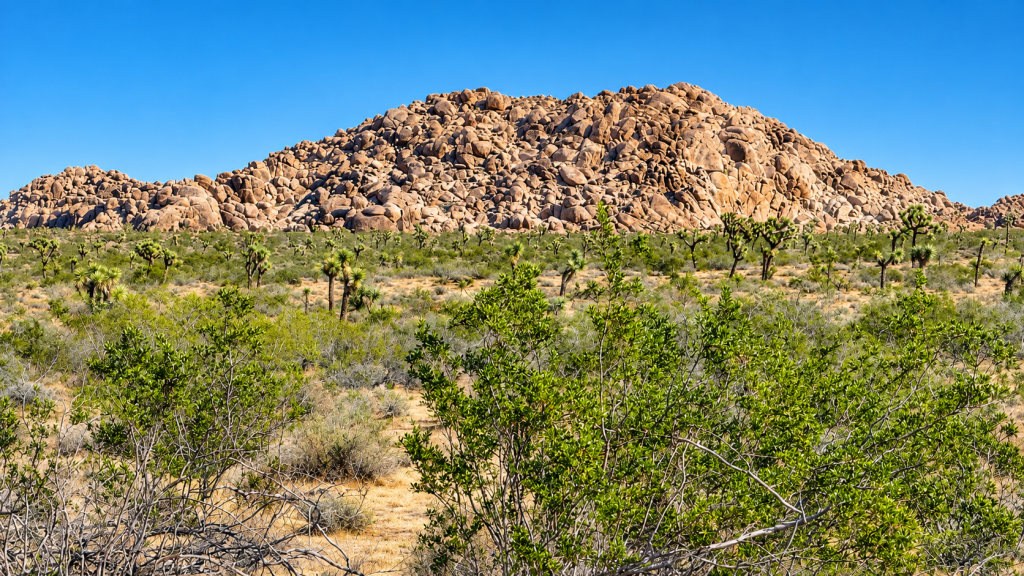
The landscape was unlike anything I had expected.
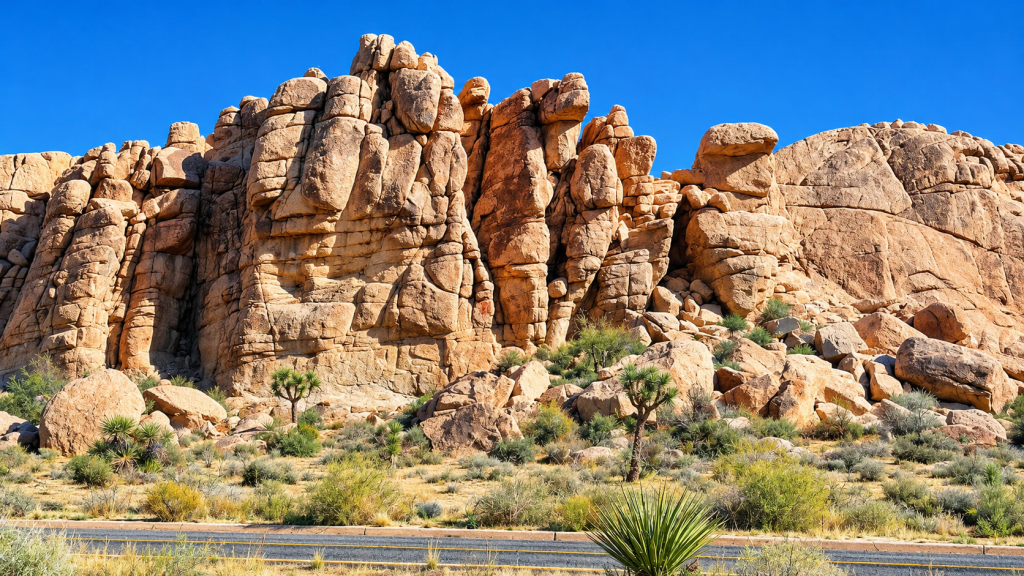
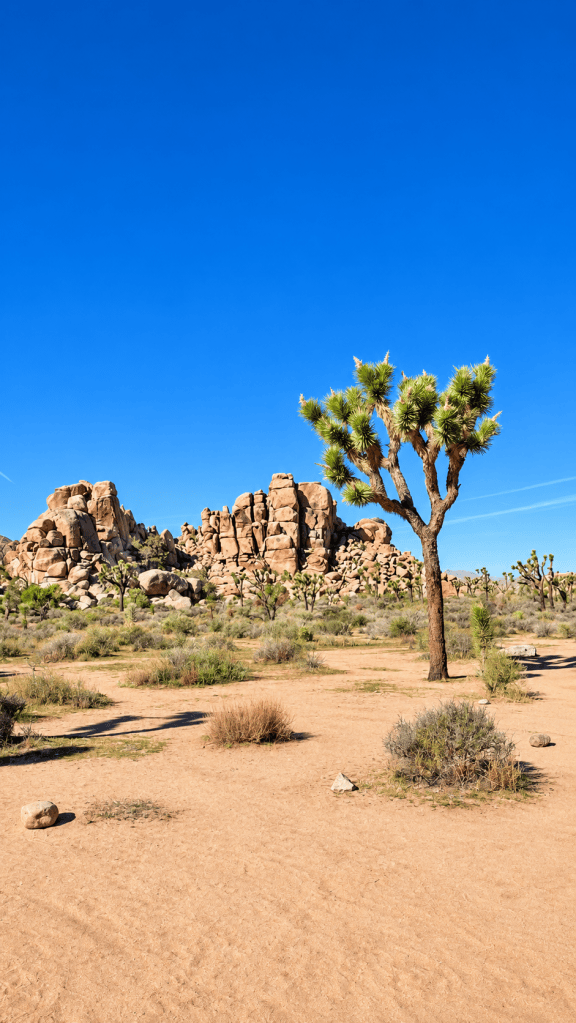
Under an astonishingly blue sky, strange trees stood scattered across an expansive desert, their twisted branches reaching in seemingly unpredictable directions. Enormous granite boulders rose from the earth, some piled upon one another in arrangements so improbable that they appeared almost deliberately constructed.
There was a starkness to the landscape, but also an unexpected beauty.
And once again, I found myself contemplating time.
We learned that Joshua trees do not possess the familiar annual growth rings that allow us to determine the ages of many other trees. Their age must be estimated through clues such as height and growth patterns, imperfect measures influenced by the conditions in which they have lived.
I found that fascinating.
Here were trees that might have stood for generations, quietly enduring the harsh conditions of the desert, yet offering no simple way to determine precisely how many years they had survived.
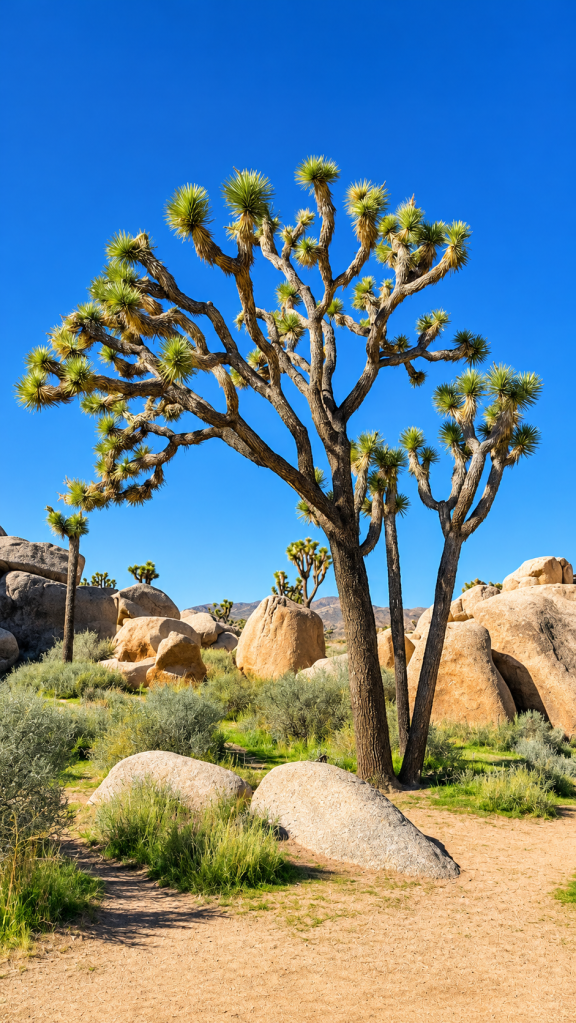
Their history was written in their growth, but not in a language we could easily decipher.
And I wondered whether human lives were not much the same.
We count our years with remarkable precision.
We know our birthdays. We celebrate anniversaries. We mark milestones. We measure our progress against calendars and clocks.
But what does a number truly tell us about a life?
Two people may be the same age and yet have experienced entirely different journeys.
One may have endured extraordinary hardship.
Another may have enjoyed relative ease.
One may have traveled the world.
Another may have spent an entire lifetime within a few miles of home.
And yet each carries a history that cannot be reduced to a number.
The Joshua trees seemed unconcerned with such calculations.
They simply stood where life had placed them, enduring the seasons, adapting to their circumstances, and continuing to grow.
Some were tall and extensively branched.
Others were smaller, their forms less elaborate.
Each appeared to have developed according to its own circumstances.
I thought about how readily we celebrate longevity in nature while sometimes lamenting it in ourselves.
We admire an ancient tree for surviving decades or centuries of drought, heat, and uncertainty.
We call it magnificent.
Yet when we see evidence of those same passing years in our own bodies, we sometimes call it decline.
Perhaps we should extend to ourselves a little of the reverence we so readily offer the natural world.
After all, growing older is evidence that we have survived enough seasons to acquire a story.
And what a privilege it is to have a story to tell.
The rocks offered an even more extraordinary perspective.
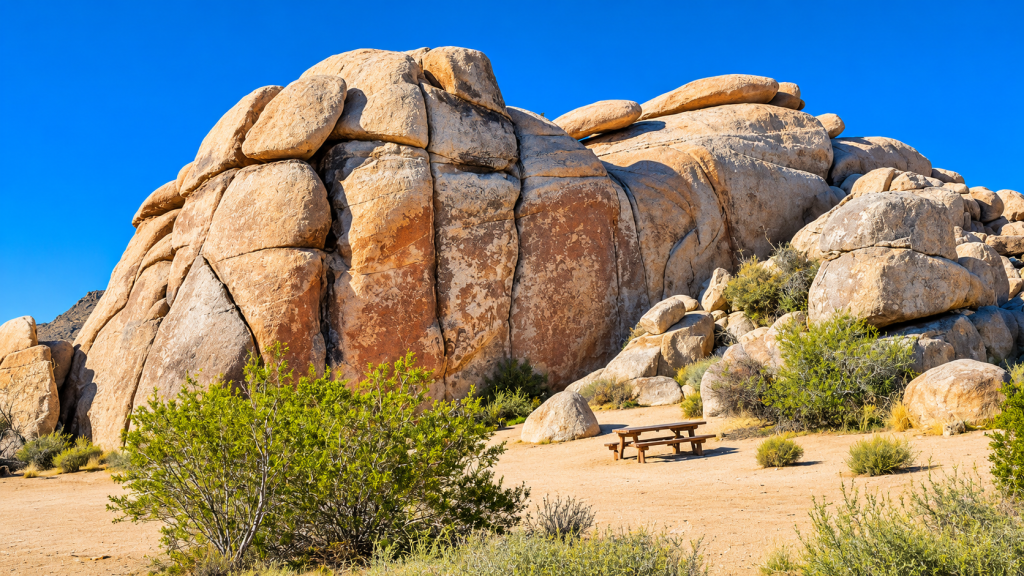
Enormous granite formations, weathered and fractured, stood around us like monuments to geological time.
Some appeared precariously balanced, as though the slightest disturbance might send them tumbling. Yet they had endured through ages beyond ordinary human comprehension.
I found myself contemplating the difference between geological time and human time.
We measure our lives in decades.
These rocks have histories extending across millions of years.
And yet even they are not permanent.
The same forces that shaped them continue their patient work.
Water penetrates their fractures.
Temperatures change.
Surfaces weather.
Particles are gradually carried away.
What appears immovable to us is, in reality, undergoing a process of continuous transformation.
Perhaps permanence is simply an illusion created by the brevity of our observation.
We call something permanent because it outlasts us.
But the universe operates on a timetable entirely indifferent to our own.
I thought again of Bob Hope’s house.
A magnificent human creation that had already passed from one generation to another.
I thought of the Joshua trees, quietly recording their years in their growth.
And now these ancient rocks, seemingly eternal, yet slowly surrendering themselves to time.
Everything was changing.
Some things quickly.
Others almost imperceptibly.
But nothing was exempt.
And strangely, I found that thought comforting.
For if even mountains are subject to change, why should we expect our own lives to be otherwise?
The day also offered moments of unexpected humor.
One of our fellow travelers recounted an African safari during which her fitness tracker had recorded an astonishing 25,000 steps.
The remarkable thing was that she had never once stepped out of the jeep.
We laughed.
Apparently, the jolts and vibrations of the vehicle had persuaded her watch that she was engaged in an extraordinary feat of physical activity.
Twenty-five thousand steps.
Without walking.
But beneath the humor was another small observation about the way we measure our lives.
We have become extraordinarily skilled at counting things.
Steps. Calories.
Hours. Years.
Income. Possessions.
Achievements.
We track, compare, and quantify almost every aspect of our existence.
And sometimes, without realizing it, we begin to confuse the measurement with the experience itself.
The watch could register the movements of a vehicle, but not the wonder of seeing wildlife in its natural habitat.
It could count thousands of supposed steps, but not a single moment of awe.
And perhaps life is much the same.
We count our years, but not necessarily the wisdom acquired within them.
We count our possessions, but not the generosity with which we have shared them.
We count our achievements, but not always the lives we have touched along the way.
We count the miles we travel, but not the ways those journeys change us.
There is nothing wrong with measurement.
It serves its purpose.
But numbers alone can never capture the fullness of human experience.
The woman had not walked 25,000 steps.
Yet she may have experienced more of the world that day than someone who had genuinely walked that distance without ever lifting their eyes to appreciate what surrounded them.
And that, I thought, was a rather wonderful irony.
At another point, the conversation turned to aging.
Someone remarked, with the familiar resignation that often accompanies discussions of advancing years, “It’s no fun getting old.”
I understood the sentiment.
Of course I did.
The body changes.
Its resilience diminishes.
The years leave their marks in ways we cannot always disguise or reverse.
We become more conscious of our limitations, and sometimes painfully aware of the fragility of those around us.
But I found myself responding almost instinctively.
“It’s a privilege to get old.”
I meant it.
Perhaps decades in Medicine have shaped my perspective.
I have seen too many lives interrupted, too many futures that never unfolded, too many people denied the opportunity to experience the very years about which we sometimes complain.
Growing old is not a privilege granted to everyone.
And perhaps that is why I resist the temptation to regard aging primarily as a process of loss.
Yes, we lose certain things along the way.
Youthful energy.
Physical resilience.
Some of the people whose presence once seemed permanent.
But we also gain perspective.
We learn to distinguish the urgent from the important.
We become less concerned with proving ourselves and more interested in understanding ourselves.
We discover that peace may be more valuable than recognition, that meaningful relationships matter more than impressive possessions, and that the ordinary moments we once overlooked may ultimately become our most treasured memories.
I do not pretend that growing older is always pleasant.
Nor do I believe that gratitude requires denying the difficulties that accompany it.
But I have come to understand that the alternative to growing older is not remaining young.
It is no longer being here.
And that is a distinction worth remembering.
As I stood among the Joshua trees, I found myself returning to that thought.
The trees had survived because they had continued to adapt.
The rocks had endured because geological time moves on a scale far beyond our own.
But neither could appreciate its existence.
We can.
We can recognize the beauty of a desert landscape.
We can laugh at the absurdity of a fitness tracker.
We can discover something familiar in the story of a stranger.
We can hold the hand of someone we love and recognize the extraordinary privilege of having shared a lifetime.
And that, perhaps, is what makes our fleeting existence so remarkable.
We may occupy only the briefest moment in the history of the world.
But within that moment, we are capable of love, memory, wonder, and gratitude.
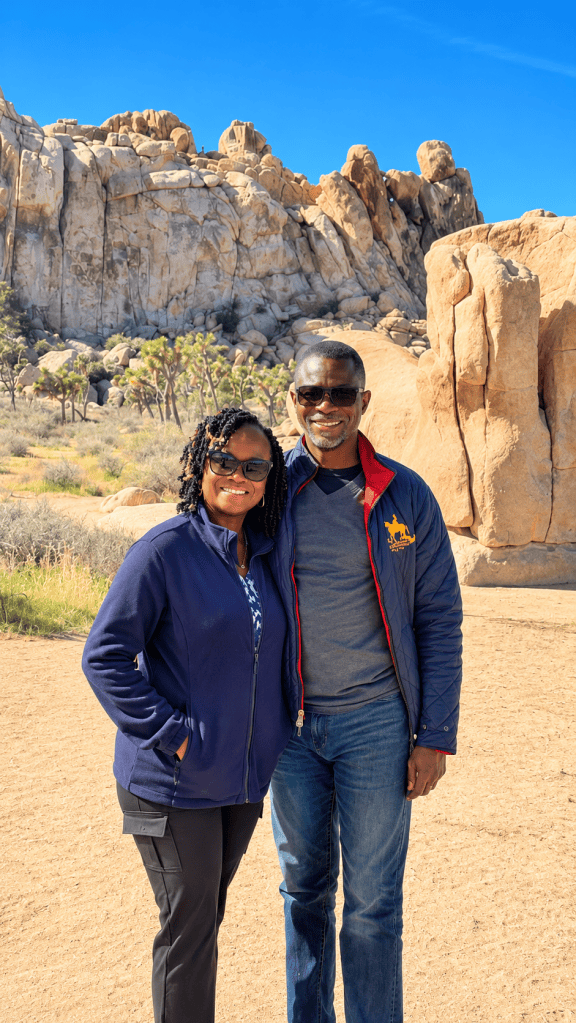
I looked at Yemi against the sunlit rocks.
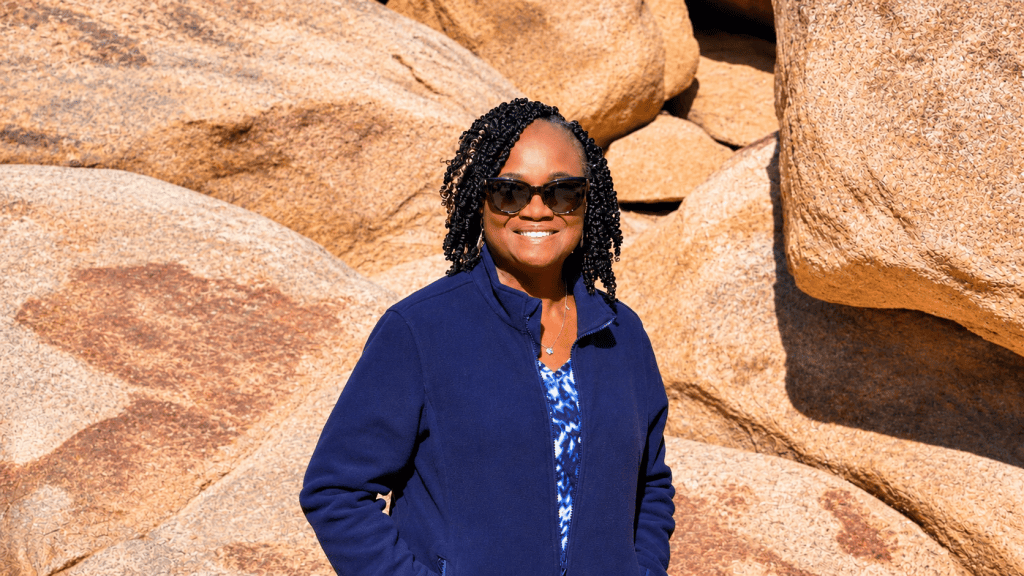
We had traveled a long way together.
Not simply from Nigeria to America, or through the different countries that had shaped our journey, but through the changing seasons of a shared life.
We had known the uncertainties of youth, the responsibilities of raising children, the demands of professional life, and the inevitable disappointments that accompany even the most fortunate existence.
We had watched our daughters grow into adulthood.
We had seen parents and loved ones grow older, and experienced the losses that remind us how fragile the human condition can be.
And now, here we were, standing together in the California desert, still traveling, still learning, still finding reasons to marvel at the world.
The rocks around us had existed for millions of years.
The trees had witnessed seasons beyond our counting.
But the moment belonged to us.
And I was grateful for it.
There was one photograph from the day that seemed particularly meaningful.
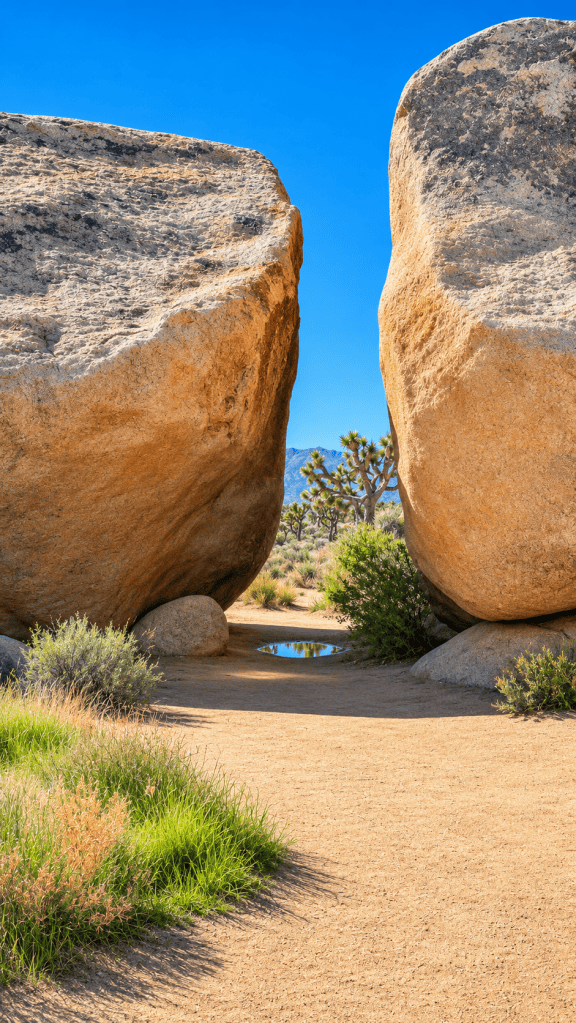
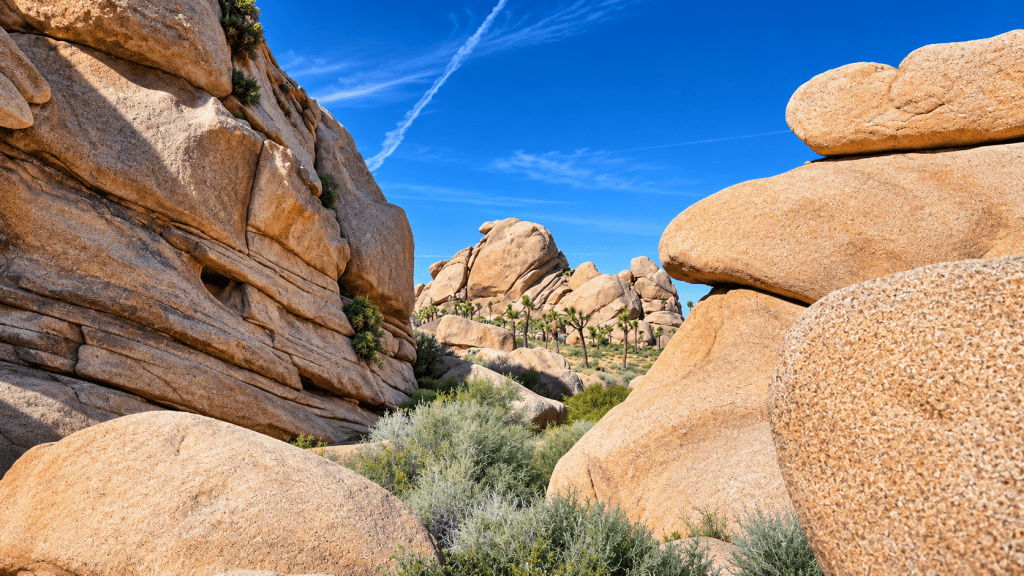
Two enormous boulders stood on either side of a narrow passage. Beyond them lay a glimpse of the desert landscape, with Joshua trees visible in the distance.
It looked almost like a doorway.
A passage between what lay behind and what remained ahead.
I found myself thinking how much of life is spent moving through such passages.
Some are wide and welcoming.
Others are narrow and uncertain.
We cannot always see what lies beyond them.
We enter with hopes, expectations, and plans, only to discover that the journey often unfolds differently from what we imagined.
And yet we continue.
We carry the experiences of where we have been, the lessons of what we have endured, and the hope that there is still something worth discovering beyond the next turning.
Perhaps that is what I have been trying to understand all these years.
Life is not simply a journey from birth to death.
It is a succession of arrivals and departures, beginnings and endings, discoveries and losses.
We leave childhood.
We arrive at adulthood.
We leave the countries of our birth.
We arrive in unfamiliar lands.
We leave careers that once defined us.
We arrive at new seasons of freedom and reflection.
We leave behind certain ambitions.
We arrive at a deeper appreciation of what truly matters.
And eventually, we leave this world altogether.
But between those moments of leaving and arriving lies the substance of our lives.
The love.
The laughter.
The work.
The disappointments.
The friendships.
The ordinary days.
The extraordinary journeys.
The memories that remain long after the circumstances that created them have passed.
As our time in the desert drew to a close, I thought again of the cab driver.
He had left Switzerland more than fifty years earlier.
He had met his wife.
He had settled in California.
And he had lived a lifetime here.
So had we.
Different beginnings.
Different paths.
A shared recognition that life had unfolded in ways neither of us could have anticipated.
I thought of Bob Hope’s house, still standing but no longer belonging to the man whose name remained attached to it.
I thought of the Joshua trees, their years hidden within the evidence of their growth.
I thought of the ancient rocks, slowly changing despite their appearance of permanence.
I thought of the woman whose watch had counted 25,000 steps without her taking them.
And I thought of the simple exchange about aging.
“It’s no fun getting old.”
“It’s a privilege to get old.”
Somehow, all these seemingly unrelated moments had become part of the same reflection.
A reflection on time.
On belonging.
On the limitations of measurement.
On mortality.
And ultimately, on gratitude.
I have no illusions about the permanence of the life Yemi and I have built.
The homes will one day belong to others.
The possessions will be distributed.
The institutions we served will continue their work.
Our daughters will carry their own stories forward, shaped in part by ours, but ultimately belonging to them.
And the world will continue, as it always has.
I do not find that prospect frightening.
There is humility in recognizing that we are temporary participants in something much larger than ourselves.
But there is also freedom.
The freedom to stop clinging so tightly.
To appreciate what we have without imagining that it must remain ours forever.
To forgive more readily.
To love more generously.
To travel while we can.
To remain curious.
To find meaning in ordinary encounters.
And to greet each additional year not merely as evidence of aging, but as another opportunity to participate in the extraordinary privilege of being alive.
I came to the California desert expecting to see its wonders.
I found them in the trees, the rocks, the mountains, and the vastness of the landscape.
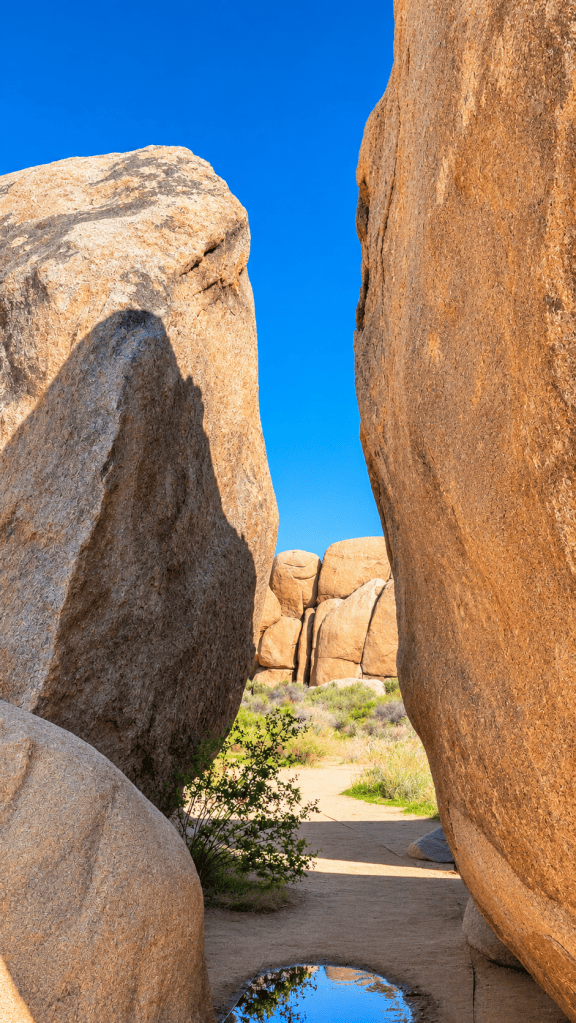
But I also found them in the conversation of a stranger, the laughter of a fellow traveler, the familiar companionship of my wife, and the quiet realization that I had lived a lifetime somewhere far from where I began.
Perhaps that is the greatest gift of this season of life.
Not that I have finally understood everything.
I have not.
Not that I have escaped the uncertainties that accompany growing older.
I have not.
But that I have learned to appreciate the journey without demanding that it last forever.
Nothing is permanent.
Not the houses we build.
Not the places we inhabit.
Not the institutions we serve.
Not even the lives we have been privileged to live.
But somewhere between leaving and arriving, we have been given the opportunity to experience something extraordinary.
We have lived.
We have loved.
We have belonged.
And if we are fortunate, we have learned to be grateful.
I looked once more at the desert landscape, at the ancient rocks and the Joshua trees standing beneath that enormous blue sky.
And I smiled.
What a privilege it is to have lived a lifetime.
And what an even greater privilege to recognize it while we are still living.
Simply O.

