






Shoes by the Danube:

There are monuments that command attention, and there are monuments that whisper.

The Shoes on the Danube whispered.

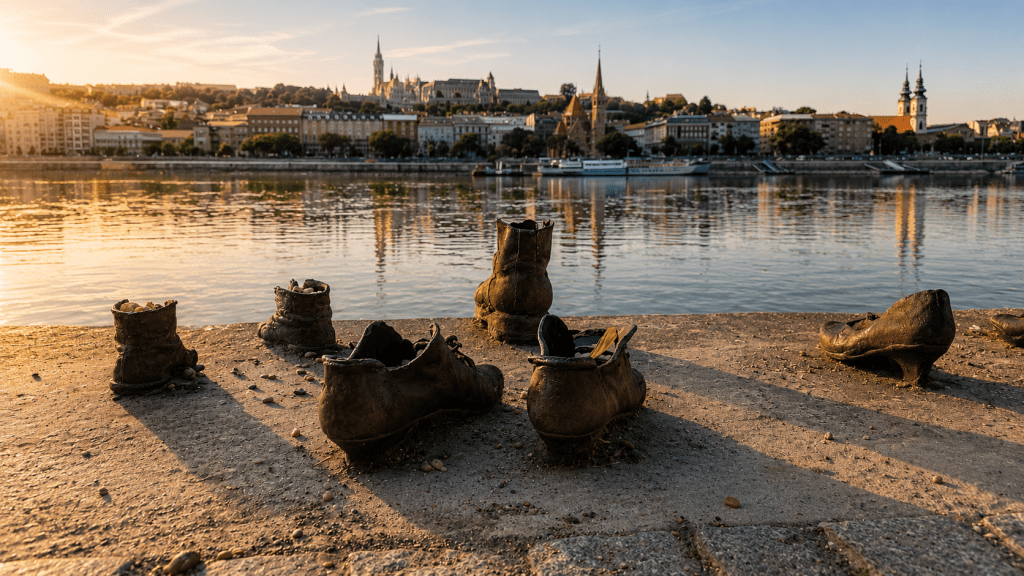
At first glance, they appear almost ordinary—pairs of worn shoes scattered along the riverbank. Some are work boots. Some are dress shoes. One looks small enough to belong to a child. They sit quietly facing the water as though their owners might return at any moment.

But they never will.

During the winter of 1944–1945, thousands of Hungarian Jews were brought to this very riverbank by members of the Arrow Cross militia. Before they were executed, they were ordered to remove their shoes. In a time of scarcity, shoes were valuable. The victims were lined up at the edge of the Danube, shot, and their bodies fell into the river.

The shoes remained.

Standing there in the evening light, with Budapest reflected in the water and the city carrying on around us, I found myself thinking about how easily human beings can become capable of extraordinary cruelty.

History often records numbers.

Six million.

Hundreds of thousands.

Millions more displaced, imprisoned, or forgotten.

But numbers can create distance.

Shoes do not.

Shoes remind us that every number was a person.

Someone who laughed.

Someone who worried about their children.

Someone who planned for tomorrow.

Someone who believed they would see another sunrise.

And yet, as I looked across the Danube toward the beauty of Budapest, another thought emerged.

Human history is not only the story of cruelty.

It is also the story of remembrance.

Someone chose to build this memorial.

Someone decided that these lives would not disappear into the current of history.

Someone believed memory matters.

Throughout our travels, I was struck by how often this tension appeared. Again and again we encountered evidence of humanity at its worst—and evidence of humanity at its best. Tyranny and courage. Hatred and sacrifice. Destruction and rebuilding.

The same species capable of creating death camps is capable of creating memorials.

The same hands that once pulled triggers can, generations later, place flowers.

The same world that wounds can also heal.

Perhaps that is why places like this matter.

They remind us that civilization is more fragile than we like to believe and more resilient than we sometimes fear.

As the sun settled over the Danube, the empty shoes cast long shadows across the stone.

The river kept moving, as rivers always do.

But memory remained.

And perhaps that is redemption—not the erasure of evil, but the refusal to forget those who suffered because of it.

For as long as the shoes remain on the riverbank, their owners are not entirely gone.

And as long as we remember, history still has something to teach us.

Simply O.

Reflections Along the Rivers of Europe

There is something about slow travel that changes not only what one sees, but how one sees.

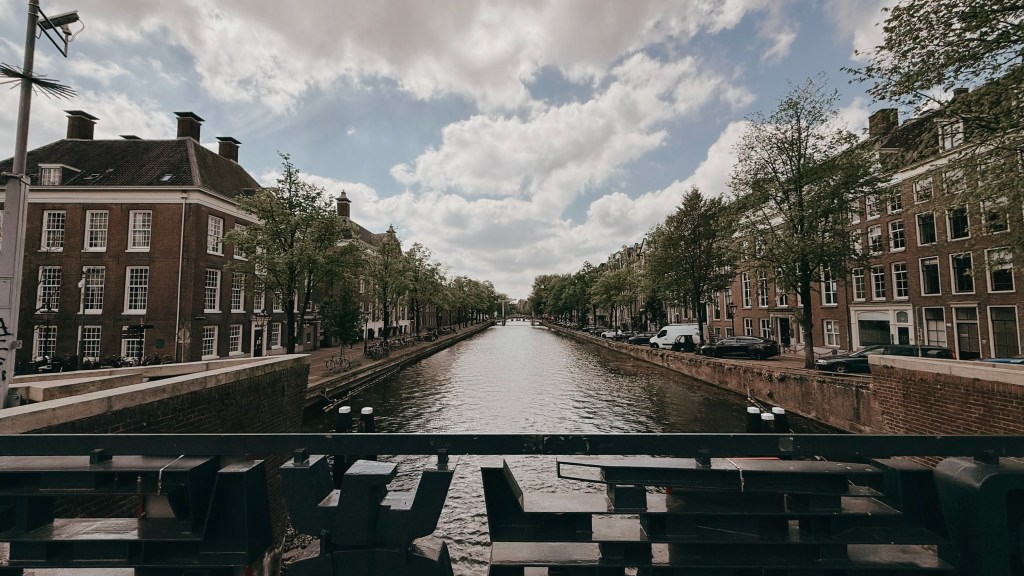
Over these past days, the rivers of Europe have carried us through landscapes of extraordinary beauty — canals lined with leaning houses, vineyards flowing down hillsides, medieval towns suspended in time, soaring cathedrals, castles perched above the Rhine, and streets still marked by centuries of footsteps. Yet beneath the beauty lies something deeper: memory.

Europe seems to preserve memory differently than anywhere else I have traveled.

Wars are not hidden here. They are engraved into bridges, memorial lights, rebuilt cities, plaques, and silence. Faith is not merely spoken of here. It rises in stone through Romanesque walls, Gothic arches, stained glass, and Baroque ceilings that once attempted to pull human eyes toward heaven. Even wine becomes memory — soil, climate, tradition, and centuries bottled together and passed from one generation to another.

What has struck me most is how often beauty and contradiction coexist side by side.

Cities that produced magnificent cathedrals also witnessed unimaginable cruelty. Places nearly destroyed by war were rebuilt not only through governments, but through ordinary people who refused to let memory disappear. Medieval streets that now charm tourists were once walked by people struggling simply to survive plague, hunger, cold, and uncertainty.

And perhaps that is the deeper lesson these rivers quietly teach.

Civilization is fragile.

Yet human beings continue building anyway:
cathedrals that take centuries,
bridges rebuilt after war,
music that survives hatred,
stories that outlive empires,
and small acts of beauty that refuse to disappear.

As I move further eastward toward Budapest, I realize this journey is becoming less about destinations and more about attention — learning to notice the layers beneath places, beneath history, and perhaps even beneath oneself.

The rivers continue flowing.

So does memory.

And somewhere between the locks, castles, cathedrals, vineyards, and conversations, I sense that travel at its best does not merely show us the world.

It slowly teaches us how to see it.

Simply O.

On Tribalism, Racism, and the Struggle to Understand

I am quintessentially African.

I grew up in Nigeria, in a society where identity mattered deeply. We did not call it racism. We called it tribalism. Politics was often shaped by region, language, and ancestry. A government official might give a job to someone from his own region even if that person was less qualified. It was unfair. It was frustrating. But it was also understandable within its context.

Our tribalism was rooted more in familiarity and survival than in metaphysical hatred. In a young post-colonial nation, where institutions were fragile and trust was local, people leaned toward “their own.” It was proximity bias. It was patronage. It was human nature amplified by insecurity.

What it was not, at least in my experience, was a doctrine that another tribe was inherently less human.

Ironically, Nigeria had very few white people when I was growing up, and those who were present were often treated better than natives. That reality complicates simplistic narratives about power and identity. Human beings form in-groups wherever they are. The categories change. The instinct does not.

I then spent a decade living and training in the United Kingdom. That experience added another layer. The UK carried its own history — empire, immigration, class stratification. There, I encountered a society more subtle in its expressions of difference. Identity was shaped not only by race, but by class, accent, schooling, postcode. You could feel the gradations. Some of it was overt; much of it was understated.

Living in both Nigeria and the UK allowed me to see that group identification is universal. It is expressed differently across cultures, but it persists. Tribe. Class. Region. Race. Nation.

Now I live in America — a country that has long described itself as a “shining city on a hill.” That phrase carries moral aspiration. It suggests a society that strives not merely for prosperity, but for example. A nation that understands its diversity as strength, not threat.

Yet I find myself disappointed.

Not angry. Disappointed.

There seems to be an innate human tendency toward group identification. That much I accept. I have seen it in Nigeria. I have seen it in the United Kingdom. I see it here. But what troubles me is not the existence of group identity. It is the elevation of that identity into hierarchy — into the belief that one human being is intrinsically superior to another.

That is where tribal preference crosses into something darker.

As a man of faith, I struggle with the sins of racism because they strike at something sacred. If every human being bears divine image, then to diminish another person’s worth on the basis of race is not merely a social flaw — it is a moral contradiction.

I am not a descendant of American slaves. My lineage is African in a direct and uninterrupted sense. And yet racism still cuts deep. It cuts because it attempts to assign lesser value to people who look like me. It cuts because it suggests that history’s ugliest hierarchies are not as buried as we hoped. It cuts because it forces one to ask how a society so educated, so powerful, so globally influential can still wrestle so publicly with basic human equality.

Perhaps group bias is universal. But dehumanization is not inevitable.

Nations can discipline their worst instincts. Leaders can elevate rather than inflame. Citizens can choose moral maturity over tribal reflex. That is what I had hoped America — with its resources, its history of civil rights struggle, and its global example — would embody more consistently.

Disappointment implies expectation.

I expected better. Not perfection. Not the erasure of human bias. But progress — visible, steady, undeniable progress toward seeing one another fully.

The shining city on a hill was always aspirational. It was never flawless. But aspiration requires maintenance. It requires courage. It requires truthfulness about our impulses and restraint in how we wield them.

I do not hate this country. I have built my life here. I have raised my daughters here. I have contributed to its institutions. I believe in its promise.

But belief does not prevent disappointment when the promise feels dimmed.

And perhaps this is why it matters so much to me. My daughters are growing up in this country. They will inherit not only its opportunities, but its tensions. I want them to live in an America that sees them fully — not as categories, not as demographic abstractions, but as complete human beings endowed with dignity. I want them to engage the world with confidence, not defensiveness; with moral clarity, not bitterness.

The deeper question I continue to wrestle with is this: How does one human being come to see another as less?

History offers explanations — fear, scarcity, political manipulation, inherited prejudice. Psychology offers mechanisms — in-group bias, threat perception, social conditioning. But explanation does not equal justification.

The moral line remains clear.

Group identity may be human.
Hierarchy of human worth is not.

And perhaps the true measure of a shining city is not whether it avoids tension, but whether it resists the temptation to sanctify its divisions — for the sake of the next generation.

Hope, after all, is a discipline.

SimplyO

A Rupturing World: On Power, Legitimacy, and What Travel Reveals.

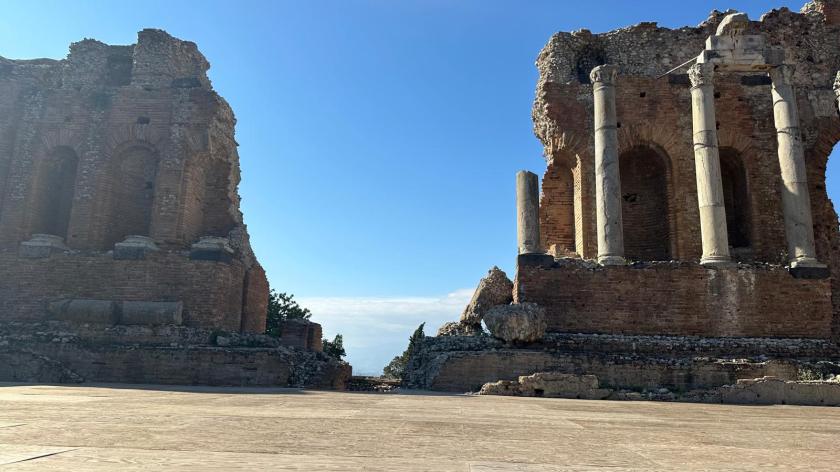
Ancient ruins showcasing the remnants of a historical structure against a blue sky.

“The past explains how we arrived here. It does not decide what comes next.”

I have come to believe that travel is not only about seeing places, but about seeing systems—how they rise, how they fracture, and how fragile they truly are. That belief frames how I see the world today, a world that is not merely changing, but rupturing.

The language of continuity—of transition, reform, or rebalancing—no longer describes our moment. What is breaking is not only the geopolitical order, but the moral scaffolding that once made that order appear coherent. Questions of sovereignty, legitimacy, and power—once politely deferred—are now being asked openly, and once asked, they refuse easy answers.

It is in this context that claims about territory and historical entitlement take on renewed urgency. Recent assertions that Denmark has no legitimate claim to Greenland because Europeans arrived there “only” five centuries ago expose a deeper contradiction. By that logic, the same question rebounds onto the United States and other settler societies. How long ago did Europeans arrive in North America to make it their own? Four hundred years? Five hundred? And what of the Indigenous peoples who lived on, governed, and cultivated the land for thousands of years before colonization began?

If temporal priority alone determines legitimacy, then much of the modern world collapses under its own weight.

Modern states were not born of moral clarity. They emerged through conquest, coercion, and unequal power, later stabilized by laws and institutions that transformed force into permanence. International norms did not erase these origins; they normalized them. Over time, repetition became legitimacy, and legitimacy became assumed. This is why appeals to history, when used selectively, are so dangerous. They are rarely about justice. More often, they are about leverage.

This tension—between how nations came into being and how they justify themselves today—is not abstract for me. It is one of the reasons I travel. To move through the world is to see, firsthand, how fragile governance really is, how contingent borders are, and how deeply history lives in the present. In ancient cities, colonial capitals, and post-conflict societies, the past is not a chapter—it is architecture, memory, grievance, and silence.

Travel strips away the illusion that governance is permanent or inevitable. It reveals how quickly order can fracture, how easily institutions fail, and how much of what we call stability rests on collective belief rather than unshakable truth. Standing in places shaped by empire, revolution, or collapse, one learns that sovereignty is less a fixed fact than a negotiated condition—renewed or eroded with every generation.

This understanding reframes the question of legitimacy. Modern states cannot justify themselves solely by how they came into being, because few would survive that reckoning. Legitimacy today must flow forward, not backward. It must rest on present consent, self-determination, and the agency of the people who live within those borders now. The past explains how we arrived here; it does not, by itself, determine who decides what comes next.

Greenland illustrates this distinction clearly. The question is not whether Denmark once claimed or administered the territory, but whether the people who live there now possess genuine agency over their future. Modern legitimacy depends not on the age of a claim, but on the reality of self-determination.

Applied honestly, this same standard exposes America’s unresolved contradiction. The United States exists as a sovereign state, yet its foundations rest on the dispossession of Indigenous nations who never truly consented to that loss. Tribal sovereignty persists, but uneasily. Land acknowledgments multiply, but restitution remains limited. Reconciliation is spoken of more often than it is achieved. America’s legitimacy today rests not on its origins, but on whether it continues to confront its history and expand justice in the present. That work remains incomplete.

These are not lessons learned from textbooks alone. They are learned by walking through cities where borders have shifted, by listening to people whose lives have been shaped by decisions made far away, long ago, and by witnessing how fragile peace and governance can be when trust erodes. Travel becomes, in this sense, a moral education. It reveals the cost of pretending that power is neutral, that history is settled, or that injustice fades on its own.

In a rupturing world, history is being reopened not to heal old wounds, but to justify new ones. Ancient grievances are revived selectively, pressed into service of modern domination. Moral language is stripped of consistency and used as strategy. That path leads not to justice, but to fragmentation and fear.

The only defensible response is an honest one: to acknowledge past injustice without allowing it to become a tool of opportunism; to reject nostalgia for an order that never fully lived up to its ideals; and to ground sovereignty not in conquest or myth, but in present agency and shared responsibility.

Travel has taught me that the world is held together not by inevitability, but by choice. The past explains how we arrived here. What matters now is whether we have the courage to see the world as it is—and to decide, together, what comes next. And whether this fracture becomes a collapse, or an opportunity to build something more honest, depends on whether we are willing to apply the principles we already accept, consistently and without exception.

Simply O